

Introduction
You want to switch to an electric car. You want to save money on gas and help the planet. But you are worried. You worry about running out of power in the middle of nowhere. You worry about sitting at a charging station for an hour while your family waits. You worry that the battery will die after a few years and cost thousands to replace. These are real problems that keep millions of people away from buying electric vehicles today.
There is good news. A new technology called solid state batteries is about to fix all of these problems at once. This is not just a small upgrade. It is a total game changer that will make electric cars drive further, charge faster, and last longer than anyone thought possible. We are going to explore exactly how this works and when you can buy one.
Key Takeaways
- You will drive much further: New batteries from companies like Nio are already driving over 620 miles on a single charge.1
- You will charge incredibly fast: Toyota and Nissan are building batteries that charge from 10% to 80% in just 10 minutes or less.2
- Your battery will last longer: Toyota plans to make batteries that can last for up to 40 years before they wear out.4
- Winter won’t be a problem: Solid-state batteries handle cold weather much better than the batteries in cars today.5
- It is happening soon: Major car makers plan to start mass production around 2027 or 2028.2
What exactly is a solid state battery?
A solid state battery is an energy storage device that uses a solid material to move energy around instead of a liquid. It is safer, stronger, and holds more power than the liquid batteries we use today.
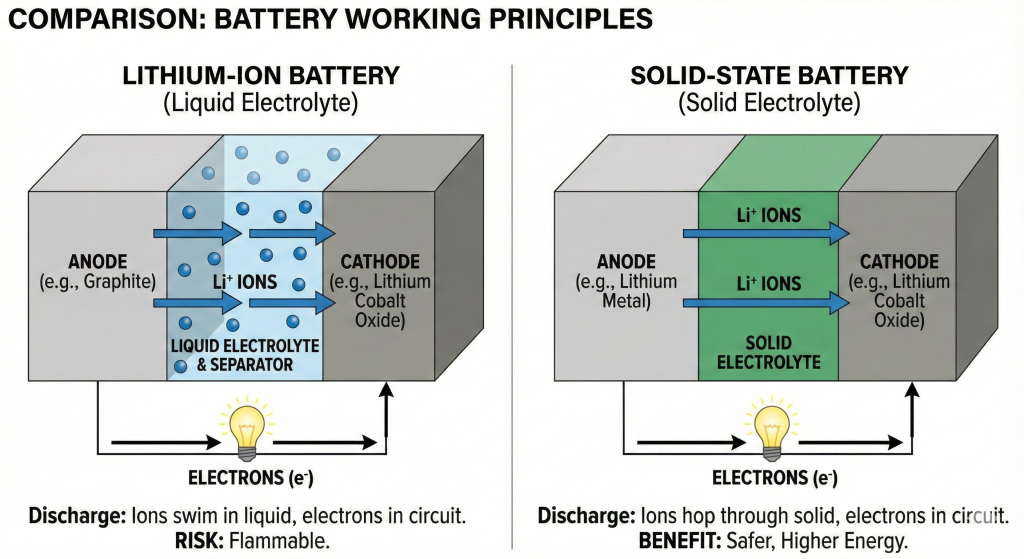
To understand this, we need to look at how a battery works. Think of a battery like a dance floor. You have a positive side and a negative side. When you charge the battery, the “dancers” (which are lithium ions) move from the positive side to the negative side. When you drive your car, they dance back to the positive side.
In the batteries we have now, called lithium-ion batteries, these dancers swim through a liquid pool to get to the other side. This liquid works well, but it has problems. It is heavy. It takes up space. Worst of all, it is flammable. If the battery gets too hot or is punctured, that liquid can catch fire.
Solid state batteries replace that liquid pool with a solid material. Think of it like replacing the pool with a solid stone path. The dancers can still move across the path, but the stone does not spill. It does not catch fire easily. It is solid.
This simple change makes a huge difference. Because you do not need the heavy safety gear to contain the liquid, you can make the battery much smaller and lighter. Or you can pack a lot more energy into the same space. This is why solid state batteries are the future of driving.7
How does this technology compare to what I have now?
We can compare the two technologies by looking at the specific benefits they offer you as a driver. The table below breaks down the key differences between the liquid batteries in current cars and the solid state batteries coming soon.
| Feature | Current Liquid Lithium-Ion Battery | New Solid State Battery |
| Electrolyte | Liquid or Gel | Solid Material (Ceramic, Glass, or Sulfide) |
| Safety | Flammable liquid can catch fire if damaged | Non-flammable solid reduces fire risk 9 |
| Energy Density | Lower (Standard Range) | Higher (Can double the range) 10 |
| Charging Speed | Slower (20-40 minutes for 80%) | Faster (10 minutes for 80%) 2 |
| Temperature | Struggles in extreme cold or heat | Handles temperature changes better 5 |
| Lifespan | Lasts 10-15 years | Could last up to 40 years 4 |
Will range anxiety really disappear?
Yes, range anxiety will likely become a thing of the past for most drivers. New solid state batteries are proving they can drive over 600 miles on a single charge.
Range anxiety is the fear that your car will stop working before you reach your destination. It is the number one reason people do not buy electric cars. Right now, a good electric car might go 300 miles. That is great for daily driving. But it makes long road trips stressful. You have to plan every stop.
Solid state technology changes the math completely. Because the solid material is safer and takes up less space, engineers can use more powerful materials inside the battery. They can use something called a “lithium metal anode.” This allows the battery to hold way more energy.
We are already seeing this happen in the real world. A Chinese company called Nio tested a new battery in their ET7 sedan. This battery is a “semi-solid” type, which is a stepping stone to the full solid version. The CEO of Nio drove the car for 14 hours. He covered 1,044 kilometers. That is about 648 miles! He did this on one single charge with 3% battery left at the end.1
Imagine driving from New York to Detroit without stopping to charge. Or driving from London to Berlin on one tank of “electrons.” When your car can go further than your bladder can last, you stop worrying about range. You just drive.
Why does a solid design give me more miles?
The solid design lets car makers use better ingredients and pack them tighter.
Think of packing a suitcase. If you have to pack fragile glass bottles filled with liquid, you need lots of padding. You need to be careful. You waste a lot of space just keeping things safe. This is like a liquid battery. It needs separators and cooling systems to keep it from getting too hot or leaking.
Now imagine you are packing solid bricks. You do not need padding. You can stack them right on top of each other. You can fit twice as much stuff in the same suitcase. This is a solid state battery.
Toyota says their first solid state batteries will offer a 20% increase in range compared to their best current batteries. They are also working on a high-performance version that could increase range by 50%. This is how we get to that 1,000 kilometer or 620 mile goal.2
Is charging actually going to be faster?
Yes, charging will be much faster. The goal is to charge your car in about the same time it takes to fill a gas tank and buy a coffee.
Right now, “fast charging” takes about 20 to 40 minutes to get your battery to 80%. That is fine if you are eating lunch. It is annoying if you are in a rush.
Solid state batteries can handle heat much better than liquid ones. Heat is the enemy of charging. When you push electricity into a battery quickly, it gets hot. If a liquid battery gets too hot, the liquid can boil or catch fire. So the car has to slow down the charging speed to keep things safe.
Solid materials can take the heat. They are much more stable. This means the charger can push power into the battery much faster without worrying about safety. Toyota is targeting a charging time of 10 minutes or less to go from 10% to 80% full.2
Think about your daily life. You pull into a station. You plug in. You run inside to use the restroom and grab a snack. By the time you come back out, your car is ready for another 400 or 500 miles. This convenience destroys the argument that electric cars are a hassle.
Will these new batteries be safe?
Solid state batteries are significantly safer than the batteries we use today. They reduce the risk of fire and explosion dramatically.
Safety is a big concern for many people. You might have seen news stories about electric bikes or cars catching fire. These fires are rare, but they are scary. They happen because the liquid electrolyte inside the battery is flammable. If the battery is crushed in a crash or has a manufacturing defect, that liquid can ignite.
Solid state batteries replace that flammable liquid with a solid stone-like material. This material generally does not burn. Even if you puncture the battery or crush it, it is very unlikely to catch fire.
There is another safety benefit too. In liquid batteries, little needle-like growths called “dendrites” can form over time. These needles can grow sharp enough to poke through the separator inside the battery and cause a short circuit. This is a major cause of battery failure and fires.
The solid electrolyte acts like a hard wall. It blocks these needles from growing. This stops the short circuits before they happen. It makes the battery more durable and reliable over the long term.9
Will they work in winter?
Yes, solid state batteries perform much better in cold weather than standard electric car batteries.
If you live in a cold place, you know that batteries hate winter. Your phone dies faster when it is freezing outside. Electric cars are the same. In freezing temperatures, a standard electric car can lose up to 30% or even 40% of its range.11 This happens because the liquid inside the battery turns into sludge. It gets thick and slow. The ions have to fight to move through the sludge.
Solid state batteries do not have this problem in the same way. The solid material does not freeze like a liquid. It maintains its ability to move energy even when the temperature drops.
While no battery is perfect in the cold, solid state technology is a huge improvement. You won’t have to worry as much about your range dropping by half just because it snowed. You also won’t need to use as much energy to heat the battery up to get it to work. This leaves more energy for driving and heating the cabin to keep you warm.5
When can I buy a car with this technology?
You will likely see the first mass-produced cars with solid-state batteries around 2027 or 2028.
It feels like we have been hearing about this technology for years. You might be wondering why it is taking so long. The truth is that making these batteries in a lab is easy. Making millions of them in a factory is very hard.
The car companies are racing to be first. They know that whoever wins this race will dominate the market. Let’s look at what the biggest players are doing.
What is Toyota’s plan?
Toyota is the leader in this space right now. They own more patents for solid state batteries than anyone else. They have been working on this for a long time.
Toyota has a clear roadmap. They plan to launch their first electric vehicle with a solid state battery in the 2027 to 2028 timeframe. They are not starting with a hybrid as they originally planned. They are going straight to a full electric car.3
Toyota is working with a big oil company called Idemitsu to figure out how to mass-produce the solid material. This is the hardest part. The material they use is a “sulfide.” It is very fast at moving energy, but it is sensitive to moisture. They have to build special factories that keep the air perfectly dry.
Toyota has very ambitious goals. They say their new batteries will allow for a cruising range of over 1,000 kilometers (621 miles). They also claim these batteries will be incredibly durable. One executive said they are aiming for the battery to last 40 years.4 Imagine buying a car and knowing the battery will outlast the rest of the vehicle!
However, you should know that Toyota has delayed this technology before. They are very cautious. They want to make sure it is perfect before they sell it to you. Recent reports say they might be adjusting their factory plans slightly, but they are still committed to that late 2020s date.12
What is Nissan doing differently?
Nissan is taking a very smart approach to catch up. They are focusing on how to make the batteries cheaper.
Nissan plans to launch their solid state EV by fiscal year 2028. They are building a pilot factory right now in Yokohama, Japan.
Nissan’s secret weapon is something called “dry electrode” manufacturing. Making batteries today is like painting a wall. You mix the battery materials with a toxic liquid solvent to make a wet paste. You spread this paste out and then you have to bake it in huge ovens to dry it. This takes a lot of time, energy, and space.
Nissan is working with a company called LiCAP to use a dry process. Think of it like baking a cake with dry powder instead of wet batter. You press the powder directly into a sheet. You do not need the toxic solvents. You do not need the massive drying ovens.
This saves a huge amount of money. Nissan thinks they can bring the cost of the battery down to $75 per kWh.13 That is a magic number. At that price, an electric car becomes cheaper to build than a gas car. If Nissan pulls this off, they could sell affordable electric cars that go 600 miles and charge in 10 minutes.
Are European companies involved?
Yes, European luxury brands like BMW and Mercedes-Benz are working hard on this too. They are mostly partnering with American startup companies to get the technology.
BMW is working with a company called Solid Power. They have already put these new batteries into a prototype BMW i7 car for testing. They are driving these cars on real roads to see how they handle bumps, weather, and daily use.14
Mercedes-Benz is working with a company called Factorial. They are testing a battery that is “semi-solid.” This is a clever middle ground. It uses mostly solid material but adds a tiny bit of liquid to help things move smoothly. This is easier to manufacture right now. They are testing this in their EQS sedan to see if they can extend the range significantly.15
These companies want to keep their reputation for premium performance. They know that luxury buyers will pay extra for a car that can drive across the country without stopping.
Is China winning again?
China is moving very fast and taking a practical approach. They are not waiting for the “perfect” solid battery. They are releasing “semi-solid” batteries right now.
We mentioned the company Nio earlier. They are already selling cars with a 150kWh semi-solid battery pack. This is the battery that did the 648-mile test drive.
China’s strategy is smart. They are getting the technology onto the road today. They are learning from real-world drivers. While Toyota and Nissan are perfecting the chemistry in the lab for 2028, Chinese drivers are already enjoying 600-mile ranges in 2025.1
This puts pressure on everyone else. It proves that the technology is real. It is not just science fiction.
Company Roadmap Comparison
Here is a quick look at when you might see these cars from different brands.
| Company | Partner | Target Date | Key Goal |
| Nio | WeLion | Now | 620+ mile range available today (Semi-Solid) 1 |
| Toyota | Idemitsu | 2027-2028 | 10 minute charge, 40 year life 2 |
| Nissan | LiCAP | 2028 | Lower cost ($75/kWh) using dry process 6 |
| BMW | Solid Power | Late 2020s | Luxury performance testing underway 14 |
| Mercedes | Factorial | Late 2020s | Extended range testing underway 15 |
Will these batteries be expensive?
At first, yes, they will be expensive. But the price will come down.
When solid state cars first arrive in 2027 or 2028, they will likely be premium models. Think luxury sedans and high-end SUVs. The manufacturing process is still new and difficult, so it costs more.
However, over time, they should actually become cheaper than current batteries. This is because they use fewer materials. They do not need the graphite anode. They do not need the complex cooling systems. They do not need the heavy safety armor.
Nissan’s dry electrode plan is a great example of this. By removing the expensive drying steps from the factory, they save money. Toyota says their first solid state batteries will be 20% cheaper to make than their high-performance liquid batteries.2
So, while the first wave will be for early adopters with deep pockets, the technology will eventually make cheap electric cars better than cheap gas cars.
Will my current EV become worthless?
This is a common worry. If a new car comes out that goes twice as far and charges three times as fast, will nobody want your old electric car?
The answer is no, your car will not be worthless. But it will depreciate.
Think about smartphones. When the new iPhone comes out, your old iPhone does not stop working. It is still a good phone. People still buy used iPhones. But they pay less for them.
It will be the same with cars. There will be a long transition period. Solid-state cars will be expensive and rare for a few years. During that time, standard electric cars will still be the affordable option for most people.
Also, many people simply do not need 600 miles of range. If you just drive to work and the grocery store, a car with 250 miles of range is perfectly fine. There will always be a market for affordable used EVs for commuters and students.
However, if you are thinking about buying a brand new, very expensive electric car right now, and you plan to sell it in 5 years, you should keep this in mind. The resale value might drop when the new tech arrives.
What happens to gas stations?
This is a fascinating question. If everyone drives a car that goes 600 miles and charges at home, do we need gas stations anymore?
Gas stations are in trouble. Their business model relies on you stopping frequently. You stop for gas, and you buy a soda or a lottery ticket. That is where they make their money.
With a solid-state EV, you might only need to charge once a week. You will do that at home while you sleep. You won’t need to visit a station for your daily commute.
For long trips, you will still need stations. But these stations will need to change. They won’t just need a plug. They will need massive power. Charging a huge battery in 10 minutes takes a lot of electricity. A highway rest stop with 10 of these chargers running at once would need as much power as a small town!
We will likely see fewer gas stations in cities and neighborhoods. The ones that survive will be big “travel centers” on the highway. They will offer ultra-fast charging, good food, and clean lounges. The corner gas station might become a thing of the past.16
Myth Busting: What is true and what is hype?
There is a lot of excitement about this technology, but we need to be realistic. Let’s clear up some common myths.
Myth 1: They are totally fireproof.
Reality: They are much safer, but not magic. If you treat them badly enough, or if there is a major defect, things can still go wrong. But the risk of a random fire or a fire after a crash is vastly lower than it is today.9
Myth 2: They are years away from working.
Reality: They work right now. You can drive a car with a semi-solid battery in China today. BMW has them in test cars on the road. The delay is not about making the battery work; it is about building the factories to make millions of them cheaply.1
Myth 3: They use “magic” materials.
Reality: They use science, not magic. They still use lithium. In fact, they might use more lithium because they use a lithium metal anode. This means we still need to mine lithium. The supply chain for these materials is a big challenge that companies are trying to solve.10
Conclusion
The wait for better electric cars is almost over. Solid state batteries are the breakthrough we have been promised for decades, and they are finally moving from the lab to the assembly line.
By the late 2020s, you will likely be able to buy a car that solves every complaint you have about EVs today. It will drive for over 600 miles. It will charge in 10 minutes. It will be safer in a crash. And it might even last for 40 years.
This shift will change how we drive. It will change our cities. It will help us move away from fossil fuels faster than we thought possible.
So, here is the question for you: If you could buy an electric car that charges as fast as filling a gas tank and drives 600 miles on a charge, would that finally be enough to make you switch? Or is there something else holding you back?
To learn more interesting Articles on AI and Technology, follow us
Works cited
- Nio finishes 150-kWh battery range challenge with 1,044 km – CnEVPost, accessed December 10, 2025, https://cnevpost.com/2023/12/18/nio-150-kwh-battery-range-challenge-1044-km/
- Our battery technology roadmap to change the future of cars – Toyota Europe, accessed December 10, 2025, https://www.toyota-europe.com/news/2023/battery-technology
- Toyota sets out advanced battery technology roadmap, accessed December 10, 2025, https://media.toyota.co.uk/toyota-sets-out-advanced-battery-technology-roadmap/
- Toyota’s 40-Year Solid-State Battery Could Change Everything We Know About EVs, accessed December 10, 2025, https://insideevs.com/news/778354/toyota-solid-state-battery-ev-40-year-lifespan/
- Do Solid-State Batteries Like Cold Weather? – News about Energy Storage, Batteries, Climate Change and the Environment, accessed December 10, 2025, https://blog.upsbatterycenter.com/do-solid-state-batteries-like-cold-weather/
- Nissan Says It’s On Track For Solid-State Batteries That Double EV Range By 2028, accessed December 10, 2025, https://insideevs.com/news/777071/nissan-solid-state-battery/
- Solid-State Battery vs Lithium-ion | Differences – Ossila, accessed December 10, 2025, https://www.ossila.com/pages/solid-state-battery-vs-lithium-ion
- Solid-state batteries: how they work, accessed December 10, 2025, https://www.flashbattery.tech/en/blog/how-solid-state-batteries-work/
- 10 Myths About Solid-State EV Batteries Debunked – Top Speed, accessed December 10, 2025, https://www.topspeed.com/solid-state-batteries-myths-debunked/
- 6 ways solid-state batteries are better than lithium-ion alternatives in electric vehicles, accessed December 10, 2025, https://www.uk-cpi.com/blog/6-ways-solid-state-batteries-are-better-than-lithium-ion-alternatives-in-electric-vehicles
- Best EV for Winter & Cold Weather Range – Recurrent, accessed December 10, 2025, https://www.recurrentauto.com/research/winter-ev-range-loss
- Toyota is yet again delaying EV battery plans – Electrek, accessed December 10, 2025, https://electrek.co/2025/11/07/toyota-yet-again-delaying-ev-battery-plans/
- Nissan’s 2028 Solid-State Battery Breakthrough: Doubling EV Range and Slashing Charge Time! – YouTube, accessed December 10, 2025, https://www.youtube.com/watch?v=-lYUPK-_Uzk
- BMW Group and Solid Power take next step in ASSB development path: new partner Samsung SDI joins the effort, accessed December 10, 2025, https://www.press.bmwgroup.com/usa/article/detail/T0453702EN_US/bmw-group-and-solid-power-take-next-step-in-assb-development-path:-new-partner-samsung-sdi-joins-the-effort?language=en_US
- These Were The 10 Biggest EV Battery Developments In 2025 – InsideEVs, accessed December 10, 2025, https://insideevs.com/news/780869/ev-battery-stories-of-2025/
Shifting Gears: How EV adoption affects the future of gas stations | Kalibrate Global, accessed December 10, 2025, https://kalibrate.com/insights/blog/location-intelligence/shifting-gears-how-ev-adoption-affects-the-future-of-gas-stations/