
Introduction
Are you tired of hearing patients say “let me think about it” after you present a treatment plan?
This is the most frustrating moment in a dentist’s day. You know the patient needs help. You can see the decay on the X-ray. You know that waiting will only make the problem worse and more expensive. Yet the patient looks at you with doubt. They wonder if you are just trying to meet a sales quota. They worry about the cost. They leave the office without scheduling the procedure. This hesitation hurts their health. It also hurts your practice revenue. It creates a gap between the care you want to provide and the care they accept.
Imagine if a neutral third party could prove you are right instantly.
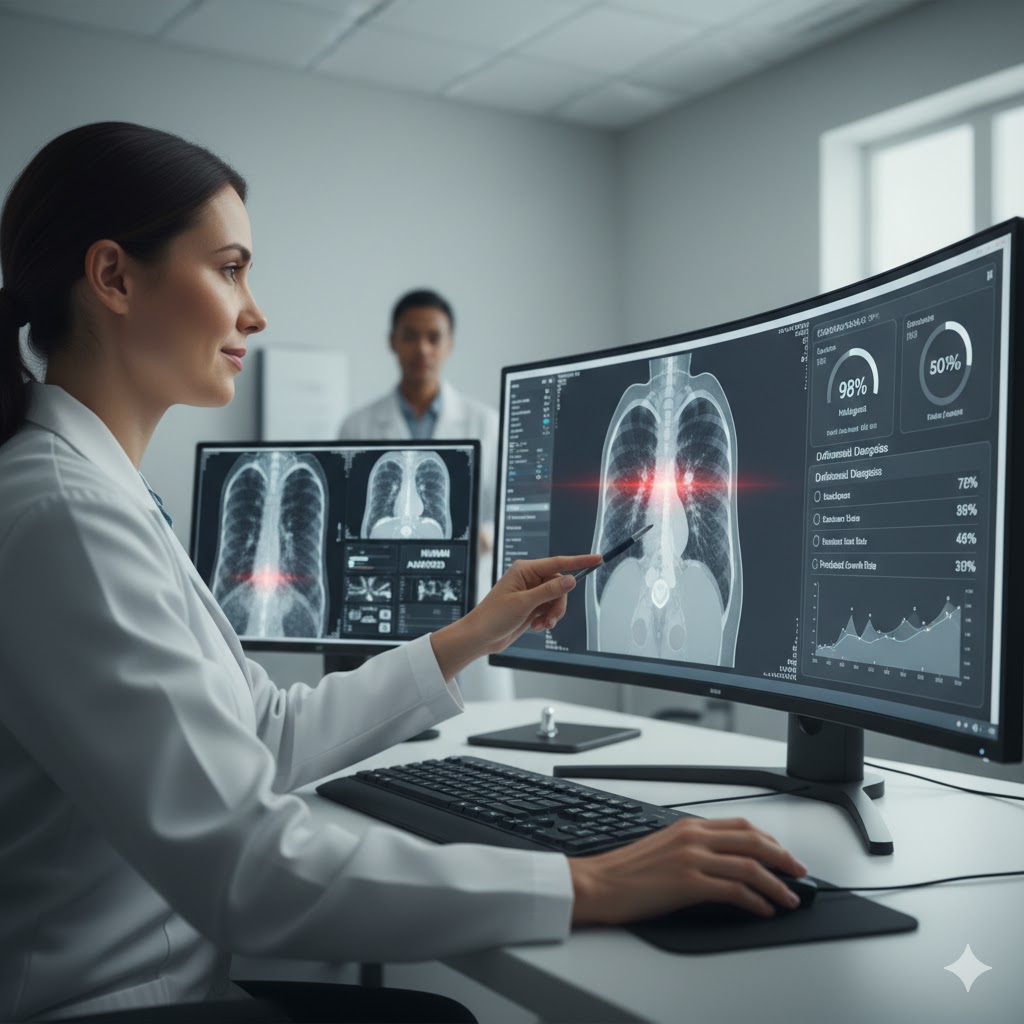
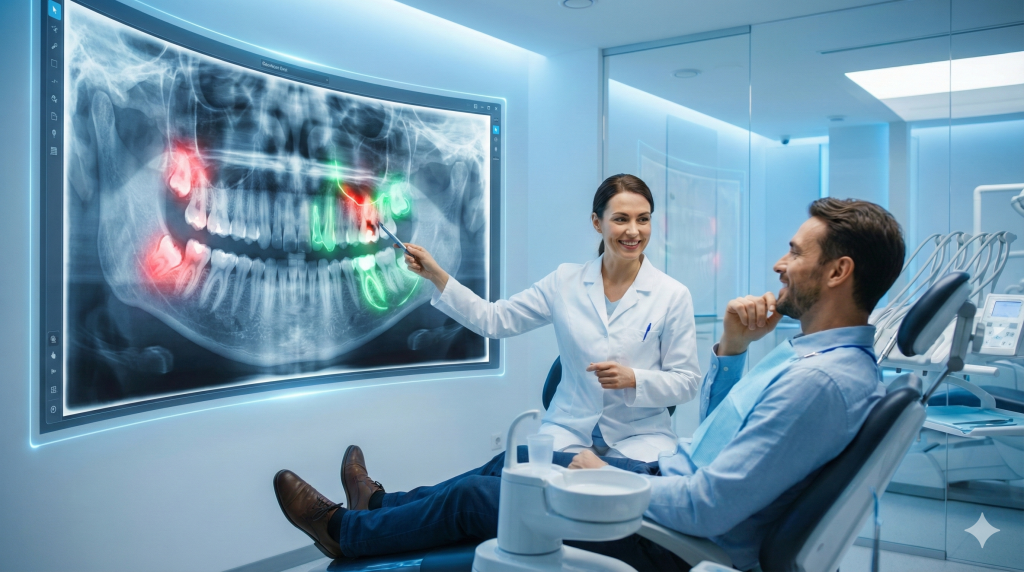
This is exactly what Artificial Intelligence does for your practice. It is not a robot that drills teeth. It is a smart assistant that analyzes X-rays in seconds. It puts a bright red box around cavities. It measures bone loss to the millimeter. It shows the patient exactly what you see. It removes the skepticism because patients trust technology. They trust the objective data on the screen.
We will guide you through the AI revolution that is securing the future of dentistry.
In this report, we will explore how AI diagnostics work. We will show you how they rebuild broken trust. We will provide real scripts to use with your patients today. We will share the data that proves why this technology is essential for a modern and profitable practice.1
Key Takeaways
- AI Builds Instant Trust: Patients stop guessing and start accepting treatment when they see objective, color-coded proof on the screen.3
- Accuracy Improves Drastically: AI detects hidden cavities and bone loss with over 90% accuracy, which is often higher than the human eye alone.4
- Revenue Grows Naturally: Practices utilizing AI see case acceptance rates jump significantly, with some reporting increases as high as 566% for specific treatments.6
- Prevention Becomes Possible: New hybrid models use data on sugar intake and hygiene to predict cavities months before they even form.7
- Insurance Claims Get Easier: AI automates claim reviews and ensures the right evidence is attached, which reduces rejections and speeds up payments.9
What is the current trust crisis in dentistry?
The current trust crisis in dentistry is a growing divide where patients view dental care as a sales pitch rather than medical necessity.
We must address the elephant in the room before we talk about technology. Patients are skeptical. The rise of corporate dentistry and the high cost of care have created an atmosphere of doubt. Online forums and social media are full of stories about “upselling.” Patients share experiences where they went to a new dentist and were told they needed ten fillings, only to get a second opinion that said they were fine. This inconsistency erodes faith in the entire profession. When a patient sits in your chair, they are often wondering if you are looking out for their health or your wallet.11
Why do patients feel like they are being sold to?
The root of the problem is the invisible nature of dental disease. When a patient has a broken arm, they can see the bone sticking out. They know they need a cast. Dental decay is different. It is often painless in the early stages. It hides between teeth.
You look at a grayscale X-ray and see a shadow. To you, that shadow is a clear cavity. To the patient, it looks like a smudge. You have to say, “Trust me, it is there.”
In a world where consumers verify everything with Google reviews and data, “trust me” is no longer enough. The subjective nature of reading X-rays adds to the problem. One dentist might watch a spot. Another might drill it. This variability confuses patients. It confirms their worst fears that dentistry is arbitrary.
The consumer mindset has shifted. Patients treat healthcare like retail. They shop around. They look for the best deal. They are on guard against fraud. This defensive posture makes your job harder. You have to be a doctor and a diplomat. You have to diagnose the disease and then win the argument that the disease actually exists.
How does this impact your bottom line?
Skepticism kills case acceptance. When trust is low, acceptance is low.
If a patient trusts you, they say “yes” to the crown. If they doubt you, they say “I will wait until it hurts.”
This waiting game is dangerous. A small filling becomes a root canal. A root canal becomes an extraction. The patient suffers more pain and pays more money. They then blame you for the high cost. It is a vicious cycle.
The financial impact on your practice is massive. Think of all the treatment plans sitting in your computer that are “unscheduled.” That is not just lost revenue. That is untreated disease.
AI offers a way to break this cycle. It moves the conversation away from subjective opinion. It moves it toward objective fact. It takes the burden of proof off your shoulders. The computer becomes the validator. It is a neutral third party that has no financial stake in the outcome. When the computer agrees with you, the patient’s wall of resistance comes down.3
What is AI in dentistry and how does it work?
AI in dentistry refers to intelligent software systems that use deep learning to analyze dental images and clinical data to identify pathologies.
Think of it like a spell-checker for your X-rays. When you type an email, the spell-checker underlines mistakes in red. It does not write the email for you. It just highlights things you might have missed. It confirms that your spelling is correct.
Dental AI works the same way. It scans the radiograph. It looks for patterns that match decay, bone loss, or infection. When it finds one, it draws a box around it. It draws a line to show where the bone level should be. It gives you a “second opinion” instantly.
How did the technology get so good?
This is not the same technology we had ten years ago. Early attempts at computer-aided diagnosis were clunky. They had too many false alarms.
Today, we use “Deep Learning” and “Convolutional Neural Networks” (CNNs). These are complex computer brains that learn by example.
Imagine showing a child a picture of a cat. You show them thousands of cats. Eventually, the child learns what a cat looks like. They can spot a cat in a new picture they have never seen before.
Developers did this with dental AI. They fed millions of X-rays into the system. Expert dentists annotated these images. They circled the cavities. They marked the bone levels. The computer studied these millions of examples.
It learned to distinguish between a cavity and a burn-out shadow. It learned to see the difference between calculus and enamel. It learned to spot the subtle widening of the PDL space that indicates an infection.
Now, these systems are incredibly sharp. They are consistent. They do not get tired. They do not have a bad day. They process every image with the same rigorous standard.
What are the different types of AI?
We see three main categories of AI entering the dental space:
- Computer Vision: This is the most common type right now. It looks at images. It analyzes bitewings, periapicals, and panoramic X-rays. Companies like Pearl, Overjet, and VideaHealth are leaders here. They help you diagnose.1
- Predictive Analytics: This looks at numbers and history. It analyzes patient data to predict risk. It tells you who is likely to get a cavity in the future. We will discuss this deep science later in the report.7
- Generative AI: This creates content. It writes emails. It generates marketing materials. It creates patient education scripts. Tools like ChatGPT fall into this bucket.15
Is it legal and safe?
Yes. The major platforms have received FDA clearance. This is a big deal. It means the US government has reviewed the data. They have confirmed that the software is safe and effective for diagnosing dental disease.
Pearl’s “Second Opinion” software was the first to read dental X-rays to get cleared for use in over 120 countries. This global acceptance proves the technology is robust. It is not an experiment anymore. It is a standard of care.16
How does AI improve diagnostic accuracy?
AI improves diagnostic accuracy by consistently detecting pathologies with success rates over 90% and reducing human error caused by fatigue.
Humans are amazing, but we are flawed. We get tired. We get distracted. Our eyes play tricks on us.
There is a phenomenon called “Mach bands.” This is an optical illusion where the eye creates a shadow next to a bright object. It can look exactly like a cavity on an X-ray. Dentists struggle with this every day. We also struggle with “burnout” on digital sensors where the image is too dark or too light.
AI does not have eyes. It looks at the raw data of the image. It looks at the pixel density. It sees through the optical illusions.
The Numbers Don’t Lie
Let’s look at the data from the research snippets.
- Caries Detection: A study showed that AI identified caries on digital radiographs with a 97.1% accuracy rate. That is nearly perfect.3
- Restoration Detection: AI successfully detected 94.6% of existing dental restorations. It knows the difference between a composite and a ceramic.3
- Comparison to Humans: In many studies, AI outperforms human dentists. One study using CNNs showed accuracy of 89% for premolars and 88% for molars. While experienced dentists are also good, the AI provides a consistency that humans cannot match.4
Table: AI Accuracy Metrics from Recent Studies
| Study Focus | Accuracy Rate | Source |
| Digital Radiograph Caries | 97.1% | 3 |
| Dental Restorations | 94.6% | 3 |
| Premolar Caries (CNN) | 89.0% | 4 |
| Molar Caries (CNN) | 88.0% | 4 |
Catching the “Invisible” Problems
AI is particularly good at finding things we miss.
- Incipient Decay: These are the tiny cavities starting between teeth. They are often less than half a millimeter deep. AI spots them early. This allows you to remineralize the tooth instead of drilling it later.
- Perio Charting: Measuring bone loss is tedious. You have to estimate lines on a screen. AI measures the distance from the CEJ (Cemento-Enamel Junction) to the bone crest instantly. It gives you a number in millimeters. It flags areas of concern in red. This makes your perio diagnosis rock solid.9
- Endodontic Issues: Shadows at the root tip can be subtle. AI highlights periapical radiolucencies that indicate a dead nerve. It helps you catch infections before the patient swells up in pain.1
Real World Example: The Consistency Problem
Imagine a large dental group with 50 offices. They have a problem. Dr. Smith in Office A diagnoses 5 cavities a day. Dr. Jones in Office B diagnoses 20 cavities a day.
Is Dr. Jones overtreating? Is Dr. Smith missing disease? The owners do not know.
They implement AI across all 50 offices.
Suddenly, everyone has the same baseline. The AI acts as a calibrator. It shows Dr. Smith what he is missing. It shows Dr. Jones where he might be too aggressive. The standard of care becomes uniform. Patients get the same diagnosis regardless of which doctor they see. This consistency builds the brand’s reputation.13
How does AI impact the patient experience?
AI transforms the patient experience by turning a confusing medical exam into a clear and visual collaboration.
The old way of doing dentistry was “paternalistic.” The doctor stood above the patient. The doctor looked at the film. The doctor pronounced the verdict. The patient just had to listen.
The new way is “collaborative.” You and the patient look at the screen together.
The Power of Color
Never underestimate the psychology of color.
Traditional X-rays are gray. Gray is boring. Gray is ambiguous.
AI overlays are colorful.
- Red means danger. It means decay or infection.
- Green means healthy bone or existing fillings.
- Yellow might mean calculus.
When a patient sees a red box on their tooth, their brain reacts. They recognize “problem.” They do not need a dental degree to understand that a red box on a tooth is bad news.
This visual aid creates an “Aha!” moment. The patient leans in. They point at the screen. “What is that red thing?” they ask.
Now they are asking you for the solution. You are no longer selling a filling. You are answering their question about how to remove the red box.3
Reducing Anxiety
Dental anxiety often comes from a lack of control. Patients feel helpless. They do not know what is happening.
AI gives them information. Information gives them control.
A study found that patients who received AI-assisted information had significantly lower anxiety levels. They felt more satisfied with the visit because they understood the why behind the treatment.18
When you explain the problem clearly, the fear of the unknown disappears. The fear of being scammed disappears. The only thing left is the clinical problem and your solution.
Enhancing Communication
AI acts as a bridge. It translates “dentist speak” into “patient speak.”
You might say “distal caries on tooth number 30.” The patient hears gibberish.
The AI shows a picture of the back tooth with a red mark on the back side. The patient sees “hole in my back tooth.”
This alignment is crucial. Statistics show that 65% of patients do not understand what their dentist is pointing at on a standard X-ray. That is two-thirds of your patients who are nodding politely but have no clue what you are saying. AI fixes this.19
The “Chairside Second Opinion”
We all have that patient who wants a second opinion. They leave your office. They go to another dentist. You lose the production.
With AI, the second opinion is already in the room.
You can tell the patient, “I think this is a cavity. Let’s see what the AI says.”
You toggle the button. The AI agrees.
“See? The computer confirms it. We should take care of this.”
This validates your expertise. It shows you are confident enough to let a computer check your work. It builds immense trust.3
What is the economic impact on case acceptance?
AI drives massive economic growth by increasing case acceptance rates through visual validation and building trust.
We have talked about feelings and trust. Now let’s talk about dollars and cents. The financial impact of AI is undeniable. The data from practices using these tools is staggering.
Skyrocketing Acceptance Rates
When patients understand, they buy. It is that simple.
- Midtown Dental Case Study: This practice implemented Overjet. They combined it with a dashboard called Practice by Numbers. They saw a 566% increase in case acceptance. That is not a typo. By showing patients the truth in a way they could understand, the barriers to acceptance vanished.6
- Rand Center for Dentistry: Their acceptance rate went from 37% to 44% quickly. This added nearly $150,000 in revenue in the first month alone. Imagine adding $150k to your month just by turning on a piece of software.20
- VideaHealth Data: Across 100 practices, they saw a 13% increase in annual net production for restorative and periodontal work. That averaged out to $78,268 in extra revenue per practice per year. That is the salary of a full-time employee found just by diagnosing better.21
Breaking Down the Numbers by Procedure
Pearl AI released data showing exactly which procedures increase the most. The results are fascinating.
Table: Increase in Treatment Opportunity with AI 22
| Procedure Type | Increase in Identification/Acceptance |
| Restorative Replacement | +39% |
| Scaling & Root Planing | +37% |
| Crowns | +34% |
| Root Canals | +23% |
| Fillings | +19% |
| Implants | +18% |
Look at the top two. Restorative replacement and scaling/root planing.
Restorative Replacement: This means finding old, failing fillings. AI is great at spotting open margins or recurrent decay under an old silver filling. Humans often miss this or “watch” it too long. AI says “this is failing now.”
Scaling & Root Planing: This is hygiene revenue. Periodontal disease is the most under-diagnosed condition in dentistry. We often skip the probing. We ignore the slight bone loss. AI measures the bone level on every tooth, every time. It flags the bone loss. It forces the conversation about gum disease. This drives hygiene production up by 37%.
Finding the “Hidden” Revenue
There is a gold mine in your existing charts.
Pearl’s “Practice Intelligence” system audited the charts of a large practice network. It found nearly $30 million in untreated patient needs.
These were patients who came in, had X-rays, and left. Maybe the doctor was busy. Maybe the patient said no. The AI went back, looked at the X-rays, and listed every missed opportunity.
You can use this to reactivate patients. You can call them and say, “We were reviewing your charts with our new AI system, and we noticed a few areas we should check again.” It gives you a valid, clinical reason to get them back in the chair.16
How does AI streamline operations and insurance?
AI streamlines operations by automating insurance verification, speeding up claims processing, and optimizing daily clinical workflows.
The front desk is the heartbeat of the practice. If they are bogged down with paperwork, the whole office suffers. AI helps them just as much as it helps the doctors.
The Insurance Battle
Dealing with insurance is a nightmare. You send a claim. They deny it. They say the X-ray isn’t clear. They say you didn’t prove medical necessity. You have to appeal. You wait 90 days. It ruins your cash flow.
AI fights back.
- Auto-Claim Review: Before you even send the claim, the AI reviews it. It checks if the procedure code matches the X-ray evidence. It warns you: “You are billing for a crown, but the X-ray doesn’t show 50% decay. You might get denied.” This allows you to fix the claim or add a narrative before sending it.
- Visual Proof for Adjusters: When you attach an AI-annotated X-ray to the claim, the insurance adjuster sees the same red boxes. It is hard for them to deny a claim when the pathology is highlighted so clearly.
- Faster Payment: Practices report getting paid 5x faster when using AI. The claims go through “auto-adjudication” (automatic approval) because the evidence is so strong.10
- Reduced Denials: Jefferson Dental used AI to stop missing documents. The system ensured every claim had the required perio chart attached. Their rejection rate dropped significantly.9
Optimizing the Daily Huddle
Great practices start with a morning huddle. AI supercharges this meeting.
The software reviews the schedule for the day. It looks at the charts of every patient coming in. It flags opportunities.
“Mrs. Jones is coming in for hygiene at 10:00 AM. The AI sees unscheduled treatment on the upper right from her last visit. Also, she has low bone levels that were never treated.”
Now the hygienist is prepared. She knows exactly what to look for. She knows what to discuss with Mrs. Jones. The team is aligned. They are proactive instead of reactive.13
Operational Efficiency
AI also helps with the boring stuff.
- Voice-Activated Charting: Tools like Bola AI allow you to speak your perio chart. “Three, two, three. Bleeding on distal.” The AI listens and fills out the chart. This saves the hygienist from twisting around to type. It saves the need for an assistant to write numbers. It is faster and more sterile.14
- Staff Training: New staff members get up to speed faster. The AI acts as a guardrail. It helps a new associate doctor diagnose with the confidence of a senior partner. It ensures the new hygienist catches all the calculus. It reduces the training burden on the owner.13
What is the science of Predictive Analytics?
Predictive analytics uses hybrid models of math and machine learning to calculate a patient’s risk of future disease based on their habits.
We are moving into the “Minority Report” era of dentistry. We can predict the crime (the cavity) before it happens.
This is a deeper level of AI. It does not just look at images. It looks at biology.
How does the Hybrid Model work?
A recent study detailed a “hybrid predictive framework.” This combines two powerful methods:
- Mathematical Modeling: This simulates the chemical battle in the mouth. It uses differential equations. It calculates how sugar causes acid, and how acid eats enamel. It also calculates how saliva and fluoride fight back to rebuild enamel. It is a simulation of the demineralization-remineralization cycle.
- Machine Learning (ANN): This stands for Artificial Neural Network. It takes the data from the math model and learns from it. It gets smarter with every patient.
This hybrid approach achieved an accuracy of 91.2% in predicting caries risk. That is incredibly high. It is much better than a dentist just guessing based on a quick look.7
What data does it need?
To predict the future, the AI needs inputs. The study identified six key variables that drive the risk score:
- Daily Sugar Intake: Measured in grams. This is the fuel for bacteria.
- Oral Hygiene Index: A score of how clean the teeth are.
- Salivary pH: Is the mouth acidic or neutral? Acid dissolves teeth.
- Fluoride Usage: Do they use fluoride toothpaste? This armors the teeth.
- Age: Risk changes as we grow.
- Sex: There are biological differences in risk.7
The Crystal Ball Effect
The AI takes these inputs and runs a simulation. It can tell you:
“If this patient continues to eat 80 grams of sugar a day and has poor hygiene, they will develop a new cavity in 18 months.”
But it also offers hope. It can simulate a different future.
“If we get the patient to drop sugar to 30 grams and use a fluoride rinse, they will remain cavity-free for 60 months.”
This is powerful. You are not just telling the patient to brush more. You are showing them a calculated future. You are giving them a specific recipe for health. “John, if you make these two changes, you buy yourself five years of health.”.7
Preventing Disease in Children
This technology is a godsend for pediatric dentistry. Kids are high risk. Their enamel is thinner. Their diets are often sugary.
AI models are now predicting risk in children with 80-90% accuracy. By identifying the “high risk” kids early, we can intervene. We can place sealants. We can do fluoride treatments more often. We can educate the parents with hard data. We can stop the decay before it ever starts. This saves the child from trauma and sets them up for a lifetime of healthy teeth.23
What are the future trends for 2026 and beyond?
The future of dentistry includes generative AI assistants, integration with general medicine, and advanced robotics.
We are just scratching the surface. The next five years will bring changes that seem like science fiction today.
Generative AI and the “Smart Office”
You have heard of ChatGPT. This type of “Generative AI” handles language. It is coming to your front desk.
- The AI Receptionist: Soon, AI agents will answer your phones. They will sound human. They will schedule appointments directly into your software. They will answer questions about insurance coverage at 2:00 AM on a Sunday.
- Patient Education: Generative AI will create custom content. Imagine a patient needs an implant. The AI will generate a personalized video explanation, addressed to “Sarah,” showing her specific X-ray, and explaining the procedure in her native language. It will email this to her automatically.15
- Clinical Notes: The AI will listen to your exam. It will write your SOAP notes for you. “Patient presented with pain in ULQ. Diagnosis irreversible pulpitis #14.” It will be done before you leave the room.25
The Mouth-Body Connection
Dentistry has been isolated from medicine for too long. AI will break down this wall.
Your dental X-rays contain medical data. A panoramic X-ray can show calcifications in the carotid artery. This is a warning sign for a stroke. Currently, dentists often miss this because they are focused on teeth.
AI will not miss it. It will scan every pano for stroke risk. It will scan for signs of osteoporosis in the jawbone. It will flag these medical issues.
You will become a primary care outpost. You will refer patients to cardiologists. You will save lives. Insurance companies will reward this because catching a stroke early saves them millions.26
Robotics and 3D Printing
AI will drive the physical tools of dentistry.
- Robotic Surgery: We already have robots for placing implants. AI will guide them. It will plan the perfect angle and depth based on the CT scan. It will prevent the drill from hitting a nerve.
- 3D Printing: AI will design your crowns. You scan the tooth. The AI designs the perfect anatomy in seconds. The 3D printer in the back room prints it in 20 minutes. Same-day dentistry becomes the norm for everyone.27
How can you implement this in your practice?
You can implement AI by choosing a vendor, training your team, and using specific scripts to introduce the technology to patients.
Ready to start? Here is your roadmap.
Step 1: Choose Your Partner
There are several major players. Look at Pearl, Overjet, and VideaHealth.
- Pearl is known for its “Second Opinion” chairside tool and global presence.16
- Overjet is strong on the insurance and dashboard side, helping with practice management.9
- VideaHealth has strong partnerships with DSOs and focuses on clinical consistency.13
Request a demo from all three. See which one integrates best with your current imaging software (Dexis, Eaglesoft, Dentrix, etc.).
Step 2: Train Your Team
Do not just install it and hope for the best. You need buy-in.
- The Hygienists: They are your front line. Show them how AI makes their job easier. Show them how it helps them get acceptance for scaling and root planing.
- The Front Desk: Show them how it helps with insurance claims. They will love anything that reduces time on the phone with insurance companies.
- The Associates: Use it as a mentoring tool. Tell them it is there to support them, not judge them.
Step 3: Talk to Your Patients
This is the most critical step. You need to explain why you are using AI.
Do not say, “The computer tells me what to do.”
Say, “I use this advanced technology to make sure you get the best care.”
Script 1: The “Second Pair of Eyes”
“Mrs. Jones, I’ve done my exam and I see a few concerns. But we have a new policy here. We run every X-ray through our AI system. It acts like a second pair of eyes. It double-checks everything to ensure we don’t miss even the tiniest detail. I want to be 100% sure about your diagnosis.”
Script 2: The “Spell-Checker” Metaphor
“Think of this like a spell-checker for your teeth. I write the email, but the spell-checker makes sure I didn’t miss a comma. I diagnose your tooth, but this AI highlights anything that looks suspicious so we can investigate it together. It helps us catch problems while they are small and cheap to fix.”
Script 3: The “Objective Truth”
“I know X-rays are just gray shadows to you. I want to turn on the AI view. It adds color. See that red box? That is where the software detects decay. It helps us see exactly what is going on so we can make the right decision together.”.24
Handling Objections
Patient: “Is this just a way to charge me more?”
You: “Actually, it’s the opposite. Our goal is to catch things early. If we trust the AI and catch this cavity now, it’s a small filling. If we wait until it hurts, it’s a root canal. This technology helps us be conservative and save your tooth structure.”
Patient: “Do you need a computer to do your job?”
You: “I am the doctor, and I make the final call. But even the best pilots use autopilot to check their course. I use this tool to ensure my standard of care is perfect every single time.”
Conclusion
The future of dentistry is here. It is not about replacing the dentist. It is about elevating the dentist.
We started this report by discussing the crisis of trust. Patients are skeptical. They are tired of feeling sold to.
AI is the antidote to this skepticism. It provides the transparency that modern consumers demand. It turns the light on in a dark room. It allows the patient to see what you see.
When you implement AI diagnostics, you are sending a powerful message. You are telling your patients that you value accuracy. You are telling them that you are investing in the best tools to protect their health.
The results are proven.
Clinical accuracy goes up.
Patient trust goes up.
Case acceptance goes up.
Revenue goes up.
The question is no longer “Should I use AI?”
The question is “How fast can I get started?”
Don’t let your practice fall behind. The technology is accessible, affordable, and effective. It is time to embrace the future and give your patients the clarity they deserve.
What is your biggest hesitation about bringing AI into your practice? Is it the cost, or the fear of changing your workflow? Leave a comment below and let’s discuss how to overcome these hurdles together.
Works cited
- How AI Dental Diagnostics Are Enhancing Accuracy and Patient Care, accessed January 6, 2026, https://www.curvedental.com/dental-blog/how-ai-enhances-accuracy-and-patient-care
- How AI in Dentistry Is Changing Clinician & Patient Experience – Stomadent Dental Lab, accessed January 6, 2026, https://stomadentlab.com/how-ai-is-changing-experience/
- AI and case acceptance: Building bridges between you and your patients – Pearl AI, accessed January 6, 2026, https://hellopearl.com/blog/topic/ai-and-case-acceptance-building-bridges-between-you-and-your-patients
- AI and dental case acceptance: a beneficial relationship for you and your patients, accessed January 6, 2026, https://dentistry.co.uk/2023/11/23/ai-and-dental-case-acceptance-a-beneficial-relationship-for-you-and-your-patients/
- AI-Driven Dental Caries Management Strategies: From Clinical Practice to Professional Education and Public Self Care – NIH, accessed January 6, 2026, https://pmc.ncbi.nlm.nih.gov/articles/PMC12138923/
- How a Large Commercial Insurer Saved $45 Million with AI – Overjet, accessed January 6, 2026, https://www.overjet.com/resources/how-a-large-commercial-insurer-saved-45-million-with-ai
- Mathematical and AI-Based Predictive Modelling for Dental Caries …, accessed January 6, 2026, https://pmc.ncbi.nlm.nih.gov/articles/PMC12649373/
- Mathematical and AI-Based Predictive Modelling for Dental Caries Risk Using Clinical and Behavioural Parameters – MDPI, accessed January 6, 2026, https://www.mdpi.com/2306-5354/12/11/1190
- Jefferson Case Study – Overjet, accessed January 6, 2026, https://info.overjet.com/hubfs/Marketing/Jefferson%20Case%20Study.pdf
- A Dental Director’s Perspective: Using AI to Boost Case Acceptance – Planet DDS, accessed January 6, 2026, https://www.planetdds.com/webinars/dental-directors-perspective-using-ai-to-boost-case-acceptance/
- Denver-area dentists are upselling invasive cleanings, PDS Health …, accessed January 6, 2026, https://www.reddit.com/r/Denver/comments/1ov70xo/denverarea_dentists_are_upselling_invasive/
- Is the Dentist Trying to Upsell Me? – Reddit, accessed January 6, 2026, https://www.reddit.com/r/RedditForGrownups/comments/16s4330/is_the_dentist_trying_to_upsell_me/
- Dental AI Results: 3 Real-World Outcomes DSOs See with VideaAI, accessed January 6, 2026, https://www.videa.ai/blog-posts/3-real-world-outcomes-from-videaai-insights-from-leading-dsos
- AI in Dentistry 2025: Separating Hype from Practical Solutions – Bola AI, accessed January 6, 2026, https://bola.ai/blog/ai-in-dentistry-2025-hype-vs-practical-solutions/
- Transforming dental diagnostics with artificial intelligence: advanced integration of ChatGPT and large language models for patient care – Frontiers, accessed January 6, 2026, https://www.frontiersin.org/journals/dental-medicine/articles/10.3389/fdmed.2024.1456208/full
- Pearl Powers AI Transformation Across Partnerships for Dentists’ Expansive Practice Network, accessed January 6, 2026, https://www.hellopearl.com/press-release/pearl-powers-ai-transformation-across-partnerships-for-dentists-expansive-practice-network
- Transforming DSOs with Overjet AI: From Chairside Insights to Enterprise Intelligence – Group Dentistry Now, accessed January 6, 2026, https://www.groupdentistrynow.com/dso-group-blog/diagnostic-ai-overjet/
- Evaluating the impact of AI-generated educational content on patient understanding and anxiety in endodontics and restorative dentistry: a comparative study – NIH, accessed January 6, 2026, https://pmc.ncbi.nlm.nih.gov/articles/PMC12060393/
- New Research from Pearl Offers Insight into Dental Patient Trust and Perceptions of Technology, accessed January 6, 2026, https://www.hellopearl.com/press-release/patient-trust-survey-2022
- AI Insights from Pearl – The Lead Magazine, accessed January 6, 2026, https://theleadmagazine.com/ai-insights-from-pearl/
- Dental AI: Hype or Reality? The True Impact on Dentistry – Videa AI, accessed January 6, 2026, https://www.videa.ai/guides/whitepaper-dental-ai-hype-or-reality-the-true-impact-on-dentistry
- Perfecting Case Presentation with Real-Time AI Assistant | Pearl, accessed January 6, 2026, https://www.hellopearl.com/experience/ai-powered-dentistry
- Comparison of traditional regression modeling vs. AI modeling for the prediction of dental caries: a secondary data analysis – Frontiers, accessed January 6, 2026, https://www.frontiersin.org/journals/oral-health/articles/10.3389/froh.2024.1322733/full
- AI Prompting for Dentists: Mastering the WWWAC Method – My Social Practice, accessed January 6, 2026, https://mysocialpractice.com/2024/03/ai-prompting-for-dentists/
- How Dental Practices Use AI – 30 Use Cases with Prompts – BastionGPT, accessed January 6, 2026, https://bastiongpt.com/post/dental-ai-use-cases
- The Role of Artificial Intelligence in Transforming Dental Public Health: Current Applications, Ethical Considerations, and Future Directions – The Open Dentistry Journal, accessed January 6, 2026, https://opendentistryjournal.com/VOLUME/19/ELOCATOR/e18742106363413/FULLTEXT/
- Artificial intelligence in dentistry: current state and future directions | The Bulletin of the Royal College of Surgeons of England, accessed January 6, 2026, https://publishing.rcseng.ac.uk/doi/10.1308/rcsbull.2023.132
- Top Dental Trends in 2025 You Need to Know, accessed January 6, 2026, https://spectrumdentalarts.com/dental-care-blog/top-dental-trends-in-2025/
- How to talk to patients about AI? (Cheatsheet) – VideaAI Learning Center, accessed January 6, 2026, https://help.videa.ai/how-to-talk-to-patients-about-ai-cheatsheet
Artificial Intelligence Reshapes the Future of Dentistry – Dimensions of Dental Hygiene, accessed January 6, 2026, https://dimensionsofdentalhygiene.com/article/artificial-intelligence-reshapes-the-future-of-dentistry/
Introduction
Are you tired of hearing patients say “let me think about it” after you present a treatment plan?
This is the most frustrating moment in a dentist’s day. You know the patient needs help. You can see the decay on the X-ray. You know that waiting will only make the problem worse and more expensive. Yet the patient looks at you with doubt. They wonder if you are just trying to meet a sales quota. They worry about the cost. They leave the office without scheduling the procedure. This hesitation hurts their health. It also hurts your practice revenue. It creates a gap between the care you want to provide and the care they accept.
Imagine if a neutral third party could prove you are right instantly.
This is exactly what Artificial Intelligence does for your practice. It is not a robot that drills teeth. It is a smart assistant that analyzes X-rays in seconds. It puts a bright red box around cavities. It measures bone loss to the millimeter. It shows the patient exactly what you see. It removes the skepticism because patients trust technology. They trust the objective data on the screen.
We will guide you through the AI revolution that is securing the future of dentistry.
In this report, we will explore how AI diagnostics work. We will show you how they rebuild broken trust. We will provide real scripts to use with your patients today. We will share the data that proves why this technology is essential for a modern and profitable practice.1
Key Takeaways
- AI Builds Instant Trust: Patients stop guessing and start accepting treatment when they see objective, color-coded proof on the screen.3
- Accuracy Improves Drastically: AI detects hidden cavities and bone loss with over 90% accuracy, which is often higher than the human eye alone.4
- Revenue Grows Naturally: Practices utilizing AI see case acceptance rates jump significantly, with some reporting increases as high as 566% for specific treatments.6
- Prevention Becomes Possible: New hybrid models use data on sugar intake and hygiene to predict cavities months before they even form.7
- Insurance Claims Get Easier: AI automates claim reviews and ensures the right evidence is attached, which reduces rejections and speeds up payments.9
What is the current trust crisis in dentistry?
The current trust crisis in dentistry is a growing divide where patients view dental care as a sales pitch rather than medical necessity.
We must address the elephant in the room before we talk about technology. Patients are skeptical. The rise of corporate dentistry and the high cost of care have created an atmosphere of doubt. Online forums and social media are full of stories about “upselling.” Patients share experiences where they went to a new dentist and were told they needed ten fillings, only to get a second opinion that said they were fine. This inconsistency erodes faith in the entire profession. When a patient sits in your chair, they are often wondering if you are looking out for their health or your wallet.11
Why do patients feel like they are being sold to?
The root of the problem is the invisible nature of dental disease. When a patient has a broken arm, they can see the bone sticking out. They know they need a cast. Dental decay is different. It is often painless in the early stages. It hides between teeth.
You look at a grayscale X-ray and see a shadow. To you, that shadow is a clear cavity. To the patient, it looks like a smudge. You have to say, “Trust me, it is there.”
In a world where consumers verify everything with Google reviews and data, “trust me” is no longer enough. The subjective nature of reading X-rays adds to the problem. One dentist might watch a spot. Another might drill it. This variability confuses patients. It confirms their worst fears that dentistry is arbitrary.
The consumer mindset has shifted. Patients treat healthcare like retail. They shop around. They look for the best deal. They are on guard against fraud. This defensive posture makes your job harder. You have to be a doctor and a diplomat. You have to diagnose the disease and then win the argument that the disease actually exists.
How does this impact your bottom line?
Skepticism kills case acceptance. When trust is low, acceptance is low.
If a patient trusts you, they say “yes” to the crown. If they doubt you, they say “I will wait until it hurts.”
This waiting game is dangerous. A small filling becomes a root canal. A root canal becomes an extraction. The patient suffers more pain and pays more money. They then blame you for the high cost. It is a vicious cycle.
The financial impact on your practice is massive. Think of all the treatment plans sitting in your computer that are “unscheduled.” That is not just lost revenue. That is untreated disease.
AI offers a way to break this cycle. It moves the conversation away from subjective opinion. It moves it toward objective fact. It takes the burden of proof off your shoulders. The computer becomes the validator. It is a neutral third party that has no financial stake in the outcome. When the computer agrees with you, the patient’s wall of resistance comes down.3
What is AI in dentistry and how does it work?
AI in dentistry refers to intelligent software systems that use deep learning to analyze dental images and clinical data to identify pathologies.
Think of it like a spell-checker for your X-rays. When you type an email, the spell-checker underlines mistakes in red. It does not write the email for you. It just highlights things you might have missed. It confirms that your spelling is correct.
Dental AI works the same way. It scans the radiograph. It looks for patterns that match decay, bone loss, or infection. When it finds one, it draws a box around it. It draws a line to show where the bone level should be. It gives you a “second opinion” instantly.
How did the technology get so good?
This is not the same technology we had ten years ago. Early attempts at computer-aided diagnosis were clunky. They had too many false alarms.
Today, we use “Deep Learning” and “Convolutional Neural Networks” (CNNs). These are complex computer brains that learn by example.
Imagine showing a child a picture of a cat. You show them thousands of cats. Eventually, the child learns what a cat looks like. They can spot a cat in a new picture they have never seen before.
Developers did this with dental AI. They fed millions of X-rays into the system. Expert dentists annotated these images. They circled the cavities. They marked the bone levels. The computer studied these millions of examples.
It learned to distinguish between a cavity and a burn-out shadow. It learned to see the difference between calculus and enamel. It learned to spot the subtle widening of the PDL space that indicates an infection.
Now, these systems are incredibly sharp. They are consistent. They do not get tired. They do not have a bad day. They process every image with the same rigorous standard.
What are the different types of AI?
We see three main categories of AI entering the dental space:
- Computer Vision: This is the most common type right now. It looks at images. It analyzes bitewings, periapicals, and panoramic X-rays. Companies like Pearl, Overjet, and VideaHealth are leaders here. They help you diagnose.1
- Predictive Analytics: This looks at numbers and history. It analyzes patient data to predict risk. It tells you who is likely to get a cavity in the future. We will discuss this deep science later in the report.7
- Generative AI: This creates content. It writes emails. It generates marketing materials. It creates patient education scripts. Tools like ChatGPT fall into this bucket.15
Is it legal and safe?
Yes. The major platforms have received FDA clearance. This is a big deal. It means the US government has reviewed the data. They have confirmed that the software is safe and effective for diagnosing dental disease.
Pearl’s “Second Opinion” software was the first to read dental X-rays to get cleared for use in over 120 countries. This global acceptance proves the technology is robust. It is not an experiment anymore. It is a standard of care.16
How does AI improve diagnostic accuracy?
AI improves diagnostic accuracy by consistently detecting pathologies with success rates over 90% and reducing human error caused by fatigue.
Humans are amazing, but we are flawed. We get tired. We get distracted. Our eyes play tricks on us.
There is a phenomenon called “Mach bands.” This is an optical illusion where the eye creates a shadow next to a bright object. It can look exactly like a cavity on an X-ray. Dentists struggle with this every day. We also struggle with “burnout” on digital sensors where the image is too dark or too light.
AI does not have eyes. It looks at the raw data of the image. It looks at the pixel density. It sees through the optical illusions.
The Numbers Don’t Lie
Let’s look at the data from the research snippets.
- Caries Detection: A study showed that AI identified caries on digital radiographs with a 97.1% accuracy rate. That is nearly perfect.3
- Restoration Detection: AI successfully detected 94.6% of existing dental restorations. It knows the difference between a composite and a ceramic.3
- Comparison to Humans: In many studies, AI outperforms human dentists. One study using CNNs showed accuracy of 89% for premolars and 88% for molars. While experienced dentists are also good, the AI provides a consistency that humans cannot match.4
Table: AI Accuracy Metrics from Recent Studies
| Study Focus | Accuracy Rate | Source |
| Digital Radiograph Caries | 97.1% | 3 |
| Dental Restorations | 94.6% | 3 |
| Premolar Caries (CNN) | 89.0% | 4 |
| Molar Caries (CNN) | 88.0% | 4 |
Catching the “Invisible” Problems
AI is particularly good at finding things we miss.
- Incipient Decay: These are the tiny cavities starting between teeth. They are often less than half a millimeter deep. AI spots them early. This allows you to remineralize the tooth instead of drilling it later.
- Perio Charting: Measuring bone loss is tedious. You have to estimate lines on a screen. AI measures the distance from the CEJ (Cemento-Enamel Junction) to the bone crest instantly. It gives you a number in millimeters. It flags areas of concern in red. This makes your perio diagnosis rock solid.9
- Endodontic Issues: Shadows at the root tip can be subtle. AI highlights periapical radiolucencies that indicate a dead nerve. It helps you catch infections before the patient swells up in pain.1
Real World Example: The Consistency Problem
Imagine a large dental group with 50 offices. They have a problem. Dr. Smith in Office A diagnoses 5 cavities a day. Dr. Jones in Office B diagnoses 20 cavities a day.
Is Dr. Jones overtreating? Is Dr. Smith missing disease? The owners do not know.
They implement AI across all 50 offices.
Suddenly, everyone has the same baseline. The AI acts as a calibrator. It shows Dr. Smith what he is missing. It shows Dr. Jones where he might be too aggressive. The standard of care becomes uniform. Patients get the same diagnosis regardless of which doctor they see. This consistency builds the brand’s reputation.13
How does AI impact the patient experience?
AI transforms the patient experience by turning a confusing medical exam into a clear and visual collaboration.
The old way of doing dentistry was “paternalistic.” The doctor stood above the patient. The doctor looked at the film. The doctor pronounced the verdict. The patient just had to listen.
The new way is “collaborative.” You and the patient look at the screen together.
The Power of Color
Never underestimate the psychology of color.
Traditional X-rays are gray. Gray is boring. Gray is ambiguous.
AI overlays are colorful.
- Red means danger. It means decay or infection.
- Green means healthy bone or existing fillings.
- Yellow might mean calculus.
When a patient sees a red box on their tooth, their brain reacts. They recognize “problem.” They do not need a dental degree to understand that a red box on a tooth is bad news.
This visual aid creates an “Aha!” moment. The patient leans in. They point at the screen. “What is that red thing?” they ask.
Now they are asking you for the solution. You are no longer selling a filling. You are answering their question about how to remove the red box.3
Reducing Anxiety
Dental anxiety often comes from a lack of control. Patients feel helpless. They do not know what is happening.
AI gives them information. Information gives them control.
A study found that patients who received AI-assisted information had significantly lower anxiety levels. They felt more satisfied with the visit because they understood the why behind the treatment.18
When you explain the problem clearly, the fear of the unknown disappears. The fear of being scammed disappears. The only thing left is the clinical problem and your solution.
Enhancing Communication
AI acts as a bridge. It translates “dentist speak” into “patient speak.”
You might say “distal caries on tooth number 30.” The patient hears gibberish.
The AI shows a picture of the back tooth with a red mark on the back side. The patient sees “hole in my back tooth.”
This alignment is crucial. Statistics show that 65% of patients do not understand what their dentist is pointing at on a standard X-ray. That is two-thirds of your patients who are nodding politely but have no clue what you are saying. AI fixes this.19
The “Chairside Second Opinion”
We all have that patient who wants a second opinion. They leave your office. They go to another dentist. You lose the production.
With AI, the second opinion is already in the room.
You can tell the patient, “I think this is a cavity. Let’s see what the AI says.”
You toggle the button. The AI agrees.
“See? The computer confirms it. We should take care of this.”
This validates your expertise. It shows you are confident enough to let a computer check your work. It builds immense trust.3
What is the economic impact on case acceptance?
AI drives massive economic growth by increasing case acceptance rates through visual validation and building trust.
We have talked about feelings and trust. Now let’s talk about dollars and cents. The financial impact of AI is undeniable. The data from practices using these tools is staggering.
Skyrocketing Acceptance Rates
When patients understand, they buy. It is that simple.
- Midtown Dental Case Study: This practice implemented Overjet. They combined it with a dashboard called Practice by Numbers. They saw a 566% increase in case acceptance. That is not a typo. By showing patients the truth in a way they could understand, the barriers to acceptance vanished.6
- Rand Center for Dentistry: Their acceptance rate went from 37% to 44% quickly. This added nearly $150,000 in revenue in the first month alone. Imagine adding $150k to your month just by turning on a piece of software.20
- VideaHealth Data: Across 100 practices, they saw a 13% increase in annual net production for restorative and periodontal work. That averaged out to $78,268 in extra revenue per practice per year. That is the salary of a full-time employee found just by diagnosing better.21
Breaking Down the Numbers by Procedure
Pearl AI released data showing exactly which procedures increase the most. The results are fascinating.
Table: Increase in Treatment Opportunity with AI 22
| Procedure Type | Increase in Identification/Acceptance |
| Restorative Replacement | +39% |
| Scaling & Root Planing | +37% |
| Crowns | +34% |
| Root Canals | +23% |
| Fillings | +19% |
| Implants | +18% |
Look at the top two. Restorative replacement and scaling/root planing.
Restorative Replacement: This means finding old, failing fillings. AI is great at spotting open margins or recurrent decay under an old silver filling. Humans often miss this or “watch” it too long. AI says “this is failing now.”
Scaling & Root Planing: This is hygiene revenue. Periodontal disease is the most under-diagnosed condition in dentistry. We often skip the probing. We ignore the slight bone loss. AI measures the bone level on every tooth, every time. It flags the bone loss. It forces the conversation about gum disease. This drives hygiene production up by 37%.
Finding the “Hidden” Revenue
There is a gold mine in your existing charts.
Pearl’s “Practice Intelligence” system audited the charts of a large practice network. It found nearly $30 million in untreated patient needs.
These were patients who came in, had X-rays, and left. Maybe the doctor was busy. Maybe the patient said no. The AI went back, looked at the X-rays, and listed every missed opportunity.
You can use this to reactivate patients. You can call them and say, “We were reviewing your charts with our new AI system, and we noticed a few areas we should check again.” It gives you a valid, clinical reason to get them back in the chair.16
How does AI streamline operations and insurance?
AI streamlines operations by automating insurance verification, speeding up claims processing, and optimizing daily clinical workflows.
The front desk is the heartbeat of the practice. If they are bogged down with paperwork, the whole office suffers. AI helps them just as much as it helps the doctors.
The Insurance Battle
Dealing with insurance is a nightmare. You send a claim. They deny it. They say the X-ray isn’t clear. They say you didn’t prove medical necessity. You have to appeal. You wait 90 days. It ruins your cash flow.
AI fights back.
- Auto-Claim Review: Before you even send the claim, the AI reviews it. It checks if the procedure code matches the X-ray evidence. It warns you: “You are billing for a crown, but the X-ray doesn’t show 50% decay. You might get denied.” This allows you to fix the claim or add a narrative before sending it.
- Visual Proof for Adjusters: When you attach an AI-annotated X-ray to the claim, the insurance adjuster sees the same red boxes. It is hard for them to deny a claim when the pathology is highlighted so clearly.
- Faster Payment: Practices report getting paid 5x faster when using AI. The claims go through “auto-adjudication” (automatic approval) because the evidence is so strong.10
- Reduced Denials: Jefferson Dental used AI to stop missing documents. The system ensured every claim had the required perio chart attached. Their rejection rate dropped significantly.9
Optimizing the Daily Huddle
Great practices start with a morning huddle. AI supercharges this meeting.
The software reviews the schedule for the day. It looks at the charts of every patient coming in. It flags opportunities.
“Mrs. Jones is coming in for hygiene at 10:00 AM. The AI sees unscheduled treatment on the upper right from her last visit. Also, she has low bone levels that were never treated.”
Now the hygienist is prepared. She knows exactly what to look for. She knows what to discuss with Mrs. Jones. The team is aligned. They are proactive instead of reactive.13
Operational Efficiency
AI also helps with the boring stuff.
- Voice-Activated Charting: Tools like Bola AI allow you to speak your perio chart. “Three, two, three. Bleeding on distal.” The AI listens and fills out the chart. This saves the hygienist from twisting around to type. It saves the need for an assistant to write numbers. It is faster and more sterile.14
- Staff Training: New staff members get up to speed faster. The AI acts as a guardrail. It helps a new associate doctor diagnose with the confidence of a senior partner. It ensures the new hygienist catches all the calculus. It reduces the training burden on the owner.13
What is the science of Predictive Analytics?
Predictive analytics uses hybrid models of math and machine learning to calculate a patient’s risk of future disease based on their habits.
We are moving into the “Minority Report” era of dentistry. We can predict the crime (the cavity) before it happens.
This is a deeper level of AI. It does not just look at images. It looks at biology.
How does the Hybrid Model work?
A recent study detailed a “hybrid predictive framework.” This combines two powerful methods:
- Mathematical Modeling: This simulates the chemical battle in the mouth. It uses differential equations. It calculates how sugar causes acid, and how acid eats enamel. It also calculates how saliva and fluoride fight back to rebuild enamel. It is a simulation of the demineralization-remineralization cycle.
- Machine Learning (ANN): This stands for Artificial Neural Network. It takes the data from the math model and learns from it. It gets smarter with every patient.
This hybrid approach achieved an accuracy of 91.2% in predicting caries risk. That is incredibly high. It is much better than a dentist just guessing based on a quick look.7
What data does it need?
To predict the future, the AI needs inputs. The study identified six key variables that drive the risk score:
- Daily Sugar Intake: Measured in grams. This is the fuel for bacteria.
- Oral Hygiene Index: A score of how clean the teeth are.
- Salivary pH: Is the mouth acidic or neutral? Acid dissolves teeth.
- Fluoride Usage: Do they use fluoride toothpaste? This armors the teeth.
- Age: Risk changes as we grow.
- Sex: There are biological differences in risk.7
The Crystal Ball Effect
The AI takes these inputs and runs a simulation. It can tell you:
“If this patient continues to eat 80 grams of sugar a day and has poor hygiene, they will develop a new cavity in 18 months.”
But it also offers hope. It can simulate a different future.
“If we get the patient to drop sugar to 30 grams and use a fluoride rinse, they will remain cavity-free for 60 months.”
This is powerful. You are not just telling the patient to brush more. You are showing them a calculated future. You are giving them a specific recipe for health. “John, if you make these two changes, you buy yourself five years of health.”.7
Preventing Disease in Children
This technology is a godsend for pediatric dentistry. Kids are high risk. Their enamel is thinner. Their diets are often sugary.
AI models are now predicting risk in children with 80-90% accuracy. By identifying the “high risk” kids early, we can intervene. We can place sealants. We can do fluoride treatments more often. We can educate the parents with hard data. We can stop the decay before it ever starts. This saves the child from trauma and sets them up for a lifetime of healthy teeth.23
What are the future trends for 2026 and beyond?
The future of dentistry includes generative AI assistants, integration with general medicine, and advanced robotics.
We are just scratching the surface. The next five years will bring changes that seem like science fiction today.
Generative AI and the “Smart Office”
You have heard of ChatGPT. This type of “Generative AI” handles language. It is coming to your front desk.
- The AI Receptionist: Soon, AI agents will answer your phones. They will sound human. They will schedule appointments directly into your software. They will answer questions about insurance coverage at 2:00 AM on a Sunday.
- Patient Education: Generative AI will create custom content. Imagine a patient needs an implant. The AI will generate a personalized video explanation, addressed to “Sarah,” showing her specific X-ray, and explaining the procedure in her native language. It will email this to her automatically.15
- Clinical Notes: The AI will listen to your exam. It will write your SOAP notes for you. “Patient presented with pain in ULQ. Diagnosis irreversible pulpitis #14.” It will be done before you leave the room.25
The Mouth-Body Connection
Dentistry has been isolated from medicine for too long. AI will break down this wall.
Your dental X-rays contain medical data. A panoramic X-ray can show calcifications in the carotid artery. This is a warning sign for a stroke. Currently, dentists often miss this because they are focused on teeth.
AI will not miss it. It will scan every pano for stroke risk. It will scan for signs of osteoporosis in the jawbone. It will flag these medical issues.
You will become a primary care outpost. You will refer patients to cardiologists. You will save lives. Insurance companies will reward this because catching a stroke early saves them millions.26
Robotics and 3D Printing
AI will drive the physical tools of dentistry.
- Robotic Surgery: We already have robots for placing implants. AI will guide them. It will plan the perfect angle and depth based on the CT scan. It will prevent the drill from hitting a nerve.
- 3D Printing: AI will design your crowns. You scan the tooth. The AI designs the perfect anatomy in seconds. The 3D printer in the back room prints it in 20 minutes. Same-day dentistry becomes the norm for everyone.27
How can you implement this in your practice?
You can implement AI by choosing a vendor, training your team, and using specific scripts to introduce the technology to patients.
Ready to start? Here is your roadmap.
Step 1: Choose Your Partner
There are several major players. Look at Pearl, Overjet, and VideaHealth.
- Pearl is known for its “Second Opinion” chairside tool and global presence.16
- Overjet is strong on the insurance and dashboard side, helping with practice management.9
- VideaHealth has strong partnerships with DSOs and focuses on clinical consistency.13
Request a demo from all three. See which one integrates best with your current imaging software (Dexis, Eaglesoft, Dentrix, etc.).
Step 2: Train Your Team
Do not just install it and hope for the best. You need buy-in.
- The Hygienists: They are your front line. Show them how AI makes their job easier. Show them how it helps them get acceptance for scaling and root planing.
- The Front Desk: Show them how it helps with insurance claims. They will love anything that reduces time on the phone with insurance companies.
- The Associates: Use it as a mentoring tool. Tell them it is there to support them, not judge them.
Step 3: Talk to Your Patients
This is the most critical step. You need to explain why you are using AI.
Do not say, “The computer tells me what to do.”
Say, “I use this advanced technology to make sure you get the best care.”
Script 1: The “Second Pair of Eyes”
“Mrs. Jones, I’ve done my exam and I see a few concerns. But we have a new policy here. We run every X-ray through our AI system. It acts like a second pair of eyes. It double-checks everything to ensure we don’t miss even the tiniest detail. I want to be 100% sure about your diagnosis.”
Script 2: The “Spell-Checker” Metaphor
“Think of this like a spell-checker for your teeth. I write the email, but the spell-checker makes sure I didn’t miss a comma. I diagnose your tooth, but this AI highlights anything that looks suspicious so we can investigate it together. It helps us catch problems while they are small and cheap to fix.”
Script 3: The “Objective Truth”
“I know X-rays are just gray shadows to you. I want to turn on the AI view. It adds color. See that red box? That is where the software detects decay. It helps us see exactly what is going on so we can make the right decision together.”.24
Handling Objections
Patient: “Is this just a way to charge me more?”
You: “Actually, it’s the opposite. Our goal is to catch things early. If we trust the AI and catch this cavity now, it’s a small filling. If we wait until it hurts, it’s a root canal. This technology helps us be conservative and save your tooth structure.”
Patient: “Do you need a computer to do your job?”
You: “I am the doctor, and I make the final call. But even the best pilots use autopilot to check their course. I use this tool to ensure my standard of care is perfect every single time.”
Conclusion
The future of dentistry is here. It is not about replacing the dentist. It is about elevating the dentist.
We started this report by discussing the crisis of trust. Patients are skeptical. They are tired of feeling sold to.
AI is the antidote to this skepticism. It provides the transparency that modern consumers demand. It turns the light on in a dark room. It allows the patient to see what you see.
When you implement AI diagnostics, you are sending a powerful message. You are telling your patients that you value accuracy. You are telling them that you are investing in the best tools to protect their health.
The results are proven.
Clinical accuracy goes up.
Patient trust goes up.
Case acceptance goes up.
Revenue goes up.
The question is no longer “Should I use AI?”
The question is “How fast can I get started?”
Don’t let your practice fall behind. The technology is accessible, affordable, and effective. It is time to embrace the future and give your patients the clarity they deserve.
What is your biggest hesitation about bringing AI into your practice? Is it the cost, or the fear of changing your workflow? Leave a comment below and let’s discuss how to overcome these hurdles together.
References and Sources
- On Trust & Psychology: 3
- On Diagnostic Accuracy: 1
- On Economic Impact: 6
- On Predictive Science: 7
- On Future Trends: 15
- On Implementation & Scripts: 24
- On Global & Regulatory: 16
Works cited
- How AI Dental Diagnostics Are Enhancing Accuracy and Patient Care, accessed January 6, 2026, https://www.curvedental.com/dental-blog/how-ai-enhances-accuracy-and-patient-care
- How AI in Dentistry Is Changing Clinician & Patient Experience – Stomadent Dental Lab, accessed January 6, 2026, https://stomadentlab.com/how-ai-is-changing-experience/
- AI and case acceptance: Building bridges between you and your patients – Pearl AI, accessed January 6, 2026, https://hellopearl.com/blog/topic/ai-and-case-acceptance-building-bridges-between-you-and-your-patients
- AI and dental case acceptance: a beneficial relationship for you and your patients, accessed January 6, 2026, https://dentistry.co.uk/2023/11/23/ai-and-dental-case-acceptance-a-beneficial-relationship-for-you-and-your-patients/
- AI-Driven Dental Caries Management Strategies: From Clinical Practice to Professional Education and Public Self Care – NIH, accessed January 6, 2026, https://pmc.ncbi.nlm.nih.gov/articles/PMC12138923/
- How a Large Commercial Insurer Saved $45 Million with AI – Overjet, accessed January 6, 2026, https://www.overjet.com/resources/how-a-large-commercial-insurer-saved-45-million-with-ai
- Mathematical and AI-Based Predictive Modelling for Dental Caries …, accessed January 6, 2026, https://pmc.ncbi.nlm.nih.gov/articles/PMC12649373/
- Mathematical and AI-Based Predictive Modelling for Dental Caries Risk Using Clinical and Behavioural Parameters – MDPI, accessed January 6, 2026, https://www.mdpi.com/2306-5354/12/11/1190
- Jefferson Case Study – Overjet, accessed January 6, 2026, https://info.overjet.com/hubfs/Marketing/Jefferson%20Case%20Study.pdf
- A Dental Director’s Perspective: Using AI to Boost Case Acceptance – Planet DDS, accessed January 6, 2026, https://www.planetdds.com/webinars/dental-directors-perspective-using-ai-to-boost-case-acceptance/
- Denver-area dentists are upselling invasive cleanings, PDS Health …, accessed January 6, 2026, https://www.reddit.com/r/Denver/comments/1ov70xo/denverarea_dentists_are_upselling_invasive/
- Is the Dentist Trying to Upsell Me? – Reddit, accessed January 6, 2026, https://www.reddit.com/r/RedditForGrownups/comments/16s4330/is_the_dentist_trying_to_upsell_me/
- Dental AI Results: 3 Real-World Outcomes DSOs See with VideaAI, accessed January 6, 2026, https://www.videa.ai/blog-posts/3-real-world-outcomes-from-videaai-insights-from-leading-dsos
- AI in Dentistry 2025: Separating Hype from Practical Solutions – Bola AI, accessed January 6, 2026, https://bola.ai/blog/ai-in-dentistry-2025-hype-vs-practical-solutions/
- Transforming dental diagnostics with artificial intelligence: advanced integration of ChatGPT and large language models for patient care – Frontiers, accessed January 6, 2026, https://www.frontiersin.org/journals/dental-medicine/articles/10.3389/fdmed.2024.1456208/full
- Pearl Powers AI Transformation Across Partnerships for Dentists’ Expansive Practice Network, accessed January 6, 2026, https://www.hellopearl.com/press-release/pearl-powers-ai-transformation-across-partnerships-for-dentists-expansive-practice-network
- Transforming DSOs with Overjet AI: From Chairside Insights to Enterprise Intelligence – Group Dentistry Now, accessed January 6, 2026, https://www.groupdentistrynow.com/dso-group-blog/diagnostic-ai-overjet/
- Evaluating the impact of AI-generated educational content on patient understanding and anxiety in endodontics and restorative dentistry: a comparative study – NIH, accessed January 6, 2026, https://pmc.ncbi.nlm.nih.gov/articles/PMC12060393/
- New Research from Pearl Offers Insight into Dental Patient Trust and Perceptions of Technology, accessed January 6, 2026, https://www.hellopearl.com/press-release/patient-trust-survey-2022
- AI Insights from Pearl – The Lead Magazine, accessed January 6, 2026, https://theleadmagazine.com/ai-insights-from-pearl/
- Dental AI: Hype or Reality? The True Impact on Dentistry – Videa AI, accessed January 6, 2026, https://www.videa.ai/guides/whitepaper-dental-ai-hype-or-reality-the-true-impact-on-dentistry
- Perfecting Case Presentation with Real-Time AI Assistant | Pearl, accessed January 6, 2026, https://www.hellopearl.com/experience/ai-powered-dentistry
- Comparison of traditional regression modeling vs. AI modeling for the prediction of dental caries: a secondary data analysis – Frontiers, accessed January 6, 2026, https://www.frontiersin.org/journals/oral-health/articles/10.3389/froh.2024.1322733/full
- AI Prompting for Dentists: Mastering the WWWAC Method – My Social Practice, accessed January 6, 2026, https://mysocialpractice.com/2024/03/ai-prompting-for-dentists/
- How Dental Practices Use AI – 30 Use Cases with Prompts – BastionGPT, accessed January 6, 2026, https://bastiongpt.com/post/dental-ai-use-cases
- The Role of Artificial Intelligence in Transforming Dental Public Health: Current Applications, Ethical Considerations, and Future Directions – The Open Dentistry Journal, accessed January 6, 2026, https://opendentistryjournal.com/VOLUME/19/ELOCATOR/e18742106363413/FULLTEXT/
- Artificial intelligence in dentistry: current state and future directions | The Bulletin of the Royal College of Surgeons of England, accessed January 6, 2026, https://publishing.rcseng.ac.uk/doi/10.1308/rcsbull.2023.132
- Top Dental Trends in 2025 You Need to Know, accessed January 6, 2026, https://spectrumdentalarts.com/dental-care-blog/top-dental-trends-in-2025/
- How to talk to patients about AI? (Cheatsheet) – VideaAI Learning Center, accessed January 6, 2026, https://help.videa.ai/how-to-talk-to-patients-about-ai-cheatsheet
Artificial Intelligence Reshapes the Future of Dentistry – Dimensions of Dental Hygiene, accessed January 6, 2026, https://dimensionsofdentalhygiene.com/article/artificial-intelligence-reshapes-the-future-of-dentistry/
Introduction
Are you tired of hearing patients say “let me think about it” after you present a treatment plan?
This is the most frustrating moment in a dentist’s day. You know the patient needs help. You can see the decay on the X-ray. You know that waiting will only make the problem worse and more expensive. Yet the patient looks at you with doubt. They wonder if you are just trying to meet a sales quota. They worry about the cost. They leave the office without scheduling the procedure. This hesitation hurts their health. It also hurts your practice revenue. It creates a gap between the care you want to provide and the care they accept.
Imagine if a neutral third party could prove you are right instantly.
This is exactly what Artificial Intelligence does for your practice. It is not a robot that drills teeth. It is a smart assistant that analyzes X-rays in seconds. It puts a bright red box around cavities. It measures bone loss to the millimeter. It shows the patient exactly what you see. It removes the skepticism because patients trust technology. They trust the objective data on the screen.
We will guide you through the AI revolution that is securing the future of dentistry.
In this report, we will explore how AI diagnostics work. We will show you how they rebuild broken trust. We will provide real scripts to use with your patients today. We will share the data that proves why this technology is essential for a modern and profitable practice.1
Key Takeaways
- AI Builds Instant Trust: Patients stop guessing and start accepting treatment when they see objective, color-coded proof on the screen.3
- Accuracy Improves Drastically: AI detects hidden cavities and bone loss with over 90% accuracy, which is often higher than the human eye alone.4
- Revenue Grows Naturally: Practices utilizing AI see case acceptance rates jump significantly, with some reporting increases as high as 566% for specific treatments.6
- Prevention Becomes Possible: New hybrid models use data on sugar intake and hygiene to predict cavities months before they even form.7
- Insurance Claims Get Easier: AI automates claim reviews and ensures the right evidence is attached, which reduces rejections and speeds up payments.9
What is the current trust crisis in dentistry?
The current trust crisis in dentistry is a growing divide where patients view dental care as a sales pitch rather than medical necessity.
We must address the elephant in the room before we talk about technology. Patients are skeptical. The rise of corporate dentistry and the high cost of care have created an atmosphere of doubt. Online forums and social media are full of stories about “upselling.” Patients share experiences where they went to a new dentist and were told they needed ten fillings, only to get a second opinion that said they were fine. This inconsistency erodes faith in the entire profession. When a patient sits in your chair, they are often wondering if you are looking out for their health or your wallet.11
Why do patients feel like they are being sold to?
The root of the problem is the invisible nature of dental disease. When a patient has a broken arm, they can see the bone sticking out. They know they need a cast. Dental decay is different. It is often painless in the early stages. It hides between teeth.
You look at a grayscale X-ray and see a shadow. To you, that shadow is a clear cavity. To the patient, it looks like a smudge. You have to say, “Trust me, it is there.”
In a world where consumers verify everything with Google reviews and data, “trust me” is no longer enough. The subjective nature of reading X-rays adds to the problem. One dentist might watch a spot. Another might drill it. This variability confuses patients. It confirms their worst fears that dentistry is arbitrary.
The consumer mindset has shifted. Patients treat healthcare like retail. They shop around. They look for the best deal. They are on guard against fraud. This defensive posture makes your job harder. You have to be a doctor and a diplomat. You have to diagnose the disease and then win the argument that the disease actually exists.
How does this impact your bottom line?
Skepticism kills case acceptance. When trust is low, acceptance is low.
If a patient trusts you, they say “yes” to the crown. If they doubt you, they say “I will wait until it hurts.”
This waiting game is dangerous. A small filling becomes a root canal. A root canal becomes an extraction. The patient suffers more pain and pays more money. They then blame you for the high cost. It is a vicious cycle.
The financial impact on your practice is massive. Think of all the treatment plans sitting in your computer that are “unscheduled.” That is not just lost revenue. That is untreated disease.
AI offers a way to break this cycle. It moves the conversation away from subjective opinion. It moves it toward objective fact. It takes the burden of proof off your shoulders. The computer becomes the validator. It is a neutral third party that has no financial stake in the outcome. When the computer agrees with you, the patient’s wall of resistance comes down.3
What is AI in dentistry and how does it work?
AI in dentistry refers to intelligent software systems that use deep learning to analyze dental images and clinical data to identify pathologies.
Think of it like a spell-checker for your X-rays. When you type an email, the spell-checker underlines mistakes in red. It does not write the email for you. It just highlights things you might have missed. It confirms that your spelling is correct.
Dental AI works the same way. It scans the radiograph. It looks for patterns that match decay, bone loss, or infection. When it finds one, it draws a box around it. It draws a line to show where the bone level should be. It gives you a “second opinion” instantly.
How did the technology get so good?
This is not the same technology we had ten years ago. Early attempts at computer-aided diagnosis were clunky. They had too many false alarms.
Today, we use “Deep Learning” and “Convolutional Neural Networks” (CNNs). These are complex computer brains that learn by example.
Imagine showing a child a picture of a cat. You show them thousands of cats. Eventually, the child learns what a cat looks like. They can spot a cat in a new picture they have never seen before.
Developers did this with dental AI. They fed millions of X-rays into the system. Expert dentists annotated these images. They circled the cavities. They marked the bone levels. The computer studied these millions of examples.
It learned to distinguish between a cavity and a burn-out shadow. It learned to see the difference between calculus and enamel. It learned to spot the subtle widening of the PDL space that indicates an infection.
Now, these systems are incredibly sharp. They are consistent. They do not get tired. They do not have a bad day. They process every image with the same rigorous standard.
What are the different types of AI?
We see three main categories of AI entering the dental space:
- Computer Vision: This is the most common type right now. It looks at images. It analyzes bitewings, periapicals, and panoramic X-rays. Companies like Pearl, Overjet, and VideaHealth are leaders here. They help you diagnose.1
- Predictive Analytics: This looks at numbers and history. It analyzes patient data to predict risk. It tells you who is likely to get a cavity in the future. We will discuss this deep science later in the report.7
- Generative AI: This creates content. It writes emails. It generates marketing materials. It creates patient education scripts. Tools like ChatGPT fall into this bucket.15
Is it legal and safe?
Yes. The major platforms have received FDA clearance. This is a big deal. It means the US government has reviewed the data. They have confirmed that the software is safe and effective for diagnosing dental disease.
Pearl’s “Second Opinion” software was the first to read dental X-rays to get cleared for use in over 120 countries. This global acceptance proves the technology is robust. It is not an experiment anymore. It is a standard of care.16
How does AI improve diagnostic accuracy?
AI improves diagnostic accuracy by consistently detecting pathologies with success rates over 90% and reducing human error caused by fatigue.
Humans are amazing, but we are flawed. We get tired. We get distracted. Our eyes play tricks on us.
There is a phenomenon called “Mach bands.” This is an optical illusion where the eye creates a shadow next to a bright object. It can look exactly like a cavity on an X-ray. Dentists struggle with this every day. We also struggle with “burnout” on digital sensors where the image is too dark or too light.
AI does not have eyes. It looks at the raw data of the image. It looks at the pixel density. It sees through the optical illusions.
The Numbers Don’t Lie
Let’s look at the data from the research snippets.
- Caries Detection: A study showed that AI identified caries on digital radiographs with a 97.1% accuracy rate. That is nearly perfect.3
- Restoration Detection: AI successfully detected 94.6% of existing dental restorations. It knows the difference between a composite and a ceramic.3
- Comparison to Humans: In many studies, AI outperforms human dentists. One study using CNNs showed accuracy of 89% for premolars and 88% for molars. While experienced dentists are also good, the AI provides a consistency that humans cannot match.4
Table: AI Accuracy Metrics from Recent Studies
| Study Focus | Accuracy Rate | Source |
| Digital Radiograph Caries | 97.1% | 3 |
| Dental Restorations | 94.6% | 3 |
| Premolar Caries (CNN) | 89.0% | 4 |
| Molar Caries (CNN) | 88.0% | 4 |
Catching the “Invisible” Problems
AI is particularly good at finding things we miss.
- Incipient Decay: These are the tiny cavities starting between teeth. They are often less than half a millimeter deep. AI spots them early. This allows you to remineralize the tooth instead of drilling it later.
- Perio Charting: Measuring bone loss is tedious. You have to estimate lines on a screen. AI measures the distance from the CEJ (Cemento-Enamel Junction) to the bone crest instantly. It gives you a number in millimeters. It flags areas of concern in red. This makes your perio diagnosis rock solid.9
- Endodontic Issues: Shadows at the root tip can be subtle. AI highlights periapical radiolucencies that indicate a dead nerve. It helps you catch infections before the patient swells up in pain.1
Real World Example: The Consistency Problem
Imagine a large dental group with 50 offices. They have a problem. Dr. Smith in Office A diagnoses 5 cavities a day. Dr. Jones in Office B diagnoses 20 cavities a day.
Is Dr. Jones overtreating? Is Dr. Smith missing disease? The owners do not know.
They implement AI across all 50 offices.
Suddenly, everyone has the same baseline. The AI acts as a calibrator. It shows Dr. Smith what he is missing. It shows Dr. Jones where he might be too aggressive. The standard of care becomes uniform. Patients get the same diagnosis regardless of which doctor they see. This consistency builds the brand’s reputation.13
How does AI impact the patient experience?
AI transforms the patient experience by turning a confusing medical exam into a clear and visual collaboration.
The old way of doing dentistry was “paternalistic.” The doctor stood above the patient. The doctor looked at the film. The doctor pronounced the verdict. The patient just had to listen.
The new way is “collaborative.” You and the patient look at the screen together.
The Power of Color
Never underestimate the psychology of color.
Traditional X-rays are gray. Gray is boring. Gray is ambiguous.
AI overlays are colorful.
- Red means danger. It means decay or infection.
- Green means healthy bone or existing fillings.
- Yellow might mean calculus.
When a patient sees a red box on their tooth, their brain reacts. They recognize “problem.” They do not need a dental degree to understand that a red box on a tooth is bad news.
This visual aid creates an “Aha!” moment. The patient leans in. They point at the screen. “What is that red thing?” they ask.
Now they are asking you for the solution. You are no longer selling a filling. You are answering their question about how to remove the red box.3
Reducing Anxiety
Dental anxiety often comes from a lack of control. Patients feel helpless. They do not know what is happening.
AI gives them information. Information gives them control.
A study found that patients who received AI-assisted information had significantly lower anxiety levels. They felt more satisfied with the visit because they understood the why behind the treatment.18
When you explain the problem clearly, the fear of the unknown disappears. The fear of being scammed disappears. The only thing left is the clinical problem and your solution.
Enhancing Communication
AI acts as a bridge. It translates “dentist speak” into “patient speak.”
You might say “distal caries on tooth number 30.” The patient hears gibberish.
The AI shows a picture of the back tooth with a red mark on the back side. The patient sees “hole in my back tooth.”
This alignment is crucial. Statistics show that 65% of patients do not understand what their dentist is pointing at on a standard X-ray. That is two-thirds of your patients who are nodding politely but have no clue what you are saying. AI fixes this.19
The “Chairside Second Opinion”
We all have that patient who wants a second opinion. They leave your office. They go to another dentist. You lose the production.
With AI, the second opinion is already in the room.
You can tell the patient, “I think this is a cavity. Let’s see what the AI says.”
You toggle the button. The AI agrees.
“See? The computer confirms it. We should take care of this.”
This validates your expertise. It shows you are confident enough to let a computer check your work. It builds immense trust.3
What is the economic impact on case acceptance?
AI drives massive economic growth by increasing case acceptance rates through visual validation and building trust.
We have talked about feelings and trust. Now let’s talk about dollars and cents. The financial impact of AI is undeniable. The data from practices using these tools is staggering.
Skyrocketing Acceptance Rates
When patients understand, they buy. It is that simple.
- Midtown Dental Case Study: This practice implemented Overjet. They combined it with a dashboard called Practice by Numbers. They saw a 566% increase in case acceptance. That is not a typo. By showing patients the truth in a way they could understand, the barriers to acceptance vanished.6
- Rand Center for Dentistry: Their acceptance rate went from 37% to 44% quickly. This added nearly $150,000 in revenue in the first month alone. Imagine adding $150k to your month just by turning on a piece of software.20
- VideaHealth Data: Across 100 practices, they saw a 13% increase in annual net production for restorative and periodontal work. That averaged out to $78,268 in extra revenue per practice per year. That is the salary of a full-time employee found just by diagnosing better.21
Breaking Down the Numbers by Procedure
Pearl AI released data showing exactly which procedures increase the most. The results are fascinating.
Table: Increase in Treatment Opportunity with AI 22
| Procedure Type | Increase in Identification/Acceptance |
| Restorative Replacement | +39% |
| Scaling & Root Planing | +37% |
| Crowns | +34% |
| Root Canals | +23% |
| Fillings | +19% |
| Implants | +18% |
Look at the top two. Restorative replacement and scaling/root planing.
Restorative Replacement: This means finding old, failing fillings. AI is great at spotting open margins or recurrent decay under an old silver filling. Humans often miss this or “watch” it too long. AI says “this is failing now.”
Scaling & Root Planing: This is hygiene revenue. Periodontal disease is the most under-diagnosed condition in dentistry. We often skip the probing. We ignore the slight bone loss. AI measures the bone level on every tooth, every time. It flags the bone loss. It forces the conversation about gum disease. This drives hygiene production up by 37%.
Finding the “Hidden” Revenue
There is a gold mine in your existing charts.
Pearl’s “Practice Intelligence” system audited the charts of a large practice network. It found nearly $30 million in untreated patient needs.
These were patients who came in, had X-rays, and left. Maybe the doctor was busy. Maybe the patient said no. The AI went back, looked at the X-rays, and listed every missed opportunity.
You can use this to reactivate patients. You can call them and say, “We were reviewing your charts with our new AI system, and we noticed a few areas we should check again.” It gives you a valid, clinical reason to get them back in the chair.16
How does AI streamline operations and insurance?
AI streamlines operations by automating insurance verification, speeding up claims processing, and optimizing daily clinical workflows.
The front desk is the heartbeat of the practice. If they are bogged down with paperwork, the whole office suffers. AI helps them just as much as it helps the doctors.
The Insurance Battle
Dealing with insurance is a nightmare. You send a claim. They deny it. They say the X-ray isn’t clear. They say you didn’t prove medical necessity. You have to appeal. You wait 90 days. It ruins your cash flow.
AI fights back.
- Auto-Claim Review: Before you even send the claim, the AI reviews it. It checks if the procedure code matches the X-ray evidence. It warns you: “You are billing for a crown, but the X-ray doesn’t show 50% decay. You might get denied.” This allows you to fix the claim or add a narrative before sending it.
- Visual Proof for Adjusters: When you attach an AI-annotated X-ray to the claim, the insurance adjuster sees the same red boxes. It is hard for them to deny a claim when the pathology is highlighted so clearly.
- Faster Payment: Practices report getting paid 5x faster when using AI. The claims go through “auto-adjudication” (automatic approval) because the evidence is so strong.10
- Reduced Denials: Jefferson Dental used AI to stop missing documents. The system ensured every claim had the required perio chart attached. Their rejection rate dropped significantly.9
Optimizing the Daily Huddle
Great practices start with a morning huddle. AI supercharges this meeting.
The software reviews the schedule for the day. It looks at the charts of every patient coming in. It flags opportunities.
“Mrs. Jones is coming in for hygiene at 10:00 AM. The AI sees unscheduled treatment on the upper right from her last visit. Also, she has low bone levels that were never treated.”
Now the hygienist is prepared. She knows exactly what to look for. She knows what to discuss with Mrs. Jones. The team is aligned. They are proactive instead of reactive.13
Operational Efficiency
AI also helps with the boring stuff.
- Voice-Activated Charting: Tools like Bola AI allow you to speak your perio chart. “Three, two, three. Bleeding on distal.” The AI listens and fills out the chart. This saves the hygienist from twisting around to type. It saves the need for an assistant to write numbers. It is faster and more sterile.14
- Staff Training: New staff members get up to speed faster. The AI acts as a guardrail. It helps a new associate doctor diagnose with the confidence of a senior partner. It ensures the new hygienist catches all the calculus. It reduces the training burden on the owner.13
What is the science of Predictive Analytics?
Predictive analytics uses hybrid models of math and machine learning to calculate a patient’s risk of future disease based on their habits.
We are moving into the “Minority Report” era of dentistry. We can predict the crime (the cavity) before it happens.
This is a deeper level of AI. It does not just look at images. It looks at biology.
How does the Hybrid Model work?
A recent study detailed a “hybrid predictive framework.” This combines two powerful methods:
- Mathematical Modeling: This simulates the chemical battle in the mouth. It uses differential equations. It calculates how sugar causes acid, and how acid eats enamel. It also calculates how saliva and fluoride fight back to rebuild enamel. It is a simulation of the demineralization-remineralization cycle.
- Machine Learning (ANN): This stands for Artificial Neural Network. It takes the data from the math model and learns from it. It gets smarter with every patient.
This hybrid approach achieved an accuracy of 91.2% in predicting caries risk. That is incredibly high. It is much better than a dentist just guessing based on a quick look.7
What data does it need?
To predict the future, the AI needs inputs. The study identified six key variables that drive the risk score:
- Daily Sugar Intake: Measured in grams. This is the fuel for bacteria.
- Oral Hygiene Index: A score of how clean the teeth are.
- Salivary pH: Is the mouth acidic or neutral? Acid dissolves teeth.
- Fluoride Usage: Do they use fluoride toothpaste? This armors the teeth.
- Age: Risk changes as we grow.
- Sex: There are biological differences in risk.7
The Crystal Ball Effect
The AI takes these inputs and runs a simulation. It can tell you:
“If this patient continues to eat 80 grams of sugar a day and has poor hygiene, they will develop a new cavity in 18 months.”
But it also offers hope. It can simulate a different future.
“If we get the patient to drop sugar to 30 grams and use a fluoride rinse, they will remain cavity-free for 60 months.”
This is powerful. You are not just telling the patient to brush more. You are showing them a calculated future. You are giving them a specific recipe for health. “John, if you make these two changes, you buy yourself five years of health.”.7
Preventing Disease in Children
This technology is a godsend for pediatric dentistry. Kids are high risk. Their enamel is thinner. Their diets are often sugary.
AI models are now predicting risk in children with 80-90% accuracy. By identifying the “high risk” kids early, we can intervene. We can place sealants. We can do fluoride treatments more often. We can educate the parents with hard data. We can stop the decay before it ever starts. This saves the child from trauma and sets them up for a lifetime of healthy teeth.23
What are the future trends for 2026 and beyond?
The future of dentistry includes generative AI assistants, integration with general medicine, and advanced robotics.
We are just scratching the surface. The next five years will bring changes that seem like science fiction today.
Generative AI and the “Smart Office”
You have heard of ChatGPT. This type of “Generative AI” handles language. It is coming to your front desk.
- The AI Receptionist: Soon, AI agents will answer your phones. They will sound human. They will schedule appointments directly into your software. They will answer questions about insurance coverage at 2:00 AM on a Sunday.
- Patient Education: Generative AI will create custom content. Imagine a patient needs an implant. The AI will generate a personalized video explanation, addressed to “Sarah,” showing her specific X-ray, and explaining the procedure in her native language. It will email this to her automatically.15
- Clinical Notes: The AI will listen to your exam. It will write your SOAP notes for you. “Patient presented with pain in ULQ. Diagnosis irreversible pulpitis #14.” It will be done before you leave the room.25
The Mouth-Body Connection
Dentistry has been isolated from medicine for too long. AI will break down this wall.
Your dental X-rays contain medical data. A panoramic X-ray can show calcifications in the carotid artery. This is a warning sign for a stroke. Currently, dentists often miss this because they are focused on teeth.
AI will not miss it. It will scan every pano for stroke risk. It will scan for signs of osteoporosis in the jawbone. It will flag these medical issues.
You will become a primary care outpost. You will refer patients to cardiologists. You will save lives. Insurance companies will reward this because catching a stroke early saves them millions.26
Robotics and 3D Printing
AI will drive the physical tools of dentistry.
- Robotic Surgery: We already have robots for placing implants. AI will guide them. It will plan the perfect angle and depth based on the CT scan. It will prevent the drill from hitting a nerve.
- 3D Printing: AI will design your crowns. You scan the tooth. The AI designs the perfect anatomy in seconds. The 3D printer in the back room prints it in 20 minutes. Same-day dentistry becomes the norm for everyone.27
How can you implement this in your practice?
You can implement AI by choosing a vendor, training your team, and using specific scripts to introduce the technology to patients.
Ready to start? Here is your roadmap.
Step 1: Choose Your Partner
There are several major players. Look at Pearl, Overjet, and VideaHealth.
- Pearl is known for its “Second Opinion” chairside tool and global presence.16
- Overjet is strong on the insurance and dashboard side, helping with practice management.9
- VideaHealth has strong partnerships with DSOs and focuses on clinical consistency.13
Request a demo from all three. See which one integrates best with your current imaging software (Dexis, Eaglesoft, Dentrix, etc.).
Step 2: Train Your Team
Do not just install it and hope for the best. You need buy-in.
- The Hygienists: They are your front line. Show them how AI makes their job easier. Show them how it helps them get acceptance for scaling and root planing.
- The Front Desk: Show them how it helps with insurance claims. They will love anything that reduces time on the phone with insurance companies.
- The Associates: Use it as a mentoring tool. Tell them it is there to support them, not judge them.
Step 3: Talk to Your Patients
This is the most critical step. You need to explain why you are using AI.
Do not say, “The computer tells me what to do.”
Say, “I use this advanced technology to make sure you get the best care.”
Script 1: The “Second Pair of Eyes”
“Mrs. Jones, I’ve done my exam and I see a few concerns. But we have a new policy here. We run every X-ray through our AI system. It acts like a second pair of eyes. It double-checks everything to ensure we don’t miss even the tiniest detail. I want to be 100% sure about your diagnosis.”
Script 2: The “Spell-Checker” Metaphor
“Think of this like a spell-checker for your teeth. I write the email, but the spell-checker makes sure I didn’t miss a comma. I diagnose your tooth, but this AI highlights anything that looks suspicious so we can investigate it together. It helps us catch problems while they are small and cheap to fix.”
Script 3: The “Objective Truth”
“I know X-rays are just gray shadows to you. I want to turn on the AI view. It adds color. See that red box? That is where the software detects decay. It helps us see exactly what is going on so we can make the right decision together.”.24
Handling Objections
Patient: “Is this just a way to charge me more?”
You: “Actually, it’s the opposite. Our goal is to catch things early. If we trust the AI and catch this cavity now, it’s a small filling. If we wait until it hurts, it’s a root canal. This technology helps us be conservative and save your tooth structure.”
Patient: “Do you need a computer to do your job?”
You: “I am the doctor, and I make the final call. But even the best pilots use autopilot to check their course. I use this tool to ensure my standard of care is perfect every single time.”
Conclusion
The future of dentistry is here. It is not about replacing the dentist. It is about elevating the dentist.
We started this report by discussing the crisis of trust. Patients are skeptical. They are tired of feeling sold to.
AI is the antidote to this skepticism. It provides the transparency that modern consumers demand. It turns the light on in a dark room. It allows the patient to see what you see.
When you implement AI diagnostics, you are sending a powerful message. You are telling your patients that you value accuracy. You are telling them that you are investing in the best tools to protect their health.
The results are proven.
Clinical accuracy goes up.
Patient trust goes up.
Case acceptance goes up.
Revenue goes up.
The question is no longer “Should I use AI?”
The question is “How fast can I get started?”
Don’t let your practice fall behind. The technology is accessible, affordable, and effective. It is time to embrace the future and give your patients the clarity they deserve.
What is your biggest hesitation about bringing AI into your practice? Is it the cost, or the fear of changing your workflow? Leave a comment below and let’s discuss how to overcome these hurdles together.
References and Sources
- On Trust & Psychology: 3
- On Diagnostic Accuracy: 1
- On Economic Impact: 6
- On Predictive Science: 7
- On Future Trends: 15
- On Implementation & Scripts: 24
- On Global & Regulatory: 16
Works cited
- How AI Dental Diagnostics Are Enhancing Accuracy and Patient Care, accessed January 6, 2026, https://www.curvedental.com/dental-blog/how-ai-enhances-accuracy-and-patient-care
- How AI in Dentistry Is Changing Clinician & Patient Experience – Stomadent Dental Lab, accessed January 6, 2026, https://stomadentlab.com/how-ai-is-changing-experience/
- AI and case acceptance: Building bridges between you and your patients – Pearl AI, accessed January 6, 2026, https://hellopearl.com/blog/topic/ai-and-case-acceptance-building-bridges-between-you-and-your-patients
- AI and dental case acceptance: a beneficial relationship for you and your patients, accessed January 6, 2026, https://dentistry.co.uk/2023/11/23/ai-and-dental-case-acceptance-a-beneficial-relationship-for-you-and-your-patients/
- AI-Driven Dental Caries Management Strategies: From Clinical Practice to Professional Education and Public Self Care – NIH, accessed January 6, 2026, https://pmc.ncbi.nlm.nih.gov/articles/PMC12138923/
- How a Large Commercial Insurer Saved $45 Million with AI – Overjet, accessed January 6, 2026, https://www.overjet.com/resources/how-a-large-commercial-insurer-saved-45-million-with-ai
- Mathematical and AI-Based Predictive Modelling for Dental Caries …, accessed January 6, 2026, https://pmc.ncbi.nlm.nih.gov/articles/PMC12649373/
- Mathematical and AI-Based Predictive Modelling for Dental Caries Risk Using Clinical and Behavioural Parameters – MDPI, accessed January 6, 2026, https://www.mdpi.com/2306-5354/12/11/1190
- Jefferson Case Study – Overjet, accessed January 6, 2026, https://info.overjet.com/hubfs/Marketing/Jefferson%20Case%20Study.pdf
- A Dental Director’s Perspective: Using AI to Boost Case Acceptance – Planet DDS, accessed January 6, 2026, https://www.planetdds.com/webinars/dental-directors-perspective-using-ai-to-boost-case-acceptance/
- Denver-area dentists are upselling invasive cleanings, PDS Health …, accessed January 6, 2026, https://www.reddit.com/r/Denver/comments/1ov70xo/denverarea_dentists_are_upselling_invasive/
- Is the Dentist Trying to Upsell Me? – Reddit, accessed January 6, 2026, https://www.reddit.com/r/RedditForGrownups/comments/16s4330/is_the_dentist_trying_to_upsell_me/
- Dental AI Results: 3 Real-World Outcomes DSOs See with VideaAI, accessed January 6, 2026, https://www.videa.ai/blog-posts/3-real-world-outcomes-from-videaai-insights-from-leading-dsos
- AI in Dentistry 2025: Separating Hype from Practical Solutions – Bola AI, accessed January 6, 2026, https://bola.ai/blog/ai-in-dentistry-2025-hype-vs-practical-solutions/
- Transforming dental diagnostics with artificial intelligence: advanced integration of ChatGPT and large language models for patient care – Frontiers, accessed January 6, 2026, https://www.frontiersin.org/journals/dental-medicine/articles/10.3389/fdmed.2024.1456208/full
- Pearl Powers AI Transformation Across Partnerships for Dentists’ Expansive Practice Network, accessed January 6, 2026, https://www.hellopearl.com/press-release/pearl-powers-ai-transformation-across-partnerships-for-dentists-expansive-practice-network
- Transforming DSOs with Overjet AI: From Chairside Insights to Enterprise Intelligence – Group Dentistry Now, accessed January 6, 2026, https://www.groupdentistrynow.com/dso-group-blog/diagnostic-ai-overjet/
- Evaluating the impact of AI-generated educational content on patient understanding and anxiety in endodontics and restorative dentistry: a comparative study – NIH, accessed January 6, 2026, https://pmc.ncbi.nlm.nih.gov/articles/PMC12060393/
- New Research from Pearl Offers Insight into Dental Patient Trust and Perceptions of Technology, accessed January 6, 2026, https://www.hellopearl.com/press-release/patient-trust-survey-2022
- AI Insights from Pearl – The Lead Magazine, accessed January 6, 2026, https://theleadmagazine.com/ai-insights-from-pearl/
- Dental AI: Hype or Reality? The True Impact on Dentistry – Videa AI, accessed January 6, 2026, https://www.videa.ai/guides/whitepaper-dental-ai-hype-or-reality-the-true-impact-on-dentistry
- Perfecting Case Presentation with Real-Time AI Assistant | Pearl, accessed January 6, 2026, https://www.hellopearl.com/experience/ai-powered-dentistry
- Comparison of traditional regression modeling vs. AI modeling for the prediction of dental caries: a secondary data analysis – Frontiers, accessed January 6, 2026, https://www.frontiersin.org/journals/oral-health/articles/10.3389/froh.2024.1322733/full
- AI Prompting for Dentists: Mastering the WWWAC Method – My Social Practice, accessed January 6, 2026, https://mysocialpractice.com/2024/03/ai-prompting-for-dentists/
- How Dental Practices Use AI – 30 Use Cases with Prompts – BastionGPT, accessed January 6, 2026, https://bastiongpt.com/post/dental-ai-use-cases
- The Role of Artificial Intelligence in Transforming Dental Public Health: Current Applications, Ethical Considerations, and Future Directions – The Open Dentistry Journal, accessed January 6, 2026, https://opendentistryjournal.com/VOLUME/19/ELOCATOR/e18742106363413/FULLTEXT/
- Artificial intelligence in dentistry: current state and future directions | The Bulletin of the Royal College of Surgeons of England, accessed January 6, 2026, https://publishing.rcseng.ac.uk/doi/10.1308/rcsbull.2023.132
- Top Dental Trends in 2025 You Need to Know, accessed January 6, 2026, https://spectrumdentalarts.com/dental-care-blog/top-dental-trends-in-2025/
- How to talk to patients about AI? (Cheatsheet) – VideaAI Learning Center, accessed January 6, 2026, https://help.videa.ai/how-to-talk-to-patients-about-ai-cheatsheet
Artificial Intelligence Reshapes the Future of Dentistry – Dimensions of Dental Hygiene, accessed January 6, 2026, https://dimensionsofdentalhygiene.com/article/artificial-intelligence-reshapes-the-future-of-dentistry/