

The digital world is facing a silent crisis that threatens to make your website invisible. For twenty years, we relied on a simple deal where we made content and Google sent us visitors. That deal is dead. By the end of 2026, traditional search volume will drop by 25 percent as people move to AI chatbots.1 If you do not change how you show up online, your brand will vanish from the conversations that matter. Generative Engine Optimization (GEO) is the only way to save your business by making sure AI models cite you as the trusted answer.
Key Takeaways
- Traditional search rankings are losing value because AI models now summarize the web and provide answers without requiring a single click.1
- Success in 2026 is measured by how often AI platforms like ChatGPT and Gemini cite your brand as an authoritative source for a specific topic.1
- You must shift your content from marketing fluff to high-density facts to give AI models an inference advantage when they decide which products to recommend.8
- The search journey is moving toward the agentic web where AI agents will browse, compare, and buy products for humans using secure payment protocols.9
- Top of funnel traffic is disappearing, so you must optimize for deep intent and conversational queries to capture users at the exact moment they are ready to convert.11
What is Generative Engine Optimization (GEO)?
Generative Engine Optimization or GEO is the practice of making your content easy for artificial intelligence to find, understand, and use in its answers. While old SEO focused on ranking a link, GEO focuses on making your brand the source that the AI quotes and recommends to the user.
We are living through a massive shift in how people find things online. For a long time, we used search engines as a gateway to the web. You typed a word, and the engine gave you a list of links. You had to click those links and read the pages yourself. GEO changes this because it targets the engines that think for you.1 These engines, like ChatGPT or Perplexity, read the whole web and then tell the user what they found.
Think of it like a tour guide in a new city. Traditional SEO is like putting a big sign on your shop so people walking by can see it. GEO is like becoming the shop that the tour guide personally recommends to everyone on the bus. If the tour guide does not know you exist or does not trust you, it does not matter how big your sign is. You will still have an empty store.13
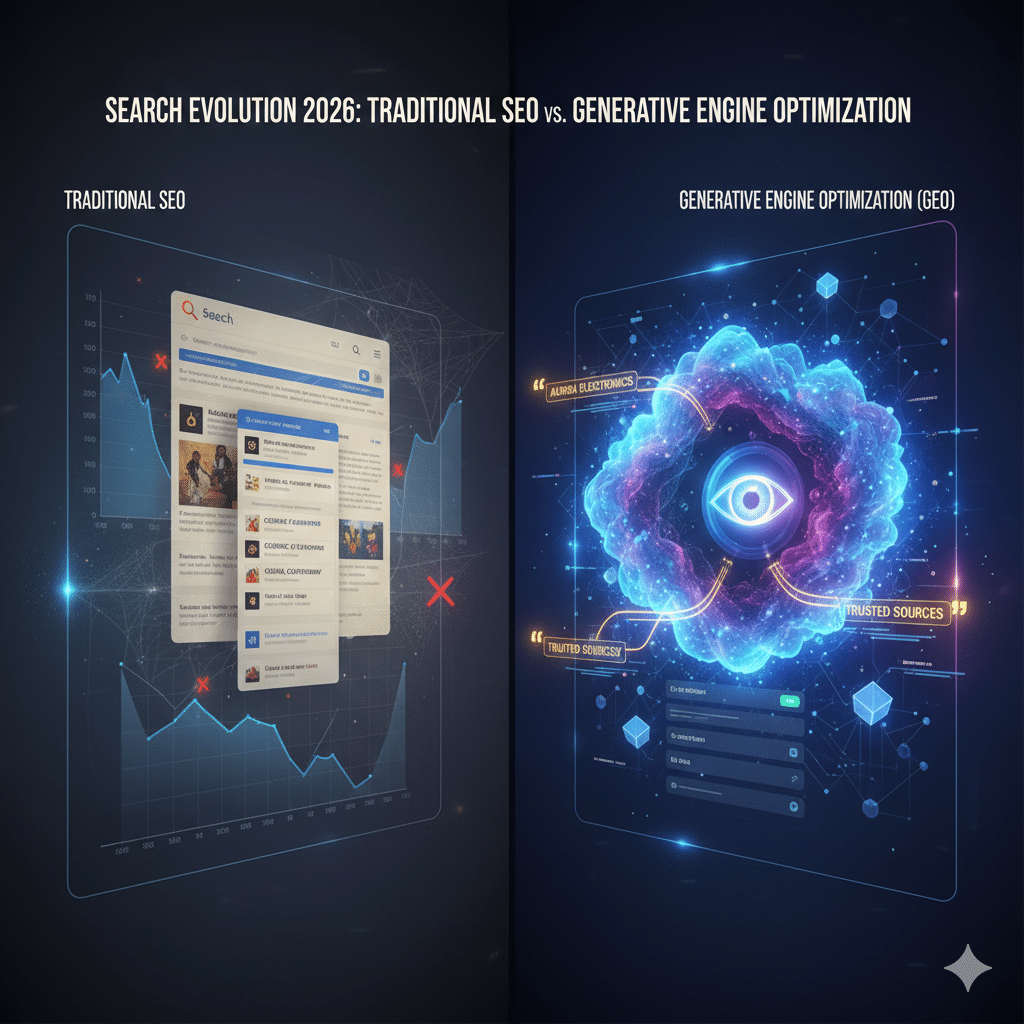
In 2026, the difference between these two worlds is very clear. One is about position, and the other is about interpretation.14 The following table shows how these two strategies compare across the core parts of digital marketing.
| Feature | Traditional SEO | Generative Engine Optimization (GEO) |
| Main Target | Human users browsing a list of blue links 1 | AI models synthesizing many sources into one answer 1 |
| Key Metric | Clicks, impressions, and how high you rank 1 | Citation frequency and brand mention share 1 |
| Content Goal | Get a user to visit your website 8 | Become the information the AI trusts and shares 4 |
| Technical Focus | Keywords, links, and page speed 1 | Structured data, fact density, and semantic depth 8 |
| Typical Query | Short keywords like “best coffee” 17 | Long questions like “which coffee is best for cold brew at home?” 17 |
This shift matters because AI engines are quickly becoming substitute answer engines.5 They satisfy the user’s need right there in the chat. This means your website might get fewer visitors, but the people who do click through are much more likely to buy something. They have already done their research with the AI and are coming to you to finish the job.11
How do you rank in AI Overviews?
To rank in AI Overviews, you must provide a clear and direct answer in the first two sentences of your page. You should use the inverted pyramid style where the most important fact comes first, followed by context, and then detailed steps or examples for the reader.
Google AI Overviews are the summaries that appear at the top of Google searches. They act like a quick answer for the user. To get your site listed there, you have to make the AI’s job easy. You should think of the AI as a busy student who is scanning your page for the right answer. If you hide the answer at the bottom of a long story, the AI will skip you and use a different site.17
The best way to do this is to use question-based headers. If you want to answer a question like “how to fix a leaky pipe,” make that your header. Then, start the next paragraph with a bold sentence that answers the question directly.17 This is called the answer-first method. It helps Google’s AI “lift” your text and place it into the summary box.
We can see that certain patterns work better than others. Longer questions that are about ten words long trigger AI responses nearly 20 percent of the time.17 Short keywords are not as effective. You should focus on the “who, what, when, where, and why” of your topic immediately. If you can explain your point clearly in the first 50 words, you have a much better chance of being cited.17
| Tactic | Action Step | Why It Works |
| Lead with Answers | Put the main point in the first 2 or 3 sentences 17 | AI models have a short focus and want the facts quickly 22 |
| Use Lists | Break steps into bullet points or numbered lists 24 | Lists are easy for machines to read and reassemble into summaries 24 |
| Add Key Takeaways | Put a summary box at the top of your article 17 | It acts as a perfect snippet for the AI to copy 22 |
| Structured Data | Use FAQ and HowTo schema markup 19 | It provides a machine-readable version of your content 8 |
Think of it like writing a news story. A reporter always puts the biggest news in the first paragraph. We call this the lede. In GEO, your lede is what gets you the citation. If your first paragraph is a long story about your childhood, the AI will never find the facts it needs to recommend your brand.23
Why is the search funnel collapsing in 2026?
The search funnel is collapsing because AI engines now handle the entire research stage of a buyer’s journey. Users no longer visit multiple sites to learn about a topic. They stay in the AI chat to research and compare options, only visiting a website when they are ready to buy.
In the past, the marketing funnel had three main parts. The top was for learning, the middle was for comparing, and the bottom was for buying. People would search for “what is a CRM” to learn. Then they would search for “best CRM reviews” to compare. Finally, they would search for a specific brand to buy. Today, the AI does all of that in one conversation.8
Top of funnel traffic is dropping fast because the AI can explain concepts better than a basic blog post.11 This means if you only rely on educational content to get visitors, you are in trouble. You must focus on the bottom of the funnel where people have high intent. These are pages like pricing calculators, comparison tables, and detailed case studies.11
While you might see fewer clicks overall, the quality of those clicks is much higher. Data shows that people arriving from an AI engine have a conversion rate that is nearly ten times higher than standard search.11 They are not just browsing. They are ready to take action. You should treat your website as a repository for these advanced agents who are looking for the final proof they need to make a choice.8
What are the technical pillars of GEO?
The three technical pillars of GEO are expanding your semantic footprint, increasing your fact density, and enhancing your structured data. These pillars ensure that AI engines can mathematically map your content to the problems your customers are trying to solve.
To succeed in 2026, you must understand how AI models see your website. They do not see words the same way we do. They see mathematical points in space called vectors.8 To be visible, your brand must have a strong presence in the areas of that map that relate to your business.
The first pillar is the semantic footprint. This means you should not just focus on one keyword. You need to cover all the related topics and adjacent questions that a user might have.16 AI engines use a trick called query fan-out to turn one user question into many hidden questions. If your site covers all those hidden questions, the AI is more likely to trust you.19
| Technical Pillar | Definition | Key Action |
| Semantic Footprint | The range of topics and terms your site covers 16 | Create topic hubs that connect related guides together 4 |
| Fact Density | The amount of real data and unique info on a page 16 | Add statistics, citations, and proprietary research 16 |
| Structured Data | Code that labels parts of your page for machines 16 | Implement JSON-LD schema for products and authors 19 |
The second pillar is fact density. AI models hate fluff. They want to see hard numbers, dates, and names.16 If you can provide unique data that nobody else has, you gain what we call information gain. This is a huge signal to the AI that your content is worth quoting because it provides new value.16
The third pillar is structured data. This is like a set of labels for the AI. It tells the machine exactly what is a price, what is an author, and what is a review.19 While humans do not see this code, it is the primary source of truth for AI models when they need to verify facts.8
How does Retrieval-Augmented Generation (RAG) work?
Retrieval-Augmented Generation or RAG is the process where an AI engine looks up fresh information from the internet to answer a user’s question. It combines the AI’s learned intelligence with real-time data from your website to provide accurate and up-to-date responses.
Think of it like a librarian and a research assistant. The librarian has a lot of general knowledge but might not know what happened this morning. When you ask a specific question, the librarian sends the assistant to the shelves to find the newest magazines and reports. The librarian then reads those fresh materials and gives you a smart answer based on both their memory and the new data.28
This process is why your content must be fresh. AI engines do not want to give old advice. If your article was written in 2021 but your competitor has an update from 2026, the AI will choose the newer one.30 You should aim to refresh your most important pages at least once a year, or even quarterly for fast-moving topics.31
RAG is the bridge that connects your brand to the AI’s brain. If your site is technically broken or blocks AI crawlers, the assistant cannot find your “magazines.” You must check your robots.txt file to make sure you are not accidentally locking out bots like GPTBot or ClaudeBot.23 If the AI cannot see you, it cannot cite you.
What is the “Inference Advantage” for e-commerce?
The inference advantage is the ease with which an AI model can draw a correct conclusion about your product. It happens when you provide clear, objective specifications that allow the AI to see exactly how your product solves a user’s specific problem without any guesswork.
In the world of online shopping, AI agents are starting to make decisions for people. A user might say, “find me a hiking boot that is waterproof and good for icy trails”.8 If your product page only says the boot is “high quality” and “stylish,” the AI will not know if it fits those specific needs.
To win the inference advantage, you must move away from marketing adjectives. You need to use objective facts. Instead of “waterproof,” use “tested for immersion up to 4 inches for 2 hours.” Instead of “good for ice,” use “features 5mm rubber lugs for extreme grip on frozen surfaces”.8 This level of detail removes data friction.
| Data Type | Marketing Fluff (High Friction) | GEO-Ready Fact (Low Friction) |
| Temperature | “Perfect for winter” | “Rated for temperatures as low as -20°F” 8 |
| Material | “Durable leather” | “1.8mm full-grain Italian leather” 8 |
| Size | “Fits all people” | “Adjustable strap fits wrists from 15cm to 22cm” 34 |
| Speed | “Blazing fast” | “Processes up to 500 transactions per second” 35 |
When the AI can easily calculate that your product meets the user’s requirements, it will recommend your brand with high confidence. This is why building an AI-ready product architecture is the most important move for e-commerce teams in 2026.8 You want to make it impossible for the AI to misunderstand what you are selling.
How do you optimize for the Agentic Web?
Optimizing for the Agentic Web means making your site easy for autonomous AI bots to navigate and use. This requires clean code, logical navigation, and the use of specialized machine-readable files like llms.txt to guide agents to your most important information.
We are moving into an era where AI agents can actually do things for us. They can book a table at a restaurant or buy a new laptop.9 These agents do not look at your site the way a person does. They do not care about your pretty colors or your logo. They only care about the underlying code and the data they can extract.23
If your site is hard for a screen reader to use, it will be hard for an AI agent to use too.36 You should use proper HTML labels for every form and button. If an agent cannot find the “buy” button because it is labeled as a generic image, you will lose the sale. This is why accessibility is now a massive ranking factor for AI systems.36
You should also use new protocols that help agents talk to each other. The Agent Payments Protocol (AP2) allows an AI to pay for things securely on your site.9 The Model Context Protocol (MCP) helps different AI tools share information about what a user likes.9 By adopting these standards, you are telling the world that your business is open for AI commerce.
How can you manage your reputation and hallucinations?
You can manage your brand reputation by performing a prompt audit to see what AI models are saying about you. If an AI “hallucinates” or gives wrong information, you must fix the data at the source by updating your website, schema, and third-party profiles like Wikidata.
AI models are not perfect. Sometimes they get confused and make things up. They might say your company was founded in the wrong year or that you sell products you do not have. This can happen if there is a data void where the AI cannot find enough true facts about you.37
To fix this, you must be proactive. Think of it like a digital doctor’s visit. You should ask different AI models basic questions like “What does my company do?” and check their answers against the truth.37 If you find an error, you need to reinforce the facts. You can do this by publishing a brand-facts.json file on your site that acts as a primary source of truth for the AI.37
| Reputation Risk | Definition | Fix |
| Hallucination | The AI makes up a false fact about your brand 37 | Update Wikidata and publish a brand-facts.json file 37 |
| Data Noise | Conflicting info on the web confuses the AI 37 | Delete old pages and align all social profile info 37 |
| Sentiment Drift | The AI starts describing you in a negative way 13 | Improve reviews on sites like G2 and Trustpilot 38 |
| Entity Confusion | The AI mixes you up with another brand 37 | Use unique identifiers in your schema code 38 |
Consistency is your best friend here. If your website, your LinkedIn, and your news articles all say the same thing, the AI will be much more confident in that information. This reduces the risk of the model inventing its own nonsense to fill the gaps.23
What are the best tools for tracking GEO success?
The best tools for tracking GEO success in 2026 are specialized platforms like Bluefish, Profound, and Otterly.ai. These tools do not just track keywords. They monitor how often your brand is cited in AI conversations and what sentiment the AI uses when talking about you.
Old tools that only show your rank on Google are not enough anymore. You need to see into the black box of the AI engines.40 You need to know if ChatGPT is recommending you or if Gemini is citing your competitors instead. This requires a new category of software often called AI visibility tracking.
The leader for large companies is often Bluefish. It provides a deep look at how your brand is positioned across all major models.41 For smaller teams, Otterly.ai is a great choice because it is affordable and easy to use.7 These tools help you see your brand through the eyes of the machine.
| Tool Category | Example Platforms | Best For |
| Enterprise GEO | Bluefish, Profound AI 41 | Large brands needing deep analytics and safety checks 41 |
| SMB Monitoring | Otterly.ai, Promptmonitor 7 | Small teams wanting to track citations and brand mentions 7 |
| SEO to AI Bridge | Semrush, Ahrefs 41 | Teams already using these tools for traditional SEO 41 |
| Content Optimization | Clearscope, Surfer 41 | Writers who want to make their text more AI-friendly 41 |
The most important number to watch is your Citation Share. This tells you what percentage of the AI’s answers in your niche include a mention of your brand.6 If your share is growing, your GEO strategy is working. If it is shrinking, you need to add more fact density and authority signals to your site.34
How do you build authority for GEO?
Building authority for GEO requires earning mentions from trusted third-party sites, publishing original data, and establishing clear human expertise. AI engines prioritize sources that have a strong digital footprint and are recognized as leaders by other authoritative voices.
AI engines are very careful about who they trust. They do not want to cite a site that has no reputation. This is why the old rules of link building still matter, but they have changed slightly. Now, it is not just about the link itself. It is about the brand mention that comes with it.30
Think of it like building a reputation in real life. If you want to be seen as a great cook, you should win some awards, write a book, and have other famous chefs talk about you. In GEO, this means getting your CEO on famous podcasts, publishing industry reports that other sites link to, and having a verified presence on major platforms like LinkedIn and Reddit.30
Original research is a massive win for authority. When you publish a survey or a study that provides new facts, you become a primary source. AI models love citing primary sources because it makes their answers more credible.16 This is a great way to leapfrog over larger competitors who only publish generic content.
What is a real-world example of GEO success?
A great example of GEO success is a case study from a digital agency called Xponent21. They used GEO tactics to achieve a massive 4,162 percent increase in organic traffic and earned the number one ranking on Perplexity for questions about how to rank in AI search.
Success in 2026 is about being the “chosen” brand. We can see this in how companies like Ring Doorbell improved their visibility. By building aggressive links and focusing on technical data, they moved from page two of search to the top five results for major terms.44 This move also helped them get cited more often by AI shopping assistants who were looking for home security options.
Another example is Canva. They created thousands of optimized landing pages for every type of design template. Each page used clear headers and lists that were easy for AI to parse. Today, they drive millions of visits every month because AI engines consistently point people to their templates as the best solution for quick design tasks.45
These examples show that GEO is not about magic tricks. It is about being the most helpful and clear source on the internet. Whether you are a small local shop or a global tech brand, the principles are the same. You must answer the user’s question better and faster than anyone else.21
What are the common mistakes in GEO?
The most common mistakes in GEO include blocking AI crawlers in your robots.txt file, using too much marketing jargon, and failing to update old content. These errors prevent AI engines from trusting or even finding your information, making your brand invisible in conversational search.
One big mistake is hiding your best info behind a login wall. While privacy is important, AI engines like ChatGPT cannot “log in” to your site. If your best research is hidden, the AI cannot use it to answer questions, and you will miss out on the citation.32 You should consider providing an abstract or a summary of your premium content that is publicly visible to AI bots.
Another mistake is having a slow website. Even though AI engines are doing the reading, they still care about technical performance. If your site takes too long to load, the crawler bot might give up and move to a faster site.21 You should also avoid using too much JavaScript for your main content, as some AI crawlers struggle to read it correctly.19
| Mistake | Consequence | How to Fix It |
| Blocking Bots | Your brand never appears in AI answers 23 | Check robots.txt and allow OAI-SearchBot and others 33 |
| Outdated Facts | The AI cites your competitor with newer info 31 | Update key stats and dates at least once a year 31 |
| Vague Language | The AI cannot understand your specific value 8 | Use hard numbers and clear definitions 8 |
| No Schema | The AI might mix up your facts or ignore them 8 | Use valid JSON-LD code for every page 19 |
How can you adapt your content strategy for 2026?
To adapt for 2026, you should move from high-volume automated content to human-led strategies that prioritize precision and authority. You should focus on creating deep topic hubs rather than many separate posts, ensuring every page serves a specific purpose in an AI-driven journey.
In the old days, some people tried to “win” by publishing hundreds of low-quality articles every month. In 2026, this backfires. AI models are smart enough to recognize generic text and will often ignore it in favor of high-quality, human-crafted pieces.47 You should focus on being the best, not the loudest.
A good strategy is to think in terms of “micro-queries.” These are very specific, detailed questions that show exactly what a user wants.49 Instead of a broad guide to “fitness,” you should write a detailed piece on “how to train for a marathon while working a 50-hour week.” This level of specificity is what AI engines love to cite because it provides a precise answer to a complex prompt.27
Finally, you should make your content modular. Every section of a page should be able to stand on its own as a complete answer.19 This allows the AI to “slice and dice” your content to fit different types of summaries. By making your information easy to extract, you are making it easy for the AI to promote your brand.
Conclusion
The world of search has changed forever. We are no longer just fighting for a spot on a list. We are fighting to be the most trusted and clear voice in a global conversation. Traditional SEO is not dead, but it is no longer enough. You must layer GEO on top of your existing work to stay relevant. This means focusing on facts over fluff, structure over style, and authority over volume. By making your brand easy for AI to understand and cite, you are building an asset that will last for years. The future belongs to the brands that provide the best answers, not just the best keywords.
How has your team started to change your content structure to better suit AI engines like ChatGPT and Google AI Overviews?
Works cited
- GEO vs SEO: Understanding the Evolution of AI-Powered Search – Timmermann Group, accessed February 4, 2026, https://www.wearetg.com/blog/geo-vs-seo/
- SEO vs GEO in 2026: Is Traditional Search Optimization Dead? – nerdbot, accessed February 4, 2026, https://nerdbot.com/2026/01/13/seo-vs-geo-in-2026-is-traditional-search-optimization-dead/
- Best Generative Engine Optimization (GEO) Agency Statistics: USA 2026 – Artios.io, accessed February 4, 2026, https://artios.io/best-generative-engine-optimization-statistics-usa/
- Will Generative Engine SEO Replace Google SEO? Predictions for 2026 – The Ad Firm, accessed February 4, 2026, https://www.theadfirm.net/will-generative-engine-seo-replace-google-seo-predictions-for-2026/
- SEO vs. GEO vs. AEO: Navigating the New Search Landscape for 2026 – Arc Intermedia, accessed February 4, 2026, https://www.arcintermedia.com/shoptalk/seo-vs-geo-vs-aeo-navigating-the-new-search-landscape-for-2026-beyond/
- Generative Engine Optimization FAQs: Your Guide to GEO in 2025, accessed February 4, 2026, https://www.braveheartdigitalmarketing.com/blog-post/generative-engine-optimization-faqs/
- How to Track AI Citations and Measure GEO Success: The 2026 Metrics Guide – Averi, accessed February 4, 2026, https://www.averi.ai/how-to/how-to-track-ai-citations-and-measure-geo-success-the-2026-metrics-guide
- Ecommerce LLM Strategy 2026: Engine Optimization Guide – Presta, accessed February 4, 2026, https://wearepresta.com/ecommerce-llm-the-2026-guide-to-engine-optimization-geo/
- Agentic Commerce: The Complete 2026 Guide for Ecommerce – Charle Agency, accessed February 4, 2026, https://www.charle.co.uk/articles/agentic-commerce/
- Top Agentic AI Protocols for Website Growth in 2026: Essential Guide – Wix.com, accessed February 4, 2026, https://www.wix.com/studio/ai-search-lab/agentic-ai-protocols
- Mentions, citations, and clicks: Your 2026 content strategy, accessed February 4, 2026, https://searchengineland.com/mentions-citations-and-clicks-your-2026-content-strategy-465789
- From SEO to GEO: How 2025 changed search, and what 2026 will demand from brands, accessed February 4, 2026, https://dataintelligence.ro/from-seo-to-geo-how-2025-changed-search-and-what-2026-will-demand-from-brands/
- From SEO to GEO: What Actually Changes for You in 2026? | by Simple AI – Medium, accessed February 4, 2026, https://medium.com/@stahl950/from-seo-to-geo-what-actually-changes-for-you-in-2026-e4050e82538b
- Everything You Need to Know to Build Your GEO Strategy in 2026, accessed February 4, 2026, https://tuatara.co/en/blog/marketing-en/everything-you-need-to-know-to-build-your-geo-strategy-in-2026/
- GEO vs. SEO: A Comparison for 2026 – Pimberly, accessed February 4, 2026, https://pimberly.com/blog/geo-vs-seo-a-comparison-for-2026/
- Generative Engine Optimization Strategies (GEO) for 2026 – Go Fish …, accessed February 4, 2026, https://gofishdigital.com/blog/generative-engine-optimization-strategies/
- How to Rank in Google AI Overviews in 2026? [8 Actionable Methods] – OMNIUS, accessed February 4, 2026, https://www.omnius.so/blog/how-to-rank-in-google-ai-overviews
- AI SEO & GEO Only Work If You Optimize This First (It’s NOT your homepage), accessed February 4, 2026, https://www.youtube.com/watch?v=69ZoyUZGB64
- How to Rank in Google’s AI Overviews: 7 Pro Tips – Semrush, accessed February 4, 2026, https://www.semrush.com/blog/how-to-rank-in-ai-overviews/
- How to Write Content That Will Rank in AI and SEO in 2026: The New Framework – Reddit, accessed February 4, 2026, https://www.reddit.com/r/GenEngineOptimization/comments/1qi30mk/how_to_write_content_that_will_rank_in_ai_and_seo/
- How to Rank in AI Overviews & Zero-Click Results 2026 Guide – Mag Cloud Solutions, accessed February 4, 2026, https://magcloudsolutions.com/2026/01/19/how-to-rank-in-ai-overviews-zero-click-results-2026-guide/
- AI Overview Ranking Guide for 2026 – Sky SEO Digital, accessed February 4, 2026, https://skyseodigital.com/ai-overview-ranking-guide-for-2026/
- How to optimize for AI search | 2026 AEO Guide – Pilot Digital Marketing, accessed February 4, 2026, https://pilotdigital.com/blog/how-to-optimize-for-ai-search/
- How to Rank in Google AI Overviews (2026 Guide) – Wellows, accessed February 4, 2026, https://wellows.com/blog/how-to-rank-in-google-ai-overviews/
- 10 Proven Strategies to Rank in AI Overviews in 2026 – Nudge, accessed February 4, 2026, https://www.nudgenow.com/blogs/rank-ai-overviews-proven-strategies
- GEO in 2026: the best practices I’m already using (and that actually work) – Reddit, accessed February 4, 2026, https://www.reddit.com/r/DigitalMarketing/comments/1qbxm20/geo_in_2026_the_best_practices_im_already_using/
- How to Rank for AI Overviews in 2026 – Keyword.com, accessed February 4, 2026, https://keyword.com/blog/how-to-rank-for-ai-overviews/
- A Simple Analogy to Understand ChatGPT, LLMs, RAG, and AI Agents | by Sonu Tyagi, accessed February 4, 2026, https://sonu-tyagi.medium.com/a-simple-analogy-to-understand-chatgpt-llms-rag-and-ai-agents-cde4e53d62d4
- AI Visibility: 5 Steps to Optimize for AI Search Ranking in 2026 | Data-Mania, LLC, accessed February 4, 2026, https://www.data-mania.com/blog/ai-search-ranking-optimization-steps/
- GEO Best Practices for 2026: Drive LLM Discoverability by Getting SEO, Content Marketing, PR, and Social Media to Work Together, accessed February 4, 2026, https://www.firebrand.marketing/2025/12/geo-best-practices-2026/
- A Guide to Generative Engine Optimization (GEO) Best Practices – Directive Consulting, accessed February 4, 2026, https://directiveconsulting.com/blog/a-guide-to-generative-engine-optimization-geo-best-practices/
- 14 Answers to Common Questions about Generative Engine Optimization (GEO) in 2025, accessed February 4, 2026, https://www.oomphinc.com/insights/geo-optimization-questions-2025/
- GEO & AEO SEO: Generative & Answer Engine Optimization – WRITER, accessed February 4, 2026, https://writer.com/blog/geo-aeo-optimization/
- GEO Strategy Guide: 100 FAQs on Generative Engine Optimization – Vertu, accessed February 4, 2026, https://vertu.com/lifestyle/the-complete-guide-to-generative-engine-optimization-100-critical-questions-answered/
- 11 Generative Engine Optimization (GEO) Best Practices Every Technology Vendor Needs to Know – Solutions Review, accessed February 4, 2026, https://solutionsreview.com/marketing-automation/generative-engine-optimization-geo-best-practices-every-technology-vendor-needs-to-know/
- The Agentic Browser Landscape in 2026: A Complete Guide | No Hacks Podcast, accessed February 4, 2026, https://www.nohackspod.com/blog/agentic-browser-landscape-2026
- How to identify and fix AI hallucinations about your brand – Search Engine Land, accessed February 4, 2026, https://searchengineland.com/guide/fix-your-brands-ai-hallucinations
- Entity Resolution: Fix Brand Hallucinations in LLMs Fast | SearchAtlas, accessed February 4, 2026, https://searchatlas.com/blog/entity-resolution-fix-brand-hallucinations-llms-2026/
- How to Improve Your Brand Visibility in AI Search in 2026 – Mentionlytics, accessed February 4, 2026, https://www.mentionlytics.com/blog/improve-brand-visibility-in-ai/
- GEO: Generative Engine Optimization – Princeton University, accessed February 4, 2026, https://collaborate.princeton.edu/en/publications/geo-generative-engine-optimization
- The Top 10 GEO Platforms of 2026: In-Depth Comparison – Bluefish AI, accessed February 4, 2026, https://www.bluefishai.com/blog/the-10-best-geo-platforms
- The 8 best AI visibility tools in 2026 – Zapier, accessed February 4, 2026, https://zapier.com/blog/best-ai-visibility-tool/
- 8 best AI visibility tracking tools explained and compared, accessed February 4, 2026, https://visible.seranking.com/blog/best-ai-visibility-tools/
- The Best Generative Engine Optimization (GEO) Agencies of 2026 – LSEO, accessed February 4, 2026, https://lseo.com/blog/generative-engine-optimization/the-best-generative-engine-optimization-geo-agencies-of-2026/
- Top SEO Success Stories & Case Studies 2026 | Wix, Canva, Airbnb & More – Glorywebs, accessed February 4, 2026, https://www.glorywebs.com/blog/seo-success-stories-and-case-studies
- GEO 2026 Guide (3/3): Who Wins in AI Search (Case Studies) | by Yevhen Babko – Medium, accessed February 4, 2026, https://medium.com/@yevgo888/geo-2025-2026-a-plain-english-guide-to-visibility-in-ai-search-part-3-8b373c3da886
- 15 Best SEO & GEO Agencies In 2026 – Elementor, accessed February 4, 2026, https://elementor.com/blog/best-seo-geo-agencies/
- The shift from SEO to GEO: What marketers need to know about AI and search | Contentful, accessed February 4, 2026, https://www.contentful.com/blog/seo-geo-shift-marketers-ai-search/
- SEO Trends 2026: GEO, AEO & Future of Search Optimization – Next Olive Technologies, accessed February 4, 2026, https://nextolive.com/blogs/seo-trends-2026-geo-aeo-future-search-ai-search/