
Getting your child to sit still for dental X-rays is a major challenge for many families. Small mouths and wiggly bodies often lead to blurry images and missed cavities that hide between teeth. When we miss decay, it grows into a painful infection that requires scary treatments like crowns or extractions, which causes lots of stress for your child. AI diagnostic tools for pediatric dentistry solve this by acting as a high tech partner for your dentist. These tools find tiny spots of decay and show them to you in bright colors so you can make the best choice for your child’s health. 1
Key Takeaways
- Modern AI software can improve the detection of pediatric dental decay by up to 80% compared to a standard visual exam. 2
- Leading tools like Pearl Second Opinion and Overjet Caries Assist are now FDA cleared for children as young as four years old. 5
- Smart diagnostic systems reduce the need for repeat X-rays, which helps keep radiation exposure for children very low.
- These tools use color coded pictures to help parents and kids understand exactly where the “sugar bugs” are hiding. 7
- New AI models can predict a child’s future risk for cavities based on their diet and genetics before decay ever starts. 10
How do AI diagnostic tools for pediatric dentistry help your dentist?
AI diagnostic tools for pediatric dentistry work like a high tech second set of eyes for your dentist. These systems use smart software to look at dental images and spot tiny signs of decay or growth issues. This helps ensure your child gets a perfect diagnosis every time. 1
The use of artificial intelligence in the dental office helps change the way we look at your child’s mouth. In a normal visit, a pediatric dentist has to look at gray X-rays that are often crowded with baby teeth and permanent teeth. This can be very confusing for the human eye to process during a busy day. Artificial intelligence models are trained on millions of images that were checked by top experts. This training lets the software find the very first signs of a cavity that might be too small for a person to see. 2
Think of it like a smart weather satellite that spots a small storm forming long before it hits the ground. While a person looking at the sky might just see clouds, the satellite uses sensors to find changes in the air. In the same way, the AI looks at the tiny pixels on an X-ray. It finds small changes in the tooth shadows that show a cavity is starting. This is very important for kids because their tooth enamel is thin, and decay can travel to the nerve very quickly. 13
These tools do more than just find holes in teeth. They can also help track how your child’s adult teeth are growing and find extra teeth hidden in the jaw. By providing a neutral and clear report, the AI makes sure every child gets the same high level of care. It removes the guesswork and gives parents peace of mind that nothing was missed during the checkup. 2
| Tool Feature | What It Does | Benefit for Your Child |
| Image Segmentation | Colors in parts of the tooth. | Shows exactly how deep a cavity has gone. |
| Bounding Boxes | Draws boxes around problems. | Points the dentist to the exact spot to check. |
| Color Overlays | Uses red or orange highlights. | Makes it easy for kids to see where to brush. |
| Auto Charting | Records findings in the file. | Saves time and prevents typing errors in records. |
Why is it harder to diagnose children than adults?
Diagnosing children is hard because they have small mouths, mixed teeth, and often struggle to stay still. Kids may move during an X-ray, which causes a blurry picture. Also, having both baby and adult teeth at the same time makes images look very crowded. 2
A child’s mouth is always changing. Between the ages of six and twelve, kids have a mix of baby and adult teeth. This creates a crowded view on an X-ray where one image can have twice as many teeth as an adult X-ray. These teeth often overlap, which creates shadows that look like cavities when they are not. On the other hand, the small size of a child’s mouth makes it hard to place the sensor correctly, which can hide decay that sits between the teeth. 2
The way a child acts also affects the diagnosis. A nervous or wiggly child might not bite down on the sensor the right way. If they move their head, the image comes out blurry. This makes it hard to see tiny problems. In the past, dentists often had to make a guess or take the X-ray again. AI helps solve this because it is very good at reading images that are not perfect. 20
Real World Example In a study of over 1,400 children, dentists used AI to look for teeth growing in the wrong spots. The AI was able to find these issues 86% of the time. This was actually more accurate than three very experienced pediatric dentists who looked at the same images. 14
Which AI diagnostic tools for pediatric dentistry are FDA cleared?
The FDA has cleared several top tools for kids, including Pearl Second Opinion and Overjet Caries Assist. These products are legally approved for use on children as young as four years old. They help dentists find decay and other growth issues with high accuracy. 5
Getting FDA clearance is a very big deal. It means the software has been tested on thousands of cases to prove it is safe and works well. In 2024 and 2025, many new tools reached this goal. Pearl launched a special version of its software just for kids. This version has a kid friendly look and is made specifically to handle the smaller teeth and different growth patterns of children. 1
Overjet also has a special pediatric module that was cleared in early 2024. Many large dental groups use this tool to make sure every office is finding cavities the same way. When a dentist uses an FDA cleared tool, you know they are using a system that has been checked by experts at the government level. 5
| Company | Main Product | Age Group | FDA Status |
| Pearl | Second Opinion for Kids | 4 and up | Cleared Nov 2025 |
| Overjet | Caries Assist – Pediatric | 4 and up | Cleared Mar 2024 |
| VideaHealth | Videa Dental AI | 3 and up | Cleared Sep 2025 |
| Denti.AI | Denti.AI Detect | All ages | Cleared Oct 2023 |
| Velmeni | Velmeni for Dentists | All ages | Cleared Sep 2025 |
How does AI help keep radiation levels low for my child?
AI helps lower radiation by making sure the dentist gets a clear answer from the very first X-ray. Since the software can read images that are a little blurry or dark, there is no need to take the X-ray a second time.
Dentists follow a rule called ALARA, which means “As Low As Reasonably Achievable.” This rule is used to protect children from getting too much radiation. Because children are still growing, we want to use the smallest amount of X-rays possible. Modern digital X-rays already use 90% less radiation than old film, but AI makes them even safer.
Think of it like a smart phone camera that can take a bright picture even in a dark room. The AI uses its software to “brighten” the X-ray and find details without needing more radiation from the machine. If the AI can see a cavity on a low dose image, the dentist does not have to turn up the power or try again. This keeps your child safe and makes the visit go much faster.
Can AI make my child less afraid of the dentist?
AI helps reduce fear by turning the dental visit into a fun, interactive experience. Tools like Virtual Reality and smart apps can distract children or explain what is happening using games and stories so they feel in control.
Many kids are afraid of the dentist because they do not know what is going to happen. AI is now being used with VR headsets to create “digital sedation.” A child can wear a headset and watch a movie or play a game while the dentist works. Some of these systems even track the child’s heart rate. If the AI sees that the child is getting nervous, it can change the music or the game to be more calming.
AI also helps by changing how we talk to kids. Instead of showing a scary gray X-ray, the software can show a colorful map of their teeth. Dentists can use a “tell show do” method where the AI helps explain the tools. For example, the software can show “sugar bugs” on a screen, and the child can watch as the dentist “washes them away.” This makes the child feel like a hero in a game rather than a patient in a chair.
How do AI diagnostic tools for pediatric dentistry help parents?
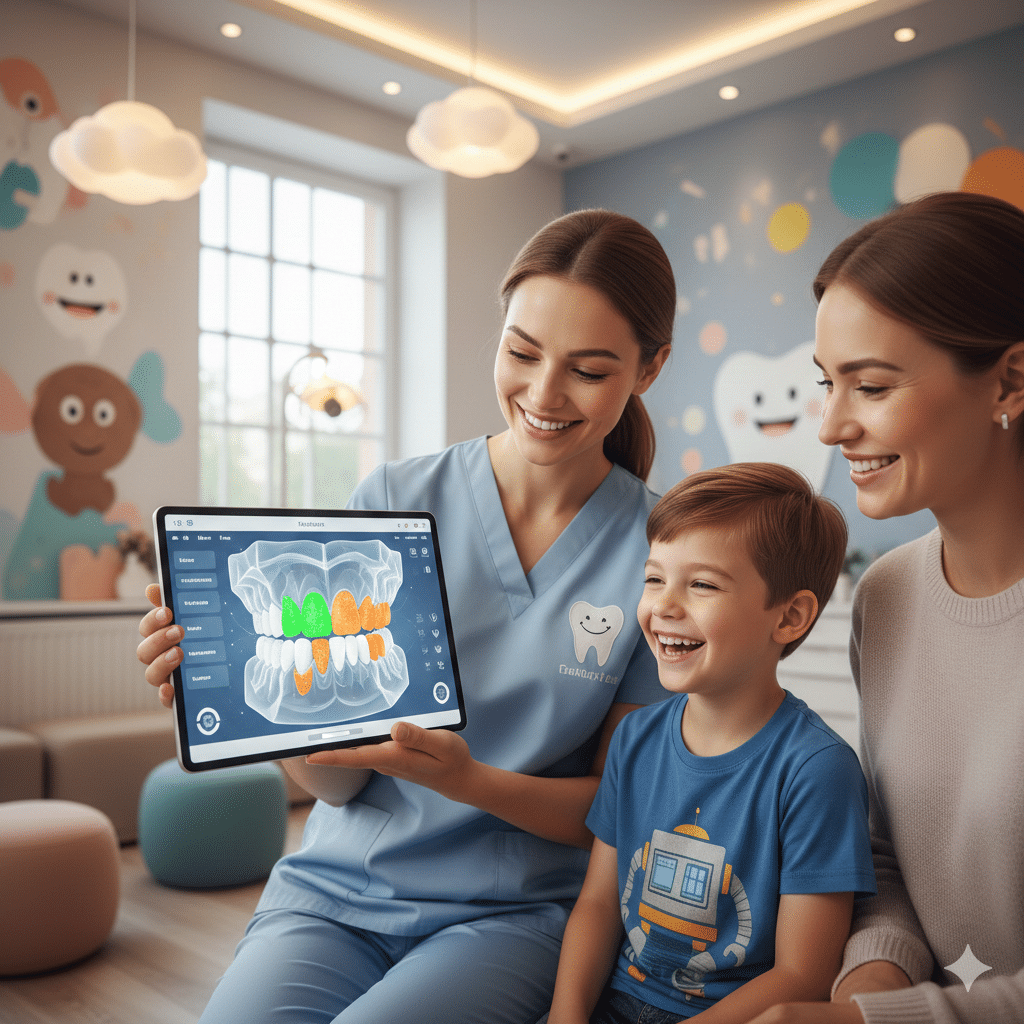
AI helps parents by showing them exactly what the dentist sees in a way that is easy to understand. Instead of just taking the dentist’s word for it, you can see the evidence on a screen with clear color highlights.
For many parents, looking at a dental X-ray is like looking at a blurry map. It can be hard to tell if a shadow is a real cavity or just part of the tooth. AI acts as a translator. It colors in the different parts of the tooth so you can see the problem for yourself. When you see a red box around a cavity, it is much easier to understand why your child needs a filling.
This clear proof helps build trust between you and the doctor. Research shows that parents are 20% more likely to agree to a treatment when they see AI results. It helps you feel sure that you are making the right choice for your child’s health. It also helps you save money by catching problems when they are small and easy to fix, before they turn into expensive emergencies.
Real World Example
A study showed that when parents were shown AI images during a visit, they understood the need for care much faster. This shortened the time spent talking about the problem and let the team focus more on making the child comfortable.
Is AI more accurate than a human dentist?
AI is not meant to replace your dentist, but it is excellent at finding tiny details that humans might miss. Clinical tests show that AI finds about 80% more cavities in kids than a standard visual checkup alone. 2
A dentist is a doctor who cares for your child, while AI is a tool that helps them work. Humans can get tired or distracted after seeing many patients in one day. AI never gets tired and looks at every X-ray with the same focus. It is especially good at finding decay in primary teeth, which have very thin enamel and can be hard to read on a screen. 11
| Task | AI Accuracy | Why It Matters |
| Finding Cavities | 80% improvement | Catches decay before it causes pain. |
| Finding Extra Teeth | 94% Sensitivity | Prevents crowding in adult teeth. |
| Mixed Tooth Naming | 98% Accuracy | Keeps dental records perfect for every child. |
| Growth Tracking | 86% Sensitivity | Helps plan for braces at the right time. |
By using AI, your dentist has a safety net. If they miss a tiny spot because of a shadow, the AI will flag it. This teamwork between the human doctor and the smart software provides the most accurate diagnosis possible for your child.
How can AI help with better brushing at home?
Smart toothbrushes and apps use AI to track how your child brushes and give them instant rewards. These tools show kids exactly which teeth they missed, turning a boring chore into a fun game with badges and points.
One of the hardest jobs for a parent is making sure their child brushes every tooth for two minutes. Smart brushes connect to a phone or tablet. As the child brushes, an AI character on the screen might fight “plaque monsters” in the same spot the child is brushing. This teaches them the right technique while they have fun.
For you, the AI provides a “report card.” You can check the app to see if your child is missing their back teeth or brushing too hard. This lets you give them helpful tips without having to watch them every single second. Many dentists can now look at this data during a checkup to give your child a personalized cleaning plan.
As a parent, which of these AI tools would make you feel most comfortable during your child’s next dental visit? Let us know in the comments!
Works cited
- Pearl – Press Release | Pearl Expands Pediatric Capabilities with …, accessed February 25, 2026, https://hellopearl.com/news/pearl-expands-pediatric-capabilities-with-second-opinion-r-for-kids
- AI in Pediatric Dentistry: Shaping the Future of Children’s Dental …, accessed February 25, 2026, https://www.videa.ai/blog-posts/ai-in-pediatric-dentistry-shaping-the-future-of-childrens-dental-care
- AI in Pediatric Dentistry | AMN Healthcare, accessed February 25, 2026, https://www.amnhealthcare.com/blog/dentist/ai-in-pediatric-dentistry-a-guide-for-dentists/
- Best AI Dental Software in 2025: Top Tools for Clinics | scanO, accessed February 25, 2026, https://scanoai.com/blog/best-ai-dental-software-in-2025-top-tools-for-clinics
- FDA-Approved AI Solutions in Dental Imaging: A Narrative Review of Applications, Evidence, and Outlook – PMC, accessed February 25, 2026, https://pmc.ncbi.nlm.nih.gov/articles/PMC12775797/
- Artificial Intelligence in Pediatric Dentistry: A Systematic Review and Meta-Analysis – PMC, accessed February 25, 2026, https://pmc.ncbi.nlm.nih.gov/articles/PMC12839933/
- Pearl’s Second Opinion expanded with kids capabilities | DrBicuspid.com, accessed February 25, 2026, https://www.drbicuspid.com/clinical/treatment-software/ai/article/15773158/pearls-second-opinion-expanded-with-kids-capabilities
- Enhancing Dental Patient Education with AI | VideaHealth Blog – Videa.ai, accessed February 25, 2026, https://www.videa.ai/blog-posts/beyond-words-videahealths-ai-and-the-future-dental-patient-education
- The role of artificial intelligence in diagnosing pediatric dental disorders—a narrative review, accessed February 25, 2026, https://pmc.ncbi.nlm.nih.gov/articles/PMC12907376/
- Smart Care in Kids Dentistry 2025: How Technology Is Revolutionizing Children’s Dental Health, accessed February 25, 2026, https://www.littlekidsdentistry.com/smart-care-2025-smart-tech-dental-care/
- AI Applications in Dentistry: Smarter Care, Better Smiles in 2025 – kidskarepc, accessed February 25, 2026, https://kidskarepc.com/blog/ai-applications-in-dentistry-smarter-care-better-smiles-in-2025/
- AI, Phone Photos, and the Future of Cavity Prevention – Little Kids Dentistry, accessed February 25, 2026, https://www.littlekidsdentistry.com/ai-phone-photos-and-the-future-of-cavity-prevention/
- Dental caries detection with Pearl AI, accessed February 25, 2026, https://hellopearl.com/blog/topic/dental-caries-detection-with-ai-pearl
- The role of artificial intelligence in diagnosing pediatric … – Frontiers, accessed February 25, 2026, https://www.frontiersin.org/journals/dental-medicine/articles/10.3389/fdmed.2025.1685359/full
- Best AI Software for Dental Offices to Improve Operations – Whippy AI, accessed February 25, 2026, https://www.whippy.ai/ai-software/best-ai-software-for-dental-offices
- The growth of AI in dental radiology – Pearl Dental AI Blog, accessed February 25, 2026, https://hellopearl.com/blog/the-growth-of-ai-in-dental-radiology
- Bridging smiles: AI-driven dental health awareness for the next gen—a systematic review, accessed February 25, 2026, https://www.frontiersin.org/journals/dental-medicine/articles/10.3389/fdmed.2025.1639572/full
- Artificial Intelligence-Enabled Medical Devices – FDA, accessed February 25, 2026, https://www.fda.gov/medical-devices/software-medical-device-samd/artificial-intelligence-enabled-medical-devices
- Pediatric Dental X-Rays: Safety, Frequency, and Benefits, accessed February 25, 2026, https://uchidapediatricdds.com/pediatric-dental-x-rays-safety-benefits
- The Rise of AI in Pediatric Dentistry | How AI is Transforming Kids’ Dental Care, accessed February 25, 2026, https://www.springfielddentalkids.com/blogs/rise-of-ai-in-pediatric-dentistry
- Why Digital X-Rays Are a Safer Option for Kids – Pediatric Dentist Hutto, accessed February 25, 2026, https://pediatricdentisthutto.com/why-digital-x-rays-are-a-safer-option-for-kids-4/
Decoding Kids’ Dentistry: From Ancient Remedies to AI-Powered Smiles! – Kid Dental Studio, accessed February 25, 2026, https://antiochkidsdentist.com/decoding-kids-dentistry-from-ancient-remedies-to-ai-powered-smiles/