
Introduction: Welcome to the Future of Care (AI in Healthcare)
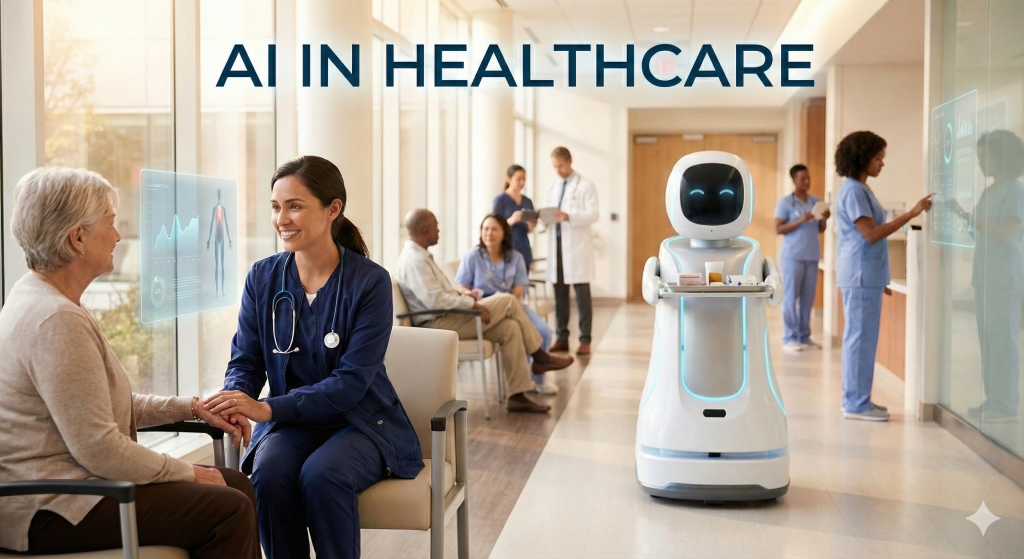
The year is 2026. You might have noticed that your last doctor’s visit felt a little different. Maybe your doctor spent more time looking at you and less time typing on a computer screen. Maybe you received a reminder from an app that seemed to know exactly how you were feeling before you even said a word. Or perhaps you saw a friendly robot gliding down the hospital hallway delivering medicine. This is not science fiction anymore. This is the new reality of healthcare.
Artificial Intelligence, or AI, has moved beyond the buzzwords we heard back in 2023 and 2024. It is now a real working part of how we stay healthy. It has put on its work boots.1 From the massive servers processing medical records to the physical robots helping nurses lift patients, AI is everywhere. But what does that actually mean for you as a patient? What does it mean for the doctors and nurses taking care of you? And is it safe?
In this comprehensive guide, we will explore exactly what AI in healthcare looks like today. We will look at the amazing benefits that are saving lives right now. We will also look honestly at the risks that keep experts awake at night. We will break it all down simply so you can understand the technology that is shaping your health.
Part 1: Understanding the Basics
What Exactly Is AI in Healthcare?
AI in healthcare is the use of smart computer programs and machines to perform tasks that typically require human intelligence, such as diagnosing diseases, creating treatment plans, and even performing physical tasks in hospitals.
When we talk about AI in 2026, we are not just talking about one single thing. We are talking about a collection of technologies that work together. It includes computer programs that can read and write like humans. It includes robots that can see and move through the physical world. It includes complex math systems that can find patterns in data that no human could ever see.
Think of it like…
Imagine you have a team of thousands of medical students who have memorized every medical textbook in the world, can read X-rays in milliseconds, and never get tired or need a coffee break. That is what AI acts like for a doctor. It does not replace the doctor. It gives the doctor a superpower to see more, know more, and do more.
In the past, AI was mostly about “generating” things. You might remember when ChatGPT first came out and people used it to write poems or emails. That was called Generative AI. In 2026, we have moved to something called Agentic AI.2
Think of it like…
Generative AI is like a writer. You ask it to write a letter, and it writes it. Agentic AI is like a smart personal assistant. You tell it to “handle the insurance claim,” and it doesn’t just write the letter. It logs into the website, uploads the document, waits for a response, and fixes any errors without you having to help it. It takes action.
We also have Physical AI.1 This is when the brain of the AI is put inside a robot body. This allows the AI to do chores, move boxes, or help you get out of bed. It is the bridge between the digital world of code and the real world of atoms.
How Is AI Different from Standard Computer Programs?
Standard computer programs follow a strict set of rules written by a human, while AI learns from data to make its own decisions and predictions.
A normal computer program is like a recipe. If you follow the steps exactly, you get the same result every time. If step one is “add sugar,” the computer adds sugar. It cannot decide to add honey instead because it thinks you might like it better.
AI is different because it learns. It looks at millions of examples and figures out the rules for itself. If you show an AI millions of pictures of skin rashes, it learns to identify a rash not because a human told it “look for red spots,” but because it learned what a rash looks like by seeing so many of them.5
Think of it like…
A standard program is like a calculator. It only knows that 2 plus 2 equals 4 because it was programmed that way. AI is like a student learning to play the piano. At first, it might make mistakes. But after practicing for thousands of hours, it can play beautiful music that it was never explicitly taught to play. It understands the “feeling” of the music, not just the notes.
This ability to learn is why AI is so powerful in healthcare. Human bodies are complicated. We are all different. A strict rule that works for one person might not work for another. AI can look at your specific data—your genetics, your lifestyle, your medical history—and find the pattern that fits you perfectly. This is called Precision Medicine.6
What Are the Main Types of AI Used in 2026?
The main types of AI used today are Machine Learning for finding patterns, Natural Language Processing for understanding speech and text, and Physical AI for robotics.
To understand the healthcare of 2026, you need to know three key terms. Do not worry. We will keep it simple.
- Machine Learning (ML): This is the engine of AI. It is the part that crunches numbers and finds patterns. In hospitals, ML is used to predict things. It can predict if a patient is getting sicker. It can predict if a tumor is cancerous. It is the crystal ball of medicine.6
- Natural Language Processing (NLP): This is the part of AI that understands human language. Doctors write a lot of notes. They talk to patients for hours. NLP listens to these conversations and reads these notes. It turns messy human talk into organized data. It is the reason your doctor can look at you instead of typing. The AI is listening and writing the notes for them.6
- Physical AI (Robotics): This is the newest and most exciting trend in 2026. These are robots equipped with AI brains. They can navigate busy hospital hallways without bumping into people. They can deliver medicine. They can even help perform surgery with superhuman precision.1
Think of it like…
If the hospital were a construction site, Machine Learning would be the architect drawing the plans. Natural Language Processing would be the translator helping workers from different countries understand each other. And Physical AI would be the heavy machinery lifting the steel beams.
| AI Type | What It Does | Example in Healthcare |
| Machine Learning | Finds patterns and predicts outcomes | Predicting which patients might get sepsis 9 |
| Natural Language Processing | Understands and speaks human language | Writing doctor’s notes automatically 9 |
| Physical AI | Moves and acts in the real world | Robots delivering medicine to hospital rooms 10 |
Part 2: The Major Benefits of AI in Healthcare
How Does AI Help Reduce Doctor Burnout?
AI reduces burnout by automating the boring, repetitive administrative tasks that used to take up hours of a doctor’s day.
For a long time, doctors and nurses were drowning in paperwork. They spent more time filling out forms than treating patients. This led to “burnout,” where medical professionals were exhausted, stressed, and unhappy. In 2026, AI has come to the rescue.
The biggest game-changer is Ambient Documentation.9 Imagine a doctor walks into your room. There is no computer in front of them. They just sit down and talk to you. A secure AI app on their phone listens to the conversation. It filters out the chit-chat about the weather. It picks out the medical facts. Then it writes a perfect medical note for the patient’s file.
This saves doctors an average of 14 minutes for every single note they write. That might not sound like much, but it adds up to hours every week. It means doctors can go home to their families on time. It means they are not typing in their pajamas at midnight.
Think of it like…
Imagine if a chef had to stop cooking every five minutes to write a detailed report about how they chopped the onions. The food would burn, and the chef would be miserable. AI is like a secretary standing in the kitchen taking notes so the chef can focus entirely on cooking a delicious meal.
Surveys show that 45% of wound care professionals say AI is the most effective technology for reducing their burnout.11 By handling the paperwork, AI lets doctors be doctors again. It brings the “human” back into healthcare by taking the “robot” work away from humans.11
Can AI Really Detect Diseases Better than Humans?
Yes, in many specific cases, AI can detect early signs of diseases like cancer and heart conditions more accurately and much earlier than human doctors can.
Humans are amazing, but we have limits. Our eyes can only see so much detail. Our brains can only remember so many patterns. AI does not have these limits. It can look at an X-ray or a CT scan and see tiny variations in pixel color that a human eye would miss.
In 2026, we have AI models like MUSK from Stanford Medicine.12 This AI was trained on over 50 million medical images. It can predict how a patient’s cancer will progress better than standard methods. It can look at a biopsy and tell if immunotherapy will work for that specific patient.
Here are some real examples of AI saving lives through better detection:
- Heart Failure: At Mayo Clinic, an AI tool looks at simple heart tests (ECGs) and spots weak heart pumps that doctors might miss. This led to a 32% increase in catching heart problems early.9
- Sepsis: Sepsis is a deadly infection response that kills many people in hospitals. It moves fast. A system called Bayesian Health uses AI to watch patients 24/7. It caught 46% more sepsis cases than doctors did on their own, and it did it hours earlier. That extra time saves lives.9
- Pancreatic Cancer: This is a very hard cancer to find early. New AI tools are analyzing images to find risks of pancreatic cancer before it becomes untreatable.13
Think of it like…
Trying to find a tiny crack in a massive bridge is hard for a human inspector. They might miss it. AI is like using a special laser scanner that checks every inch of the bridge instantly and highlights the microscopic cracks in bright red.
It is important to remember that AI is not working alone. It is a “second set of eyes.” The doctor still makes the final call, but the AI makes sure they have all the information they need.
How Is AI Helping Patients at Home?
AI is enabling “Zero Labor Homes” where smart robots and sensors help care for patients, especially the elderly, allowing them to live independently for longer.
One of the biggest trends in 2026 is moving care out of the hospital and into the home. Hospitals are expensive and can be uncomfortable. Most people prefer to be in their own beds. AI makes this safe.
We now have robots like CLOiD from LG.14 This is a smart robot that wanders around the home. It learns the user’s habits. It can tell if you have fallen. It can remind you to take your pills. It acts like a live-in nurse who is always on duty.
This is part of a concept called Ambient Intelligence.15 The house itself becomes smart. Sensors can track your breathing and heart rate without you touching anything. If something looks wrong, the AI alerts a doctor immediately.
Think of it like…
having a guardian angel watching over you. You don’t see it or feel it, but if you stumble, it is there to catch you or call for help.
This is especially important for our aging population. There are not enough human caregivers to look after everyone. AI robots and sensors fill that gap. They provide “Physical AI” help, like carrying things, and “social” help, like talking to keep people company.14
What Is the “Agentic” Revenue Cycle and Why Does It Matter?
Agentic AI automates the complex financial side of healthcare, ensuring hospitals get paid correctly so they can afford to keep treating patients.
This might sound boring, but it is critical. Healthcare involves a lot of money and confusing rules. When you visit a doctor, a complex dance happens to get your insurance to pay for it. If there is a single mistake in the code, the insurance company denies the claim.
In 2026, we use Agentic AI to handle this. These are not just chatbots. They are autonomous agents. They review the doctor’s notes and the insurance rules. They find the mistakes before the claim is sent. If a claim is denied, the AI agent can even write an appeal letter, log into the insurance portal, and fight for the payment.17
This helps hospitals reduce “denials” (when insurance says no) by over 60%.9 This saves billions of dollars. That is money that can be spent on new machines, better nurses, and lower costs for patients.
Think of it like…
Imagine you have a super-lawyer who reads every line of your insurance contract and argues with the insurance company for you every time they try to not pay a bill. And this lawyer does it for free, instantly, for every single patient.
Part 3: Real-World Examples and Success Stories
Who Is Lauren Bannon and How Did AI Save Her Life?
Lauren Bannon is a patient whose thyroid cancer was detected by ChatGPT after human doctors repeatedly misdiagnosed her symptoms as simple acid reflux.
Stories like Lauren’s are becoming more common in 2026. Lauren was a 40-year-old mother who felt terrible. She had pain. She was losing weight. Her human doctors told her it was just acid reflux or maybe arthritis. They gave her pills and sent her home. But she knew something was wrong.
Desperate for answers, she turned to ChatGPT. She typed in all her symptoms. The AI suggested it might be Hashimoto’s disease, a thyroid condition. She went back to her doctor and insisted on a test. The AI was right. She had the condition. This led to further scans which found two cancerous lumps in her neck.19
Because of the AI, she caught the cancer. She credits the technology with saving her life. This shows the power of the “Second Opinion Economy.” Patients are no longer passive. They are using AI to check their doctors’ work.
Think of it like…
Using a spell-checker on an essay. The writer (the doctor) is smart, but sometimes they make a typo or miss a word. The spell-checker (the AI) catches the mistake before the essay is turned in.
What Is Moxi the Robot Doing in Hospitals?
Moxi is a hospital robot that delivers medicine, lab samples, and supplies so that nurses can stay with their patients instead of running errands.
If you visit a hospital in 2026, you might see a robot named Moxi rolling down the hall. Moxi has a head, eyes, and an arm. It is friendly and polite. But it is a hard worker.
Moxi robots have completed over 300,000 deliveries in US hospitals.10 Before Moxi, if a patient needed a specific medicine from the pharmacy, a nurse had to leave the patient’s room, walk all the way to the pharmacy, wait, and walk back. This is the “Last Mile” problem. It wastes thousands of hours of nursing time.
Now, Moxi does the running. It can even handle secure medicines like chemotherapy drugs because it has locking drawers.10
Think of it like…
Moxi is the ultimate “gofer.” In a restaurant, you have waiters who talk to customers and runners who just carry food. Moxi is the runner. It does the heavy lifting so the nurses (the waiters) can focus on making the customers (patients) happy and healthy.
This reduces nurse burnout and makes the hospital run smoother. Nurses love Moxi because it gives them their time back.
Are There Other Robots Helping Out?
Yes, industrial giants like Hyundai, Samsung, and Tesla are building humanoid robots to perform heavy lifting and support tasks in healthcare settings.
At the big technology show CES 2026, we saw the rise of Physical AI. Companies that used to make cars are now making healthcare robots.
- Tesla Optimus Gen 2: This is a humanoid robot that looks like a person. It is being tested to do heavy tasks, like lifting waste bins or moving heavy equipment.20
- 1X NEO: This is a softer, lighter robot designed to be safe around people. It is built for home help and basic hospital tasks. It can open doors and pick up objects.20
These robots are becoming cheaper. Experts think they will soon cost between $13,000 and $17,000.21 That is affordable for many clinics.
Think of it like…
The industrial revolution for hospitals. Just as machines took over the hard physical labor in factories 100 years ago, smart robots are now taking over the hard physical labor in hospitals.
Part 4: The Risks and Challenges (The Scary Stuff)
What Is “Shadow AI” and Why Is It Dangerous?
Shadow AI is when doctors or staff use unauthorized AI tools, like pasting patient notes into a public chatbot, which creates huge privacy and security risks.
This is a massive problem in 2026. Doctors are busy. They want to finish their work. Sometimes, they find a free AI tool online that helps them write notes faster. They copy a patient’s private medical history and paste it into the tool.
The problem? That tool might not be secure. The data might be saved on a server in another country. It might be used to train the next version of the AI. This is a privacy disaster. In 2024 alone, data breaches exposed over 274 million records, and Shadow AI makes this easier.22
It is called “Shadow” because it happens in the dark, without the hospital’s IT department knowing. It also opens the door to hackers. If the AI tool is fake or hacked, it can steal the doctor’s passwords.
Think of it like…
Giving your house keys to a stranger you met on the street because they offered to carry your groceries. It seems helpful in the moment, but you have just compromised the safety of your entire home.
Hospitals are fighting this by creating “AI Safe Zones.” These are secure, approved playgrounds where staff can use AI tools safely without the data ever leaving the hospital’s control.23
Are Doctors Forgetting How to Be Doctors?
There is a growing fear of “Clinical Deskilling,” where young doctors rely so much on AI that they lose the ability to diagnose patients on their own.
If an AI always tells you the answer, do you ever really learn the subject? This is the fear. A study published in The Lancet found that when doctors used an AI to help find polyps during colonoscopies, their ability to find them without the AI got worse. Their unassisted detection rate dropped from 27% to 22% after just three months.24
This is the “Autopilot Effect.” Pilots who fly mostly on autopilot sometimes struggle when they have to fly the plane manually in an emergency. We worry the same will happen to doctors. If the AI system crashes, can the doctor still save the patient?
Over 57% of clinicians are worried about this erosion of skills.25
Think of it like…
Using a GPS to drive everywhere. After a while, you forget how to read a map or navigate your own neighborhood. If your phone battery dies, you are lost. We cannot afford for our doctors to be “lost” without their AI.
To fix this, medical schools are changing how they teach. They are teaching “AI collaboration.” They are forcing students to practice without AI, just like pilots practice flying manually in simulators.
What About Privacy and Bias?
There are significant concerns about who owns the data used to train these models and whether the AI is fair to all types of people.
AI learns from data. If the data comes mostly from one group of people (for example, white men), the AI will be really good at treating white men and not so good at treating women or people of other races. This is called Algorithmic Bias.
In 2026, we are working hard to fix this. But it is still a risk. There is also the issue of Data Sovereignty. Who owns your medical data? Is it the hospital? You? Or the big tech company that built the AI?.26
Indigenous communities and developing nations are especially worried that their data will be taken and used to build products they cannot afford. This is a new form of digital exploitation.27
Think of it like…
If a chef only learned to cook by tasting food from one country, they would be a terrible cook for anyone from a different culture. AI needs to taste “food” (data) from everywhere to be a good doctor for everyone.
Part 5: Future Trends and What Comes Next
Will AI Replace Doctors?
No, AI will not replace doctors, but doctors who use AI will replace doctors who do not.
This is the most common saying in the industry for a reason. AI is a tool. It handles the data, the paperwork, and the patterns. But it does not have empathy. It cannot hold a dying patient’s hand and offer comfort. It cannot understand the subtle emotional nuance of a family’s fear.
The future is Augmented Intelligence. This means the human and the machine working together. The machine does the calculation; the human does the caring.
By 2030, we expect to see the “Iron Triangle” of healthcare broken. Usually, you can only have two of three things: Access, Quality, or Low Cost. With AI, we might finally have all three. We can lower costs with automation, improve quality with precision diagnostics, and improve access with digital tools that reach remote areas.
What Is the “Second Opinion” Economy?
Patients are becoming active participants in their care, using consumer AI tools to check diagnoses, research treatments, and advocate for themselves.
With 40 million people using AI for health questions daily 28, the power dynamic has shifted. Patients are walking into clinics with AI-generated dossiers. They are asking harder questions.
This is a good thing. It catches errors. But it also means doctors have to be better communicators. They have to explain why the AI might be wrong, or admit when it is right. It is a partnership.
What Is Next for Robotics?
We will see more specialized robots that can perform complex tasks, from surgery to home cleaning, becoming a standard part of our infrastructure.
The “Zero Labor Home” is the goal.14 Imagine a home where the robot does the laundry, cooks healthy meals based on your doctor’s plan, and cleans the house to prevent asthma triggers. This is the ultimate preventative medicine. It stops you from getting sick in the first place.
Key Takeaways
- AI Has Evolved: We have moved from simple chatbots (Generative AI) to smart agents that do work for us (Agentic AI) and robots that move in the real world (Physical AI).
- Burnout Buster: The biggest immediate win for AI is saving doctors time. Ambient documentation saves hours of typing, letting doctors focus on you.
- Life-Saving Detection: AI tools like MUSK and Bayesian Health are catching cancers and infections earlier than humanly possible, saving lives every day.
- Robots are Here: Robots like Moxi are solving hospital logistics, and home robots like CLOiD are making independent aging possible.
- Beware of Shadows: “Shadow AI” is a major security risk. Using unapproved tools puts patient data in danger.
- Don’t Forget the Human: We must be careful not to let doctors lose their skills (Deskilling). AI is a teammate, not a replacement.
- Patient Power: You have more power than ever. Use AI to educate yourself, but always verify with a professional.
Final Thoughts
The year 2026 is a turning point. We are no longer just talking about what AI could do. We are seeing what it is doing. It is delivering pills. It is writing notes. It is finding cancer.
It is messy. There are risks. We have to be careful about privacy and skills. But the potential is undeniable. AI offers us a chance to build a healthcare system that is more efficient, more accurate, and ironically, more human. By giving the robot jobs to the robots, we let the humans get back to the work of caring.
So the next time you see a robot in the hallway or your doctor speaks into their phone instead of typing, do not worry. It is just the system getting an upgrade. And it is an upgrade that might just save your life.
Statistical Appendix: The Numbers Behind the Trends
To give you a clearer picture of the impact, here are the key statistics driving the AI healthcare revolution in 2026.
| Statistic | Description | Implication |
| 300,000+ | Deliveries by Moxi robots in US hospitals 10 | Nurses are spending less time running errands and more time with patients. |
| 40 Million | Daily users asking ChatGPT health questions 28 | Patients are self-triaging on a massive scale, often outside clinic hours. |
| 45% | Wound care pros citing AI as best for burnout 11 | The technology is successfully addressing the mental health crisis in healthcare workers. |
| 14 Minutes | Average time saved per note with Ambient AI 9 | This aggregates to hours per week, reducing “pajama time” charting. |
| 63-75% | Reduction in claim denials with Agentic AI 9 | Hospitals are losing less money to administrative errors. |
| 46% | Increase in sepsis detection by Bayesian Health AI 9 | Significant improvement in catching deadly infections early. |
| 274 Million | Records exposed in 2024 breaches 22 | The risk of data insecurity is real and growing, highlighting the Shadow AI danger. |
| 57% | Clinicians worried about deskilling 25 | The medical community is aware of the risk of relying too much on technology. |
Deep Dive: How AI is Changing Specific Medical Fields
Cardiology (Heart Health)
AI is acting like a super-sensitive stethoscope. It analyzes ECGs (heart rhythm charts) to find “silent” problems.
- The Innovation: AI algorithms detecting low ejection fraction (a weak heart pump).
- The Result: A 32% increase in diagnosis at Mayo Clinic.9
- Why it matters: Identifying this early prevents heart attacks and heart failure later.
Oncology (Cancer Care)
AI is becoming the ultimate detective for finding hidden cancers.
- The Innovation: Multi-cancer early detection and AI-enhanced imaging.
- The Result: Detection of pancreatic cancer precursors and aggressive breast cancer types that humans often miss.13
- Why it matters: Cancer caught at Stage 1 is often curable. Cancer caught at Stage 4 often is not. AI shifts diagnosis to Stage 1.
Logistics and Operations
AI is the traffic controller for the hospital.
- The Innovation: Predictive analytics for patient flow.
- The Result: Predicting ambulance needs with 80% accuracy in some studies.27
- Why it matters: This ensures that when you arrive at the ER, there is a bed and a doctor ready for you, because the system knew you were coming.
Home Health and Aging
AI is the live-in caregiver.
- The Innovation: Ambient sensing and humanoid robots (CLOiD, NEO).
- The Result: Continuous monitoring of falls, vitals, and medication adherence without intrusive cameras.15
- Why it matters: It allows dignity for the elderly, letting them stay in their own homes rather than moving to nursing facilities.
This report was synthesized from industry data, expert insights, and technological trends current as of early 2026. The landscape is moving fast, but the direction is clear: Intelligence is moving from the screen to the physical world, and healthcare will never be the same.
Works cited
- 5 Not-to-Miss Tech Trends and Events Defining CES 2026, accessed January 8, 2026, https://www.latimes.com/b2b/ai-technology/story/2026-01-06/ces-2026-physical-ai-robotics-quantum-computing-trends
- What Is AI in Healthcare? – Arm, accessed January 8, 2026, https://www.arm.com/glossary/ai-in-healthcare
- Healthcare Agentic AI: Benefits & Use Cases | Salesforce, accessed January 8, 2026, https://www.salesforce.com/healthcare-life-sciences/healthcare-artificial-intelligence/healthcare-agentic-ai/
- CES 2026: Robots Bring AI into the Physical World, accessed January 8, 2026, https://invidis.com/news/2026/01/ces-2026-robots-bring-ai-into-the-physical-world/
- AI in Healthcare: Uses, Examples & Benefits | Built In, accessed January 8, 2026, https://builtin.com/artificial-intelligence/artificial-intelligence-healthcare
- Artificial Intelligence (AI) in Healthcare & Medical Field, accessed January 8, 2026, https://www.foreseemed.com/artificial-intelligence-in-healthcare
- Machine Learning vs. Natural Language Processing Explained – DigitalOcean, accessed January 8, 2026, https://www.digitalocean.com/resources/articles/machine-learning-vs-natural-language-processing
- Robotics & Physical AI: A New Era in Automation – Global X ETFs, accessed January 8, 2026, https://www.globalxetfs.com/articles/robotics-and-physical-ai-a-new-era-in-automation
- 5 Leading Hospitals That Use AI in 2025 for Better Care – Prosper AI, accessed January 8, 2026, https://www.getprosper.ai/blog/top-5-hospitals-that-use-ai-in-2025-for-better-care
- Diligent Robotics Leads U.S. Adoption of Hospital Pharmacy Robotics, Redefines the Last Mile, accessed January 8, 2026, https://www.diligentrobots.com/blog/diligent-robotics-leads-us-adoption-of-hospital-pharmacy-robotics-redefines-the-last-mile
- From 2025 Insights to 2026 Impact: AI and the Human Center of a Digital Future – Net Health, accessed January 8, 2026, https://www.nethealth.com/blog/2025-insights-2026-impact-ai-human-center/
- Unique Stanford Medicine-designed AI predicts cancer prognoses, responses to treatment, accessed January 8, 2026, https://med.stanford.edu/news/all-news/2025/01/ai-cancer-prognosis.html
- David O’Malley: The James Cancer Center’s 25 Breakthrough Stories from 2025, accessed January 8, 2026, https://oncodaily.com/voices/david-omalley-436979
- LG Electronics Presents LG ClOiD Home Robot To Demonstrate “Zero Labor Home” at CES 2026, accessed January 8, 2026, https://www.lg.com/global/newsroom/news/home-appliance-and-air-solution/lg-electronics-presents-lg-cloid-home-robot-to-demonstrate-zero-labor-home-at-ces-2026/
- Artificial intelligence in healthcare: transforming the practice of medicine – PMC – NIH, accessed January 8, 2026, https://pmc.ncbi.nlm.nih.gov/articles/PMC8285156/
- Moxi 2.0 mobile manipulator is built for AI, says Diligent Robotics – The Robot Report, accessed January 8, 2026, https://www.therobotreport.com/diligent-robotics-moxi-2-0-mobile-manipulator-built-for-ai/
- Why 2026 Is The Year Healthcare Trades Documentation For “Hireable” AI Agents, accessed January 8, 2026, https://dataconomy.com/2026/01/07/why-2026-healthcare-hireable-ai-agents/
- 5 Critical Questions Facing Revenue Cycle Leaders in 2026, accessed January 8, 2026, https://www.healthleadersmedia.com/revenue-cycle/5-critical-questions-facing-revenue-cycle-leaders-2026
- Woman says ChatGPT saved her life by helping detect cancer, which doctors missed, accessed January 8, 2026, https://www.foxnews.com/health/woman-says-chatgpt-saved-her-life-helping-detect-cancer-which-doctors-missed
- Top 12 Humanoid Robots of 2026, accessed January 8, 2026, https://humanoidroboticstechnology.com/articles/top-12-humanoid-robots-of-2026/
- AI goes physical: Navigating the convergence of AI and robotics, accessed January 8, 2026, https://www.deloitte.com/us/en/insights/topics/technology-management/tech-trends/2026/physical-ai-humanoid-robots.html
- The Risk of Shadow AI in Healthcare and why it matters – Sagility, accessed January 8, 2026, https://sagilityhealth.com/the-risk-of-shadow-ai-in-healthcare-and-why-it-matters/
- 2026 healthcare AI trends: Insights from experts, accessed January 8, 2026, https://www.wolterskluwer.com/en/expert-insights/2026-healthcare-ai-trends-insights-from-experts
- Will Overreliance on AI Tools Lead to Deskilling of Doctors? | www.PhysiciansWeekly.com, accessed January 8, 2026, https://www.physiciansweekly.com/post/will-overreliance-on-ai-tools-lead-to-deskilling-of-doctors
- As AI rises, has the “Great De-skilling” started to hit healthcare? – Digital Health Insights, accessed January 8, 2026, https://dhinsights.org/news/as-ai-rises-has-the-great-deskilling-started-to-hit-healthcare
- 2025 Watch List: Artificial Intelligence in Health Care – NCBI Bookshelf, accessed January 8, 2026, https://www.ncbi.nlm.nih.gov/books/NBK613808/
- 7 ways AI is transforming healthcare – The World Economic Forum, accessed January 8, 2026, https://www.weforum.org/stories/2025/08/ai-transforming-global-health/
- Consumers are increasingly turning to ChatGPT for healthcare answers, accessed January 8, 2026, https://www.healthcarefinancenews.com/news/consumers-are-increasingly-turning-chatgpt-healthcare-answers