
Introduction
AI in HR And Recruitment
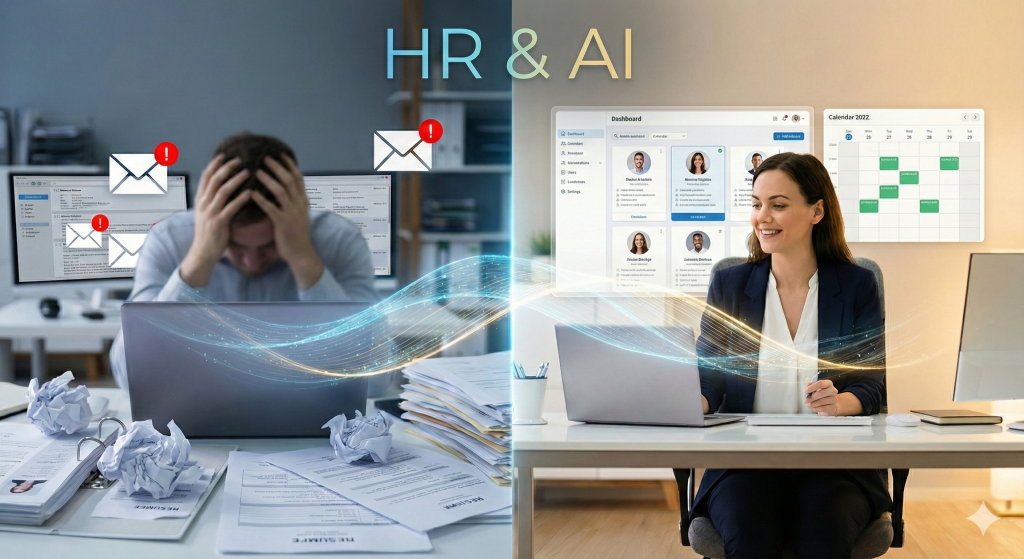
You sit at your desk on a Monday morning with a hot cup of coffee. You open your email and see hundreds of unread messages. You open your applicant tracking system and see thousands of new resumes. A heavy feeling settles in your chest. You want to give every single person a fair chance.
You want to read every word they wrote. You want to reply to everyone personally. But you know the truth. There is simply not enough time in the day. You have to make quick choices. You skim resumes for six seconds. You archive people who might be great but just missed a keyword. You feel bad about it. You feel like a machine.
The candidates feel it too. They spend hours writing cover letters. They tweak their resumes. They hit submit and wait. They wait for days. They wait for weeks. Often they hear nothing back. They feel like they sent their hopes into a black hole. They feel ignored. They feel like numbers in a spreadsheet. This is the big problem with modern recruitment. It is broken. It is too fast and too impersonal. We have lost the human connection in a sea of data.
This report explores a solution. It explores a new way to work centered on AI in HR. But this is not about robots taking your job. It is not about turning hiring into a cold process. It is the opposite. It is about using smart tools to handle the busy work. It is about letting machines do the sorting and the scheduling. This frees you up to do what you do best. You can talk to people. You can listen to their stories. You can build relationships. You can bring the human back into Human Resources.
We will explore how to find this balance. We will look at how top companies use AI in HR to transform their processes. We will learn how to avoid the mistakes that make people hate automation. We will see how you can be more efficient without losing your heart.
Key Takeaways
- AI is a Tool and Not a Replacement: Think of AI as a helpful assistant or a co-pilot that handles boring tasks so you can focus on people.1
- Speed Must Not Kill Empathy: Using AI to reject people in three minutes makes them hate your brand so you must build delays into the system.3
- The Human in the Loop is Essential: Never let an algorithm make the final hiring decision because a human must always have the final say.4
- Data Quality Matters: If you teach AI with biased data it will make biased choices so you must check your tools constantly.6
- Transparency Builds Trust: Tell candidates when you use AI and be open about it because they will respect you more for the honesty.8
- The Future is Augmented Intelligence: The best recruiters in 2026 will be the ones who work alongside AI agents to do more work with less stress.9
Why Is Everyone Talking About AI in Recruitment Right Now?
What Is Driving This Massive Shift in Hiring?
Direct Answer: Recruitment is changing fast because the technology has become much better and easier to use. In the past only big tech companies had smart tools. Now anyone can use them. Generative AI tools like ChatGPT have made it possible to write emails and analyze text in seconds. This has created a massive opportunity to use AI in HR to save time and money.10
Elaboration
We are living through a major change in how we work. For a long time, Human Resources software was just a place to store files. We called these systems of record. They were like digital filing cabinets. You put a resume in and it stayed there. It did not do anything. It just sat there.
Now we are moving to systems of work.10 These are tools that actually help you do your job. They do not just store data. They read the data. They understand the data. They can tell you which candidate is the best fit. They can write an email to that candidate for you. They can even schedule the interview on your calendar.
This change is happening because of Generative AI. This is a type of AI that can create new things. It can create text. It can create images. It can create code. In recruitment this is a superpower. You can ask the AI to write a job description for a Sales Manager and it will do it in five seconds. You can ask it to write a polite rejection letter and it will do that too.
The adoption numbers are huge. In 2024 the use of AI in HR nearly doubled.11 Almost every hiring manager says they use some form of AI now.12 It is becoming as common as email. One expert says AI is like oxygen.13 It is everywhere. You cannot avoid it. You have to learn how to breathe it.
But this speed brings fear. Recruiters worry they will be replaced. Candidates worry they will be judged by a robot. This report will show that the goal is not to replace people. The goal is to make people stronger. We call this Augmented Intelligence.1 It means the human plus the machine is better than either one alone.
The recruitment landscape is under immense pressure. The volume of applications has exploded. One click applying on job boards means a single job post can get thousands of responses. A human recruiter physically cannot read them all. This leads to burnout. It leads to mistakes. It leads to the ghosting problem where candidates never hear back. AI offers a way out of this trap. It offers a way to handle the volume without losing the quality.
We also see a shift in expectations. Candidates today expect speed. They expect instant answers. If they ask a question about the job they do not want to wait three days for an email. They want a chat response now. AI in HR allows companies to provide this 24/7 service. It allows a company to be always on even when the recruiters are sleeping. This improves the experience for the candidate. It makes them feel attended to.
However the conversation is not just about efficiency. It is about fairness. Humans are biased. We have unconscious preferences. We might prefer a candidate because they went to the same school as us. We might prefer someone who likes the same sports. AI has the potential to remove these biases. It can look at skills alone. It can ignore the name on the resume. It can ignore the address. But as we will see later this is only true if we build it correctly.
Can AI Really Understand a Human Candidate?
What Are the Real Limits of the Machine?
Direct Answer: No AI cannot fully understand a human being. It can match keywords and skills. It can predict if someone might stay in a job. But it cannot feel empathy. It cannot understand a joke. It cannot sense if a person will fit in with your team culture. That is why humans are still necessary.1
Elaboration
Let us look at what AI is good at and what it is bad at. We need to be realistic about these tools. They are not magic. They are math.
AI is a Sifter.15 Imagine you have a giant pile of sand. You want to find the gold nuggets. You could look through the sand with a magnifying glass. That would take forever. Or you could use a sifter. You shake the sand through a screen. The sand falls through and the big rocks stay on top.
AI is that sifter. It can look at 1,000 resumes in a second. It can find the people who have the right skills. It can find the people who live in the right city. It removes the noise so you can see the signal. This is great for efficiency. It saves you from reading 900 resumes that are not a good fit.16
But a candidate is not a rock. A candidate is a complex person. They have hopes and dreams. They have a personality. They have soft skills. A resume is a flat piece of paper. It does not tell the whole story.
Context is where AI struggles. If someone took a year off work to care for a sick parent the AI might just see a gap and score them lower. A human recruiter would see loyalty and compassion.14 A human understands life. A human understands that career paths are not always straight lines.
Culture is another blind spot for AI. AI cannot tell if someone is funny or kind. It cannot tell if they will get along with the boss. These are things you only learn by talking to someone. You learn them from the tone of voice. You learn them from body language. You learn them from the sparkle in their eye when they talk about their work. AI cannot see that sparkle.
Nuance is difficult for machines. AI is very literal. It looks for patterns. It might miss a great candidate because they used a different word for a skill than the one the AI was looking for.17 For example if you look for “customer service” but the candidate writes “client success” a basic AI might miss the match. Better AI in HR tools are solving this but it is still a risk.
This is why we say AI should be a Co-pilot.2 The pilot is still flying the plane. The pilot decides where to go. The co-pilot handles the radio and checks the gauges. You are the pilot. You use your judgment. You use your empathy. You use the AI to help you get there safely. You do not let the co-pilot land the plane alone.
We must also remember that AI does not have intuition. Recruiters often speak of a gut feeling. This is not magic. It is years of experience processing subtle cues. You might feel a candidate is hiding something. You might feel they are exaggerating. AI takes data at face value. It believes what it reads. It cannot read between the lines in the way a seasoned professional can.
Therefore the ideal role for AI is data processing. The ideal role for humans is decision making. We should not ask the machine to decide who gets the job. We should ask the machine to present us with the best options. We should ask it to summarize the data. But the final call must always be human.
How Do We Balance Speed with Empathy?
What Is the Centaur Approach to Hiring?
Direct Answer: To balance speed and empathy you must divide your tasks. Use AI for the tasks that require speed and data processing. Use humans for the tasks that require judgment and relationship building. This creates a Centaur which is half human and half machine. The result is a process that is fast but still feels personal.18
Elaboration
We need a framework to decide who does what. We can break recruitment down into steps. This helps us see exactly where the machine helps and where the human leads.
Step 1 is Sourcing or Finding People. AI is perfect here. It can scan LinkedIn and job boards 24/7. It can find people who might not even be looking for a job. It acts like a super powered search engine.19 It can look at millions of profiles in the time it takes you to drink your coffee. The Human Role is to define the search. You tell the AI what good looks like. You set the strategy. You decide if you need a senior leader or a junior learner.
Step 2 is Screening or Sorting Resumes. AI can rank candidates based on skills. It can verify if they have the right degree or visa status. It can answer basic questions via a chatbot.20 It can remove the people who are clearly not qualified. The Human Role is to review the top candidates. You look for the things the AI missed. You make the decision on who to interview. You apply your judgment to the shortlist.
Step 3 is Scheduling or Setting up Meetings. This is the best use of AI in HR workflows. Going back and forth to find a time to meet is painful. It wastes so much time. AI can look at your calendar and the candidate’s calendar and find a slot instantly. This saves hours of time.13 The Human Role is to show up to the meeting on time and prepared. You respect the time the AI has found for you.
Step 4 is Interviewing or Meeting the Person. AI can record the interview with permission. It can transcribe what was said. It can even suggest questions to ask based on the resume.16 It can summarize the conversation afterwards. The Human Role is to have the conversation. You listen. You build a connection. You sell the company vision. You make the candidate feel special. You assess their personality and fit.
Step 5 is Decision and Offer. AI can suggest a salary based on market data. It can draft the offer letter.21 It can predict if the candidate is likely to accept. The Human Role is to make the phone call. You share the good news. You negotiate. You welcome them to the team. You create the emotional moment of success.
By splitting the work this way you get the best of both worlds. The process moves fast because the AI handles the bottlenecks. But the candidate still feels seen and heard because the human handles the important moments.
This balance is crucial for the candidate experience. Candidates want speed but they do not want to be rushed. They want to know where they stand. AI can provide updates. It can send a message saying “We are still reviewing your application.” This small touch means a lot. It prevents the silence that candidates hate.
The concept of the Centaur is about augmentation. It is not about automation replacing the human. It is about the human becoming more powerful. A recruiter with AI can handle more candidates. They can give better service. They can find better talent. They are superpowered.
We must also consider the “Human in the Loop” concept.4 This means that at every critical stage a human checks the work of the AI. If the AI suggests rejecting a candidate a human should briefly review it to be sure. If the AI drafts an email a human should read it before sending. This prevents errors. It prevents the machine from running wild. It keeps the human in control.
What Are the Real Risks of AI in Hiring?
What Happens When Algorithms Go Wrong?
Direct Answer: The biggest risks are bias and legal trouble and a bad candidate experience. If AI is trained on data from the past it might repeat the mistakes of the past. It might favor men over women. It might also reject people too quickly making them feel like trash. There are also new laws that require you to check your AI for fairness.1
Elaboration Let us talk about the Ugly side of AI.7 We cannot ignore the dangers. If we use these tools blindly we will cause harm.
The Bias Trap is a major concern. AI learns from history. If your company hired mostly men for the last ten years the AI will learn that men equals good hire. It might start rejecting women automatically. This happened to Amazon a few years ago. They built a hiring tool that learned to penalize resumes that had the word “women’s” in them like “Women’s Chess Club.” They had to shut it down.7
This is called “bias in, bias out.” The machine is not prejudiced but the data is. You have to be very careful. You cannot just trust the machine. You have to check it. This is called auditing. You have to look at the data and see if it is treating everyone fairly.6 You have to ask hard questions. Is the AI rejecting older workers? Is it rejecting people from certain zip codes?
The Speed Trap creates bad feelings. Efficiency can be cruel. Imagine you apply for a job. You upload your resume. Two minutes later you get an email saying “No thanks.” How does that feel? It feels terrible. It feels like nobody even looked at it. It feels like a slap in the face. There are horror stories of people getting rejected in under three minutes.3
Even if the AI is right it feels wrong. It feels disrespectful. A good strategy is to build in a delay. Even if the AI knows instantly that the person is not a fit wait a few hours or a day to send the email. It is a small thing but it preserves the human dignity of the applicant. It makes them feel considered.
The Split Truth creates confusion. This happens when the AI tells the candidate one thing and the recruiter another. Maybe the chatbot says “You are a great fit!” but the recruiter rejects them. This confuses the candidate. It makes your company look disorganized. You need to make sure your systems are connected and telling the same story.22
This often happens when systems are not integrated. The chatbot is on one platform and the applicant tracking system is on another. They do not talk to each other. The candidate falls into the gap.
Legal Risks are growing.
Governments are waking up to these risks. In New York City there is a law called AEDT. It says you cannot use an automated employment decision tool unless it has been audited for bias. This means you have to hire an outside expert to check your math. Even if you are not in NYC this is a good standard to follow. It protects your company from lawsuits.
The European Union has the AI Act. This is even stricter. It classifies AI in HR and recruitment as “high risk.” This means strict rules on transparency and accuracy. You cannot ignore these laws. Ignorance is not a defense.
Over-Reliance is a trap for recruiters.
There is a risk that recruiters will stop thinking. They will just click “accept” on whatever the AI suggests. They will lose their skills. They will stop reading resumes. This is dangerous. If the AI breaks the recruiter is helpless. We must maintain our skills. We must keep our critical thinking sharp. We use the tool but we do not surrender to it.
How Are Top Companies Using AI Successfully?
What Can We Learn from Real World Case Studies?
Direct Answer: Companies like Mastercard and Electrolux and Chipotle use AI to improve the experience not just to cut costs. Mastercard used AI to schedule interviews which made candidates happier. Electrolux used AI to match internal employees to new jobs. The key to their success was clear goals and focusing on the user experience.13
Elaboration
Let us look at some examples of companies getting it right. These are not theories. These are real businesses seeing real results.
Case Study 1: Mastercard
The Problem: Mastercard had a fragmented system. They had too many career sites. It was hard for candidates to find jobs. It was hard for recruiters to manage the process. They wanted a seamless experience.
The Solution: They partnered with a company called Phenom. They built a Talent Community. This is a place where people can leave their info even if they do not apply for a specific job.
The AI Role:
They focused on automation and scheduling.
- Scheduling: They used AI to automate interview scheduling. This saved huge amounts of time. 88% of interviews were scheduled within 24 hours.13
- Matching: The AI suggests jobs to people based on their skills. It helps candidates find the right fit. The Result: They grew their talent community to over 1 million profiles. They saw an 11% higher application rate than the industry average.13 Candidates were happier because things moved faster. Recruiters were happier because they stopped playing phone tag.
Case Study 2: Electrolux
The Problem: They needed to hire people more efficiently. They also wanted to keep their current employees by finding them new roles within the company. This is called internal mobility.
The Solution: They used an AI in HR platform to digitize their processes. They focused on creating a digital ecosystem.
The AI Role:
- One-Way Interviews: For some roles candidates record video answers. AI helps screen these videos. This saved 20% of recruitment time.13
- Internal Mobility: The AI looks at employees’ skills and suggests open jobs inside the company. It matches the person to the role. The Result: Time to hire dropped by 9%. Incomplete applications dropped by 51%. This means more people finished the application because it was easy.13 They saved huge amounts of time on scheduling.
Case Study 3: Chipotle
The Problem: Chipotle hires thousands of people. They get a massive volume of applications. It is impossible for humans to read them all. Speed is critical in the restaurant business. If you do not hire the cook today the restaurant across the street will hire them tomorrow. The Solution: They used a chatbot named “Paradox.” The AI Role: The chatbot talks to candidates on their phones. It answers questions. It screens them for basic requirements like “Can you work weekends?” It schedules the interview instantly. The Result: The average time from application to start date dropped from 12 days to just 4 days. This is huge. It gave them a massive competitive advantage.23
Case Study 4: L’Oréal
The Problem: L’Oréal receives over a million applications a year. They wanted to give everyone a response but the volume was crushing. The Solution: They implemented an AI chatbot named “Mya.” The AI Role: Mya handles the first round. It chats with candidates to check availability and basic qualifications. It answers questions about the culture. The Result: They achieved a 33% reduction in time to hire. Candidate satisfaction scores went up because people got instant answers.24
Case Study 5: Vodafone
The Problem: They wanted to improve the quality of hires. They also wanted to hire more women and improve diversity. The Solution: They used AI driven video interviews and predictive analytics. The AI Role: The AI analyzes the video interviews. It looks for skills and behaviors that match successful employees. It ignores gender and background. The Result: They increased internal mobility by 25%. They filled more roles with their own people. They also reduced hiring costs by 30%.24
Case Study 6: PwC
The Problem: They needed to screen candidates efficiently while ensuring diversity. They wanted to be fair. The Solution: They adopted an AI based screening tool. The AI Role: The tool scans resumes and uses sentiment analysis. It scores candidates based on multiple parameters. It ignores names and demographics. The Result: They reduced screening time by 45%. They increased diversity in hiring with a 15% rise in candidates from underrepresented groups.24
Case Study 7: Accenture
The Problem: High volume recruitment needs. They needed to scale up fast. The Solution: An AI platform named “Amber.” The AI Role: Amber manages workflows. It engages candidates with conversation. It predicts hiring trends. The Result: A 50% reduction in time to fill for high demand positions. A 40% increase in positive candidate feedback.24
These stories show that AI is not just about firing recruiters. It is about letting recruiters handle the volume. Chipotle still has managers who interview the staff. But the chatbot does the heavy lifting to get them there. L’Oréal still has humans doing the final interviews. But Mya handles the crowd at the front door.
What Is the Candidate Journey and Where Does AI Fit?
How Do We Map the Touchpoints?
Direct Answer: The candidate journey is the path a person takes from not knowing you to working for you. There are seven main steps which are Awareness and Attraction and Interest and Applying and Evaluating and Interviewing and Hiring. AI can help at every single step but the type of help changes.25
Elaboration
Think of the candidate journey as a road trip. You want the road to be smooth. Potholes make people turn around and go home. AI is the road crew that fills the potholes.
Phase 1 is Awareness and Attraction.
This is when the candidate first hears about you.
- The Human Touch: You define your employer brand. You decide what your company stands for. You create the message.
- The AI Help: AI can help you write better job ads. It can find the right “LSI Keywords”.26 These are words related to your topic that help search engines find you. For example if you are hiring a “Writer” AI tells you to also use words like “Content Creator” or “Copywriting.” This helps more people see your ad. AI can also target ads to the right people on social media.
Phase 2 is Interest and Applying.
The candidate is interested. They visit your site.
- The Human Touch: You make the career site look welcoming. You put real photos of your team.
- The AI Help: Chatbots can answer questions 24/7. “Do you allow dogs in the office?” “Yes!” The candidate gets an instant answer and feels good. AI can also make the application form shorter. It can read their LinkedIn profile and fill in the boxes for them.27 This reduces the drop off rate.
Phase 3 is Evaluating.
The application is in. Now you have to check it.
- The Human Touch: You decide the criteria. You decide what skills matter most.
- The AI Help: AI screens the resumes. It ranks them. It removes the ones that are not qualified. This is the Sifter phase. It ensures you focus on the best people.
Phase 4 is Interviewing.
This is the big moment.
- The Human Touch: This is the most important human moment. You meet face to face. You connect.
- The AI Help: AI schedules the meeting. AI sends reminders so they do not forget. AI can even send them tips on how to prepare. This lowers the anxiety for the candidate.
Phase 5 is Hiring and Onboarding.
You made the choice. Now you have to land them.
- The Human Touch: You make the offer. You celebrate. You welcome them on day one. You introduce them to the team.
- The AI Help: AI handles the paperwork. It sends the tax forms. It creates a “Preboarding” checklist.25 It sends them a welcome video. It makes sure they have a laptop on their first day.
Touchpoint Optimization is key here. You can use data to see where people are dropping out.28 If everyone quits at the application page maybe the form is too long. If everyone quits after the interview maybe the managers need training. AI in HR gives you this data. It helps you fix the broken parts of the road.
How Can We Use Generative AI for Personalization?
How Do We Write Better Emails with Robots?
Direct Answer: Generative AI like ChatGPT is great for writing outreach emails. But you cannot just say “Write an email.” You have to give it a good prompt. A good prompt includes the tone and the goal and specific details about the candidate. This makes the email feel personal even if a machine wrote the first draft.29
Elaboration
Cold emailing is hard. You have to write something that makes a stranger want to talk to you. Most recruiters use templates. They sound boring. “Dear Name I have a job for you.” Delete. No one replies to that.
AI can help you write emails that sound like you. But you have to teach it. You have to be the director.
The Bad Prompt vs. The Good Prompt 31
Let us look at a Bad Prompt.
- “Write a recruiting email for a Java Developer.”
- The Result: “Dear Candidate, We are looking for a Java Developer. Please apply.”
- Why it fails: It is boring. It is robotic. It gives no reason for the person to care.
Now let us look at a Good Prompt.
- “Act as a friendly and professional recruiter at a tech startup. Write an email to a candidate named Sarah. Mention that I saw her project on GitHub about climate change and loved it. Tell her we are hiring a Lead Engineer to work on green energy tech. Keep it under 150 words. End with a question.”
- The Result: “Hi Sarah! I just stumbled across your climate change project on GitHub—it is incredible work. I am a recruiter at GreenTech and we are building a team to solve similar problems. We need a Lead Engineer to help us drive our new energy initiative. Would you be open to a quick chat next week to hear more?”
- Why it works: It connects the candidate’s passion (climate change) to the job. It proves you did your homework. It is short and punchy.
The AI did the writing. But the human provided the connection. The human found the GitHub project. The human decided to mention it. The AI just put the words together.
Best Practices for AI Emails:
- Check the facts: AI sometimes hallucinates. This means it makes things up. It might invent a project the candidate never did. Always read it before you send it.33
- Add your flavor: Tweak a few words to sound more like you. If you say “Cheers” instead of “Sincerely” change it.
- Specify the tone: Tell the AI to be “Warm” or “Excited” or “Professional”.29 Tone matters. A lawyer expects a different tone than a graphic designer.
- Use it for grammar: If English is not your first language AI is a lifesaver. It can polish your grammar and make you sound professional.33
- Source citations: You can ask the AI to cite its sources if you are asking for facts. This helps you verify the info.33
This is how you scale personalization. You cannot write 100 perfect emails from scratch. But you can use AI to help you write 100 personalized emails in a fraction of the time.
What About Ethics and Legal Compliance?
How Do We Stay on the Right Side of the Law?
Direct Answer: Governments are starting to regulate AI in hiring. You need to be aware of laws like the NYC AEDT law and the EU AI Act. These laws require you to be transparent. You must tell candidates if AI is used. You must audit your tools for bias. If you do not you could face big fines.7
Elaboration
The Wild West days of AI are ending. New rules are coming. You cannot just do whatever you want anymore.
Transparency is Key.
Candidates have a right to know if a machine is judging them.
- Best Practice: Put a note in your job description. “We use AI to help us screen applications but a human being makes every final decision.” This builds trust.8
- It also sets expectations. If a candidate knows a bot is screening them they might format their resume differently. Being open is the fair thing to do.
The Bias Audit.
In New York City there is a law called AEDT. It stands for Automated Employment Decision Tool. It says you cannot use such a tool unless it has been audited for bias. This means you have to hire an independent auditor. They look at your data. They check if the tool treats men and women equally. They check if it treats different races equally. You have to publish the results.
Even if you are not in NYC this is a good standard to follow. It protects your company from lawsuits. It also protects your brand. You do not want to be the company known for a racist algorithm.
Data Privacy.
You are collecting a lot of data about people. You have their resumes. You have their chat logs. You might have their video interviews. You must keep it safe. You must respect their privacy.
- Consent: You should ask for permission before you record an interview with AI.
- Usage: Do not use their data to train your AI without their permission.
- Deletion: If a candidate asks you to delete their data you must be able to do it.
The “Black Box” Problem. AI is often a black box. You put data in and an answer comes out. But you do not know why. This is dangerous in hiring. If a candidate asks “Why was I rejected?” you need an answer. You cannot just say ” The computer said so.” You need “Explainable AI.” You need tools that can tell you why they made a decision.19 “The candidate was rejected because they lack the required certification.” That is a fair answer. “The candidate was rejected because score 0.45” is not a fair answer.
Human Oversight.
We keep coming back to this. The best legal defense is a human in the loop. If a human reviews the decision it is harder to blame the machine. It shows you are exercising due diligence.
What Does the Future Look Like in 2026 and Beyond?
From Chatbots to Agents and Teammates
Direct Answer: By 2026 AI in HR will move from being a tool you use to a teammate you work with. We will see AI Agents that can handle entire workflows on their own. They will not just answer questions. They will proactively find candidates and interview them and give you a shortlist. The role of the recruiter will change from finding people to designing work.9
Elaboration
The future is coming fast. The tools we have today will look like toys in a few years. Here is what the experts predict for 2026.
1. AI Agents. Right now you have to tell the AI what to do. “Write this email.” “Schedule this meeting.” In the future you will have AI Agents. You will give them a goal. “Find me three great candidates for this role.” The Agent will go off and do it. It will search LinkedIn. It will email people. It will chat with them. It will schedule the meetings. It will come back to you and say “Here are three people ready to talk to you.” It will be like having a digital intern.9 These agents will have their own identities. They will have security access. They will be part of the team.
2. Workforce Redesign. HR will stop just filling orders. “I need a person.” HR will start designing work. You will look at a job and ask “How much of this can be done by AI?” You will build teams that are a mix of humans and software. This is a huge strategic shift.10 HR leaders will become architects of work. They will decide which tasks go to the bots and which go to the humans.
3. AI Interviewing as Standard. It feels weird now but AI interviewing will become normal. Candidates will prefer it for the first round because they can do it anytime anywhere. It removes the stress of scheduling. But the final rounds will always be human.10 The technology will get better. The avatars will look real. The conversation will feel natural. It will not feel like talking to a robot.
4. Predictive Intelligence. AI will get better at predicting the future. It will tell you who is likely to quit before they quit. It will tell you which candidate will be a top performer in two years. It will use data to see the future. This allows HR to be proactive. You can offer a promotion to someone before they start looking for a new job. You can save the talent before it leaves.34
5. LSI Keywords and SEO. We mentioned LSI keywords earlier.26 LSI stands for Latent Semantic Indexing. It is how search engines understand context. In the future this will be even more important. AI in HR tools will use LSI to understand candidates better. They will not just look for the word “Manager.” They will look for related words like “Leadership” and “Strategy” and “Team Building.” This means candidates will need to write their resumes for the machine. And recruiters will need to write job descriptions for the machine. Understanding how the machine reads will be a key skill.
Conclusion
The world of recruitment is changing. It is easy to feel overwhelmed. It is easy to feel scared that machines are taking over. But if we look closely we see a different story.
We see a story where AI in HR takes away the drudgery. It takes away the hours spent staring at calendars. It takes away the mind numbing task of reading thousands of mismatched resumes.
It gives us back the time to be human.
The best recruiters of the future will not be the ones who can source the fastest. They will be the ones who can use AI to free up their time so they can have real deep meaningful conversations. They will be the ones who use technology to be more empathetic not less.
So do not be afraid of the AI co-pilot. Invite it into the cockpit. Let it handle the dials and the switches. You keep your eyes on the horizon. You fly the plane.
Questions for You
- Which part of your job do you hate the most? Is it scheduling? Screening? Sourcing?
- Could an AI in HR tool handle that task for you next week?
- How would you spend those extra five hours? Talking to candidates?
The future is not Human vs. AI. It is Human + AI. And it is looking bright.
Tables and Comparisons
Table 1: Human vs. AI – Who Does What Best?
| Task | AI Strengths (The “Sifter”) | Human Strengths (The “Pilot”) |
| Sourcing | Scanning millions of profiles in seconds. Finding passive candidates. | Defining the ideal candidate profile. Understanding team culture needs. |
| Screening | Matching skills and keywords. Verifying certifications. Ranking by data. | Spotting transferable skills. Understanding gaps or unique career paths. |
| Scheduling | Instantly finding open slots. Handling time zones. Sending reminders. | Showing up on time. Being respectful of the candidate’s time. |
| Interviewing | Asking structured questions. Recording and transcribing. Initial screening. | Assessing soft skills and empathy and humor and cultural fit. Selling the vision. |
| Decision | Providing salary data. Predicting retention risks. Ensuring consistency. | Making the final judgment call. Negotiating the offer. Building the relationship. |
Table 2: The Impact of AI on Recruitment (Metrics from Case Studies)
| Company | Problem | AI Solution | Key Result |
| Mastercard | Fragmented candidate experience. | AI scheduling & Talent CRM. | 88% of interviews scheduled in 24h. 1M+ talent profiles. |
| Electrolux | Talent shortage & inefficiencies. | One-way video interviews & matching. | 9% faster time to hire. 51% fewer incomplete apps. |
| Chipotle | High volume of applicants. | “Paradox” Chatbot. | Time to start dropped from 12 days to 4 days. |
| L’Oréal | Massive volume of applications. | “Mya” Chatbot. | 33% reduction in time to hire. |
| Vodafone | Need for internal mobility. | AI predictive analytics. | 25% increase in internal hires. |
Table 3: Checklist for Ethical AI Implementation
| Action Item | Description | Why it Matters |
| Audit for Bias | Regularly check if your AI is favoring one group over another. | Prevents discrimination and legal issues. |
| Disclose AI Use | Tell candidates clearly when they are interacting with AI. | Builds trust and complies with laws like the EU AI Act. |
| Human Fallback | Always offer a way to talk to a human if the AI fails. | Ensures accessibility and fairness. |
| Review Rejections | Have humans spot check AI rejection decisions. | Prevents the Speed Trap and unfair exclusions. |
| Data Privacy | Secure candidate data and ask for consent. | Protects privacy rights and company reputation. |
Works cited
- What is AI recruiting? Our ultimate guide to balancing tech and the human touch, accessed January 28, 2026, https://eightfold.ai/blog/ai-recruiting-ultimate-guide/
- Connectivism and Connective Knowledge – Stephen Downes, accessed January 28, 2026, https://www.downes.ca/files/books/Connective_Knowledge-19May2012.pdf
- Rejected in under three minutes : r/recruitinghell – Reddit, accessed January 28, 2026, https://www.reddit.com/r/recruitinghell/comments/1oijj9y/rejected_in_under_three_minutes/
- What Is Human-in-the-Loop? A Simple Guide to this AI Term – CareerFoundry, accessed January 28, 2026, https://careerfoundry.com/en/blog/data-analytics/human-in-the-loop/
- Human-in-the-Loop: Keeping recruiters in control of AI-Driven recruitment – SourceGeek, accessed January 28, 2026, https://www.sourcegeek.com/en/news/human-in-the-loop-keeping-recruiters-in-control-of-ai-driven-recruitment
- Pros and Cons of AI in Recruitment: A Practical 2025 Guide – AMS, accessed January 28, 2026, https://www.weareams.com/blog/pros-and-cons-of-ai-in-recruitment/
- AI in Recruiting: The Good, Bad and Ugly | The HT Group, accessed January 28, 2026, https://www.thehtgroup.com/ai-in-recruiting-the-good-bad-and-ugly/
- AI Adoption in Recruiting: 2025 Year in Review – HeroHunt.ai, accessed January 28, 2026, https://www.herohunt.ai/blog/ai-adoption-in-recruiting-2025-year-in-review
- TA Trends 2026: Human–AI Power Couple | Full Report – Korn Ferry, accessed January 28, 2026, https://www.kornferry.com/insights/featured-topics/talent-recruitment/ai-in-recruitment-trends
- 10 predictions for HR and HR tech in 2026 – Eightfold AI, accessed January 28, 2026, https://eightfold.ai/blog/predictions-hr-tech-2026/
- AI vs. Human Recruiters: Who is Winning the War for Talent? – Homans, accessed January 28, 2026, https://homans.ai/blog/ai-vs-human-recruiters-who-is-winning-the-war-for-talent/
- 2025 AI in Hiring Survey Report – Insight Global, accessed January 28, 2026, https://insightglobal.com/2025-ai-in-hiring-report/
- 7 Examples of Companies Successfully Using an AI Recruiting Platform – Phenom, accessed January 28, 2026, https://www.phenom.com/blog/examples-companies-using-ai-recruiting-platform
- AI-Driven Recruitment: Balancing Automation with the Human Touch – Cura HR, accessed January 28, 2026, https://curahr.com/ai-driven-recruitment-balancing-automation-with-the-human-touch/
- link – Hugging Face, accessed January 28, 2026, https://huggingface.co/spaces/spark-nlp/sparknlp/resolve/884e39edfe1a439e690a93a3b3e374ded9a87f22/AntBNC_lemmas_ver_001.txt?download=true
- AI vs. Human Touch: Striking the Right Balance in Recruitment, accessed January 28, 2026, https://jobtalk.ai/resources/ai-vs-human-touch-striking-the-right-balance-in-recruitment/
- AI in recruitment: The good, the bad and the ugly – People in Focus, accessed January 28, 2026, https://www.peopleinfocus.com.au/blog/2024/02/ai-in-recruitment-the-good-the-bad-and-the-ugly
- Balancing AI and the human touch in recruitment | MiHCM, accessed January 28, 2026, https://mihcm.com/resources/blog/balancing-ai-and-the-human-touch-in-recruitment/
- The Ultimate 2025 AI Recruiting Guide: Save Time, Hire Smarter, Stay Ahead – Phenom, accessed January 28, 2026, https://www.phenom.com/blog/recruiting-ai-guide
- The Future of Talent Acquisition: AI, Automation, and Human Touch, accessed January 28, 2026, https://blog.kinetixhr.com/blog/ai-in-talent-acquisition
- AI in hiring: the pros and cons – Robert Walters US, accessed January 28, 2026, https://www.robertwalters.us/insights/hiring-advice/blog/ai-in-hiring-the-pros-and-cons.html
- Why AI Recruiting Breaks in 2026: 12 Failure Modes and Fixes | Humanly, accessed January 28, 2026, https://humanly.io/blog/why-ai-recruiting-breaks-2026-failure-modes
- Real-World AI in Recruitment Examples You Can Put into Practice – AIHR, accessed January 28, 2026, https://www.aihr.com/blog/ai-in-recruitment-examples/
- Case Study: Success Stories of AI Integration in Recruiting – ShortlistIQ, accessed January 28, 2026, https://www.shortlistiq.com/blog/case-study-success-stories-of-ai-integration-in-recruiting
- The Candidate Journey: 7 Touchpoints For Hiring Success (In 2026) – AIHR, accessed January 28, 2026, https://www.aihr.com/blog/candidate-journey/
- What Are LSI Keywords and How Do You Find Them | WebFX, accessed January 28, 2026, https://www.webfx.com/seo/glossary/what-are-lsi-keywords/
- AI for Recruiting: A Definitive Guide to Talent Acquisition in 2025 | Vonage, accessed January 28, 2026, https://www.vonage.com/resources/articles/ai-for-recruiting/
- Candidate Journey Touchpoints: Best Practices for Success – Manatal.com, accessed January 28, 2026, https://www.manatal.com/blog/candidate-journey-touchpoints
- Article: Using generative AI prompts to personalize outreach to candidates – Mercer TAAP, accessed January 28, 2026, https://taap.mercer.com/en-us/resources/view-content/article/10038/article-using-generative-ai-prompts-to-personalize-outreach-to-candidates
- 6 Prompts for AI Recruiting Emails – Indeed, accessed January 28, 2026, https://www.indeed.com/hire/c/info/chatgpt-prompts-for-recruiting-emails
- ChatGPT Prompts for Recruitment – Bad Prompt vs Good Prompt – MakeTheHire.com, accessed January 28, 2026, https://www.makethehire.com/chatgpt-prompts-for-recruitment-bad-prompt-vs-good-prompt/
- Best practices for using AI to write great email outreach | Gem, accessed January 28, 2026, https://www.gem.com/blog/best-practices-for-using-ai-to-write-great-email-outreach
- 10 Ways to Use Generative AI in Recruitment – – Scede, accessed January 28, 2026, https://scede.io/blog/10-ways-to-use-generative-ai-in-recruitment/
- From Recruitment to Retention: AI Tools for Human Resource Decision-Making – MDPI, accessed January 28, 2026, https://www.mdpi.com/2076-3417/14/24/11750