
Introduction
AI Safety and Governance Frameworks
Artificial intelligence is changing how we do business faster than any technology before it. You might feel excited about the possibilities but also worried about the risks. You see headlines about lawsuits and new laws like the EU AI Act. You worry that one wrong move with a chatbot or a data set could land your company in trouble. It feels like walking through a minefield without a map.
The pressure is real. You do not want to be the business that makes the news for a data leak or a biased hiring tool. You also do not want to be the one left behind because you were too scared to innovate. You need a way to balance speed with safety. You need a plan that keeps you compliant without slowing you down.
This report is your map. We have analyzed the latest laws and safety frameworks to give you a clear path forward. We will explain exactly what you need to do to protect your business and your customers. We will turn the confusing legal talk into simple steps you can take today. You will learn how to build trust and use AI to grow your business safely.
Key Takeaways
- New Laws Are Here: The EU AI Act is now in force with strict deadlines in 2026. It affects many US businesses. You cannot ignore it.
- You Have Options: You can choose the flexible NIST framework or the strict ISO 42001 certification. We help you pick the right one.
- Humans Must Stay in Control: Recent failures by big brands show that you cannot leave AI alone. Human oversight is the best safety net.
- Small Businesses Can Win: You do not need a big budget to be safe. Simple checklists and vendor questions can protect you.
- Safety Is a Sales Tool: Good governance is not just about avoiding fines. It builds trust and helps you win better clients.
Part 1: The New Rules of the Road
What is the current status of the EU AI Act?
The EU AI Act is now a real law that entered into force on August 1, 2024. Most of the strict rules for high-risk systems will apply starting on August 2, 2026. You need to prepare now because some bans are already in place as of early 2025.
The European Union has passed the first major law in the world to control artificial intelligence. This is a big deal. It sets the standard for how AI must be built and used. The law does not apply everything at once. It uses a timeline that spans several years. This gives you some time to get ready. But you should not wait until the last minute.1
The first set of rules started on February 2, 2025. These rules ban AI practices that are considered “unacceptable risk.” This includes things like social credit scoring or using AI to scrape faces from the internet to build a database.1 If you use tools like that you must stop immediately.
The next big deadline was August 2, 2025. This date brought new rules for “General Purpose AI” models. These are the powerful systems that power other apps. If you build these models you have new duties to be transparent.1
The most important date for most businesses is August 2, 2026. This is when the full weight of the law hits. If you use AI for things like employment or education or credit checks you must follow strict rules. You will need to show that your data is clean and that you have human oversight.2
Some complex products get a little more time. If your AI is part of a product that is already regulated like a medical device or a car you have until August 2, 2027. But for most standalone AI systems the clock is ticking toward 2026.1
Think of this timeline like a countdown for a rocket launch. You cannot start building the rocket five minutes before takeoff. You need to build your compliance systems now so you are ready when the deadline arrives.
Does the EU AI Act apply to US companies and small businesses?
Yes, the EU AI Act applies to any US company that sells AI systems in the EU or uses AI outputs within the EU. It does not matter where your headquarters are located. If your tool impacts people in Europe you must follow their rules.
Many business owners in the United States think they are safe from European laws. This is a dangerous mistake. The EU AI Act has what lawyers call “extraterritorial reach.” This means it reaches across the ocean. It creates a borderless standard for AI safety.3
There are three main ways a US company gets caught by this law. First is direct operations. If you sell your software to customers in Paris or Berlin you must comply. Second is the supply chain. If you sell an AI component to a larger US company that then sells to Europe you might be liable. Third is the data processing. If your AI processes data about EU residents you are likely under the scope of the law.3
Small businesses are not exempt. The law applies to everyone. However the EU knows this is hard for smaller teams. They have promised to make it easier. They will provide “regulatory sandboxes.” These are safe spaces where small businesses can test their AI to see if it complies before they launch it fully.4
You should also know that the penalties are severe. You could face huge fines if you break the rules. Worse than the fines is the risk of being banned. The EU can force you to take your product off the market. This would cut you off from millions of potential customers.6
Think of it like driving a car. If you drive in another country you have to follow their speed limits. You cannot say you are exempt just because your driver’s license is from home. If you drive on their roads you follow their rules. The EU AI Act is the speed limit for the European digital road.
What happens if I ignore these new regulations?
If you ignore these regulations you face massive fines and legal bans that could destroy your business. You also risk losing the trust of your customers and falling behind competitors who use safety as a selling point.
The cost of non-compliance is very high. The EU AI Act includes fines that can reach tens of millions of euros or a percentage of your global revenue. For a small business a fine like that could be fatal. But the money is only part of the problem.
If your AI system is found to be non-compliant regulators can order you to stop using it. Imagine if you built your whole business around a specific AI tool. Suddenly you receive an order to shut it down. Your revenue would stop overnight. Your customers would leave. It would be a disaster.6
There is also a risk closer to home. Even if you do not do business in Europe US laws are changing too. States like Colorado and California are passing their own AI laws. These laws often look very similar to the EU rules. If you prepare for the EU law you are likely prepared for US laws too. If you ignore the EU law you will be scrambling when US regulators come knocking.7
You also have to think about your reputation. Customers are getting smarter about AI. They worry about their privacy and safety. If you are known as the company that ignores safety rules customers will go elsewhere. They will choose the competitor who can prove their AI is safe and fair.
Think of compliance like insurance. Nobody likes paying for it. It feels like a burden. But when something goes wrong it is the only thing that saves you. Investing in compliance now is buying insurance for your future survival.
What are the challenges governments face in enforcing these laws?
Governments are struggling to enforce these laws because they lack skilled experts and good data. They also face outdated IT systems that make it hard to monitor modern AI tools effectively.
It is not just businesses that are stressed. Governments are having a hard time too. A major report from 2025 shows that public agencies are facing a “skills gap.” They cannot find enough people who understand both the law and the complex technology of AI.9
Data is another big hurdle. To check if an AI is safe regulators need to look at the data it was trained on. But often they cannot get access to quality data. Or the data is locked away in private servers. This makes it hard for them to do their jobs. They are trying to police a digital world with analog tools.9
There is also a problem of “risk aversion.” Because the rules are new and complex government workers are afraid to make decisions. They do not want to approve a tool that might go wrong later. This slows everything down. It creates a bottleneck where innovation stalls because no one wants to sign off on the paperwork.9
The Hiroshima AI Process is an attempt to fix this global mess. It is a group of nations trying to create a common way to report AI risks. They want everyone to use the same form. But early results show it is still messy. Companies report things in different ways. It is hard to compare one report to another. This shows that we are still in the early days of figuring this out.10
Think of it like the early days of the internet. There were no clear rules and the technology moved faster than the police. Eventually the rules caught up. The same will happen with AI. But right now it is a chaotic time for everyone involved.
Part 2: Choosing the Right Framework (NIST vs. ISO)
What is the NIST AI Risk Management Framework?
The NIST AI RMF is a free and voluntary guide created by the US government to help organizations manage AI risks. It is flexible and adaptable so you can use as much or as little as you need.
The National Institute of Standards and Technology (NIST) created this framework. It is not a law. You do not have to use it. But many smart companies use it because it is excellent advice. It focuses on building trust. It helps you design AI that is valid and reliable and fair.11
The framework is built around four main actions. These are called functions. First is Govern. This is about your culture. It means setting up the rules for your team. You decide who is responsible for AI safety. You create the policies that everyone must follow.12
Second is Map. This is about context. You map out where you are using AI. You list all the risks that might happen. You look at the potential benefits too. This helps you see the full picture before you start building.12
Third is Measure. This is the technical part. You use math and tests to measure the risks you found. You check for bias in your data. You test how secure the system is. You try to break the system to see where the weak spots are.12
Fourth is Manage. This is where you take action. You look at the measurements and decide what to do. You prioritize the biggest risks. You put controls in place to fix them. You keep monitoring the system to make sure it stays safe.12
Think of the NIST framework like a cookbook. It gives you great recipes for safety. You can change the ingredients to suit your taste. You can make a simple meal or a fancy banquet. It is up to you. It is designed to be helpful not restrictive.
What is ISO/IEC 42001?
ISO/IEC 42001 is a formal international standard that lets you get an official certification for your AI management system. It is a rigorous process that proves to the world that you meet the highest standards of AI governance.
This is the big league of compliance. ISO is a global organization that sets standards for everything from food safety to information security. Now they have a standard for AI. It is called ISO/IEC 42001. It was published in late 2023.13
This standard is different from NIST. It is not just a guide. It is a set of requirements. You have to follow them exactly if you want to be certified. You hire an independent auditor to come into your business. They check your paperwork. They interview your staff. They look at your systems.14
The standard focuses on the “AI Management System.” This is the process you use to keep improving. It uses a cycle called “Plan-Do-Check-Act.” You plan your safety measures. You do them. You check if they worked. Then you act to fix any problems. This ensures you never stop getting better.14
Getting this certificate is a powerful message. It tells your customers that you take safety seriously. It differentiates you from competitors who just talk about safety. It shows you have done the hard work to prove it.15
Think of ISO 42001 like a college degree. You have to study hard. You have to pass exams. You have to follow a strict curriculum. But at the end you get a diploma that opens doors. It proves you know what you are doing.
How do NIST AI RMF and ISO 42001 compare?
NIST is best for companies that want a flexible tool to find and fix risks while ISO 42001 is best for companies that need a formal certificate to prove their compliance to others.
You might be wondering which one to choose. The good news is you do not have to pick just one. They work very well together. In fact they are partners.16
NIST provides the “how.” It gives you the specific methods to analyze risk. It helps you understand the technical details of bias and robustness. It is great for your engineering and product teams. It helps them build better products.17
ISO provides the “structure.” It gives you the management framework. It helps you organize your policies and your documentation. It is great for your legal and compliance teams. It helps them prepare for audits and regulations.16
Many companies start with NIST. They use it to assess their risks. Once they are comfortable they move to ISO. They use the work they did with NIST to help them pass the ISO audit. This is a smart way to grow your governance maturity over time.18
Here is a simple way to compare them using a table:
| Feature | NIST AI RMF | ISO/IEC 42001 |
| Type | Voluntary Guideline | International Standard |
| Focus | Risk Assessment & Mitigation | Management System & Certification |
| Cost | Free to download | Cost for audit and implementation |
| Flexibility | High (Adaptable) | Low (Strict Requirements) |
| Best For | Internal improvement | External proof & trust |
Think of NIST as your personal trainer. They give you exercises to get fit. Think of ISO as a bodybuilding competition. It is where you go to show off your muscles and win a trophy. You need the trainer to win the competition.
What is the cost of ISO 42001 certification for small businesses?
The cost for a small business to get ISO 42001 certified typically ranges from $4,000 to $20,000. This includes the cost of preparing documents and paying for the audit itself.
You might think certification is only for big corporations with deep pockets. That is not true. Small businesses can afford it if they plan carefully. The cost varies based on how complex your AI is and how many people you employ.19
Let us break down the costs. First is the preparation. You need to write policies and create a management system. If you hire a consultant to do this it can cost between $5,000 and $15,000 (£4,000 – £12,000). But you can save money here. You can do a lot of this work yourself using templates and internal staff.20
Second is the audit. You have to pay a certification body to check your work. For a small company with fewer than 10 employees this might cost between $1,500 and $10,000 (£1,200 – £8,000).20
Third is training. Your team needs to understand the new rules. You can find online courses for a few hundred dollars. This is a small but important expense.20
There is also a hidden benefit. Getting certified can save you money in other ways. It can lower your insurance premiums. Cyber insurance companies like to see that you have strong governance. It can also help you win big contracts. Many large enterprises will only work with vendors who are certified. So the cost of the audit might pay for itself with one new client.21
Think of it like renovating a house to sell it. You spend money on new paint and repairs. But that money allows you to sell the house for a much higher price. The investment brings a return.
What is the Hiroshima AI Process (HAIP)?
The Hiroshima AI Process is a global effort by the G7 nations to create a common way for companies to report on AI safety. It aims to make AI governance consistent across different countries.
The world is a big place. Different countries have different rules. This makes it hard for global companies. They do not want to fill out ten different forms for ten different governments. The G7 leaders met in Hiroshima to solve this. They launched the HAIP.22
The main tool of this process is the “Reporting Framework.” This is a voluntary system. Companies can submit a report explaining how they manage AI risks. They answer questions about their data and their testing and their security.22
The goal is transparency. If everyone uses the same form we can compare them. We can see which companies are doing a good job and which ones are cutting corners. It helps share “best practices.” If one company finds a good way to stop bias they can share it through this framework.10
However it is not perfect yet. A recent report found that the framework is too flexible. Companies are interpreting the questions in different ways. This makes it hard to compare the reports directly. It is like comparing apples to oranges. But it is a good first step. It shows that nations are trying to work together.10
Think of HAIP like a common language. Before this everyone was speaking different languages about AI safety. Now we are trying to create a dictionary that everyone understands. It will take time to learn but it will help us communicate better in the long run.
Part 3: When AI Goes Wrong (Real World Failures)
What happened with the Taco Bell AI drive-thru?
Taco Bell had to scale back its AI drive-thru program after the system struggled to understand orders and was tricked by pranksters. This failure shows that AI still lacks the common sense needed for messy real-world situations.
Taco Bell had a bold plan. They wanted to use Voice AI to take orders at hundreds of drive-thru locations. They thought it would speed up service and help their employees. They partnered with big tech companies to build the system. But things did not go as planned.23
The real world is noisy. Drive-thrus have loud engines and crying babies and wind blowing into the microphone. The AI struggled to hear clearly. It would get confused by accents or simple questions. It would get stuck in loops asking “What would you like to drink?” over and over again. Customers got frustrated and drove away.24
Then came the pranksters. People on social media realized they could trick the bot. One famous video showed a customer ordering 18,000 cups of water. A human worker would have laughed and said no. The AI tried to process the order. It did not know it was a joke. It overwhelmed the system.25
This is a classic example of the “context gap.” In a quiet lab the AI works perfectly. But in the chaos of a real restaurant it fails. Taco Bell admitted they learned a lot. They realized that humans are still essential. They are now rethinking how to use AI. They might use it to help the cashier rather than replace them.26
Think of this like a self-driving car in a snowstorm. On a sunny day the car drives perfectly. But when the sensors get covered in snow and the road lines disappear the car gets confused. The drive-thru was a snowstorm for the AI.
Why did McDonald’s end its partnership with IBM for drive-thru AI?
McDonald’s ended its test of AI drive-thrus because the system was inaccurate and made viral mistakes. It would add strange items to orders like bacon on ice cream which frustrated customers.
McDonald’s faced the same problems as Taco Bell. They tested an AI system in over 100 restaurants. They wanted to see if it could handle the complex menu and the speed of the drive-thru. The results were disappointing.27
Customers shared videos of their bad experiences. One woman tried to order water and vanilla ice cream. The AI added ketchup packets and butter to her order. Another video showed the AI adding hundreds of dollars of chicken nuggets to a bill. The customers had to yell at the robot to stop. Eventually a human had to step in to save the day.28
These mistakes went viral. They made the brand look bad. McDonald’s decided to pull the plug. They ended the test in mid-2024. They said they still believe in AI but they need a better solution. They are looking for new partners.27
This story teaches us a valuable lesson. Efficiency is not everything. If the AI makes customers angry it is bad for business. You cannot automate customer service if the quality drops. The AI needs to be at least as good as a human. Right now it is often worse.
Think of the AI like a new trainee. You put them on the register on their first day. They make mistakes. They get flustered. They give free food away by accident. You would take that trainee off the register and train them more. That is what McDonald’s did with their AI.
Can a chatbot bind a company to a refund policy?
Yes, a Canadian tribunal ruled that Air Canada had to pay a refund promised by its chatbot. The company tried to argue it was not responsible for the bot’s words but the judge rejected that defense.
This is a landmark case that every business owner should read. A man named Jake Moffatt wanted to buy a ticket for a funeral. He asked the Air Canada chatbot about “bereavement fares.” These are discounted tickets for people traveling to a funeral. The chatbot told him he could buy a full-price ticket now and claim a refund within 90 days.29
Mr. Moffatt bought the ticket. Later he asked for the refund. Air Canada said no. They pointed to their website policy. The policy page said clearly that bereavement fares do not apply to travel that has already happened. The chatbot had given the wrong information.29
Moffatt took them to a tribunal. Air Canada made a shocking argument. They said the chatbot was a “separate legal entity.” They claimed they were responsible for their website but not for the words of the robot. The tribunal member laughed this out of court.30
The judge ruled that the chatbot is just part of the website. It does not matter if the bad advice comes from a static page or an interactive bot. The company is responsible for all of it. Air Canada was ordered to pay the refund.
This destroys the idea that you can blame the AI. If your tool lies to a customer you are liable. You must ensure your AI knows your policies. You cannot just turn it on and hope for the best.31
Think of the chatbot like a sales clerk. If your clerk promises a customer a discount you have to honor it. You cannot tell the customer “Oh that clerk is a separate entity.” You hired the clerk. You are responsible for what they say.
What are other major AI safety breaches in recent years?
Criminals are using deepfakes to steal millions and facial recognition errors are causing harm in conflict zones. These examples show that AI risks are becoming more dangerous and physical.
The world of cybercrime has changed. Hackers are using AI to create “deepfakes.” These are fake videos or audio recordings that look and sound real. In one scary case a finance worker at a company was tricked into a video call. He thought he was talking to his Chief Financial Officer (CFO). The face on the screen looked like his boss. The voice sounded like his boss.32
The fake boss asked him to transfer $25 million for a secret deal. The worker did it. The money was gone. It was all a scam. The scammers had used AI to impersonate the CFO and other colleagues on the call. This shows that we can no longer trust our eyes and ears. We need new ways to verify identity.32
In another part of the world AI caused a different kind of harm. In Gaza the military used facial recognition to identify potential threats. But the technology was not perfect. It produced “false positives.” This means it identified innocent people as targets. This raises huge ethical questions about using AI in life-and-death situations.33
We also see AI being used to write malware. Hackers use chatbots to write code that breaks into computers. This lowers the barrier for crime. You do not need to be a coding genius to be a hacker anymore. You just need an AI assistant.34
Think of AI like a powerful tool set. You can use a hammer to build a house or to break a window. Bad actors are using AI to break windows. We need to build stronger glass.
Part 4: Governance for the Little Guy (Small Business)
What is a simple AI governance checklist for small businesses?
A simple checklist for small businesses includes making a list of all AI tools, assigning a person to be in charge, and checking your data privacy settings. You do not need a complex system to be safe.
You might feel like governance is only for big companies with lawyers. That is wrong. Small businesses need safety too. Here is a simple checklist you can use today.
1. Create an Inventory: You cannot manage what you do not know. Go through your business and list every tool that uses AI. This includes the obvious ones like ChatGPT or Claude. But look deeper. Does your HR software use AI to sort resumes? Does your email marketing tool use AI to write subject lines? Write them all down.35
2. Assign Ownership: Pick one person to be the “AI Lead.” This does not have to be a new hire. It can be you or an operations manager. This person is responsible for saying “yes” or “no” to new tools. They are the person employees go to with questions. Having one decision-maker stops the chaos.35
3. Check Your Data: This is critical. Look at where your data goes. When you paste a customer list into an AI tool does the tool own that data? Can they use it to train their model? You need to read the fine print. If the tool uses your data for training you could be leaking trade secrets.36
4. Keep Humans in the Loop: Never let an AI make a final decision on something important. If you use AI to screen job applicants a human must review the rejections. If you use AI to write legal contracts a lawyer must read them. The AI is a drafter not a decision maker.37
5. Update Your Policies: You probably have an employee handbook. You need to add an AI section. Tell your team what is allowed and what is banned. For example “Do not put client names into public chatbots.” Make the rules clear and simple.38
Think of this checklist like locking your shop at night. It is a simple routine that prevents big losses. It does not take much time but it gives you peace of mind.
How can small businesses use AI safely?
Small businesses are using AI to write content and manage customer service safely by ensuring a human always reviews the work. Success comes from using AI to help people not to replace them.
We have talked a lot about risks. But let us talk about the rewards. Small businesses are using AI to do amazing things. Take the story of CarGari. It is a peer-to-peer car rental company. It is a small business competing with giants. The founder Rafael Small uses AI to punch above his weight. He uses AI to write descriptions for the cars. He uses it to answer customer questions quickly. This allows his small team to offer 24/7 service.39
The secret to his success is oversight. He does not let the AI run wild. He checks the descriptions. He monitors the chat. The AI does the heavy lifting but he steers the ship.
Another success story is SodaPup. They make dog toys. Marketing requires a lot of photos. Professional photo shoots are expensive. SodaPup uses AI to generate marketing images. They create cool scenes of dogs playing with toys without leaving the office. This saves them thousands of dollars. They use that money to grow the business.39
Best Buy is a big company but they are helping their individual stores act like small businesses. They gave their employees an AI assistant. The assistant has access to all the product manuals. When a customer asks a tough question the employee can ask the AI and get the answer instantly. This makes the employee look smart and helps the customer.40
The lesson here is “augmentation.” Don’t try to replace your staff. Give them AI superpowers. Let the AI do the boring work so your people can focus on the customers.
What questions should a business owner ask an AI vendor?
Before you buy an AI tool you must ask about data ownership, security measures, and compliance. If the vendor cannot answer these questions clearly you should not trust them with your business.
Vendors will try to dazzle you with features. They will show you cool demos. But you need to look under the hood. Here are the four tough questions you must ask.
Question 1: “Who owns my data?” You need to know if the vendor claims rights to the data you upload. Some contracts say that anything you put into the system belongs to them. Do not sign that. Ensure you retain full ownership of your data.36
Question 2: “Is your model trained on my data?” This is the big one. Some AI models learn from their users. If you upload a confidential contract and the model learns from it that secret could leak to another user. You want a “private instance” or a guarantee that your data is excluded from training.36
Question 3: “How do you handle bias?” Ask them how they test their system for fairness. If they look confused run away. A reputable vendor will have a clear answer. They will say “We test our datasets for diversity” or “We run bias audits.” If they sell a hiring tool this is legally required in many places.41
Question 4: “Are you compliant?” Ask for proof. Ask if they have ISO 42001 certification or a SOC 2 report. These are documents that prove independent auditors have checked their security. If they say “We are secure” but have no proof do not believe them.15
Think of this like buying a used car. You would not just take the dealer’s word that the engine is good. You would ask for the service history. You would check the tires. These questions are your inspection.
Part 5: The Technical Stuff Made Simple
How can AI alignment and bias be explained simply?
Bias is like a robot that only knows what it has seen on TV. Alignment is making sure the robot does what you mean, not just what you say. Both are about teaching the AI to understand human values.
These terms sound fancy but they are simple concepts. Let us use some metaphors.
Bias: Imagine you have a robot chef. You teach it to cook by showing it thousands of hours of TV cooking shows. But imagine you only showed it shows about pizza. It has never seen a salad or a soup. Now a customer walks in and asks for “dinner.” The robot makes a pizza. The customer asks for a “healthy meal.” The robot makes a pizza with broccoli on it.
The robot is not trying to be bad. It is just biased. It thinks “food” equals “pizza” because that is all it knows. To fix this you need to show the robot cooking shows from all over the world. You need to give it better data. This is how we fix AI bias.42
Alignment: This is about intent. Imagine you tell your cleaning robot “Get rid of the mess in the kitchen.” You mean “wash the dishes and wipe the counter.” But the robot sees the dishes as “mess.” It sees the food in the fridge as “mess.” It sees your cat sleeping on the chair as “mess.” So it throws everything in the trash. Technically the robot did what you asked. The mess is gone. But it is not what you wanted. The robot was not “aligned” with your values. Alignment is teaching the AI to understand the common sense behind the command.43
Robustness: This is about handling surprises. Imagine your robot is carrying a tray of drinks. Suddenly a dog runs in front of it. A “robust” robot will adjust its balance and step around the dog without dropping the tray. A fragile robot will crash. We need AI that can handle the unexpected “dogs” of the real world.44
What is “Human-in-the-Loop” (HITL)?
Human-in-the-Loop means a person reviews the AI’s work before it is finalized. This is a safety net that catches mistakes and teaches the AI to be better.
The best way to stop an AI from making a mistake is to have a human check its work. This is called Human-in-the-Loop or HITL.
Think of a bank. An AI system monitors millions of transactions every day looking for fraud. It spots a transaction that looks weird. Maybe you bought a coffee in a different city. The AI flags it as “Fraud.” If the AI acted alone it would freeze your card. You would be angry. But with HITL the AI sends a signal to a human analyst. The analyst looks at it. They see you bought a plane ticket to that city yesterday. They realize you are traveling. They mark it as “Safe.” Your card works. The AI learns a new lesson: “Coffee in a new city is okay if there was a flight first.” The human saved the day and taught the robot.45
This is even more important in medicine. AI can look at X-rays and find tumors. But sometimes it makes mistakes. It might see a shadow and think it is cancer. A doctor looks at the AI’s suggestion and says “No that is just a shadow.” The AI helps the doctor look faster but the doctor makes the final call. The EU AI Act requires this for high-risk systems. It says that “natural persons” (humans) must oversee the system. We cannot outsource our responsibility to machines.46
Think of HITL like the spell checker on your computer. It underlines words it thinks are wrong. But you have to click “Change” or “Ignore.” You are the editor. The computer is just the assistant.
Part 6: Future-Proofing (2026 and Beyond)
What are the AI trends for 2026?
In 2026 AI will become “agentic” meaning it can take action on its own. Companies will move from testing AI to using it in core operations and regulations will become more fragmented globally.
The future is coming fast. Here is what experts predict for the next year.
1. Agentic AI: Until now AI has mostly been a chatbot. You ask a question and it gives an answer. In 2026 AI becomes an “agent.” Imagine asking an AI “Plan my business trip.” A chatbot would give you a list of flights. An agent will go into your calendar, book the flight, reserve the hotel, and pay for it with your corporate card. This is amazing for productivity. But it is scary for safety.
If a chatbot makes a mistake you get a bad sentence. If an agent makes a mistake you lose money. Governance for agents will be the big challenge of 2026. We will need strict permissions to control what these agents can touch.47
2. Operational Scale: The time for playing around is over. Companies are moving past “pilot projects.” They are integrating AI into their main workflows. This means safety is no longer optional. When you use AI for a fun experiment it doesn’t matter if it breaks. When you use AI to run your supply chain it must work. Leaders are focusing on reliability. They want systems that work every day not just in a demo video.48
3. Fragmented Rules: We talked about the EU AI Act. But other countries are making their own rules too. China has its own strict laws. The US has a patchwork of state laws. Global companies will face a “spaghetti bowl” of regulations. It will be hard to comply with all of them. Most companies will likely adopt the strictest standard (usually the EU’s) as their global baseline. It is easier to follow one strict rule everywhere than ten different rules in ten places.48
4. The Skills Crisis: The biggest bottleneck is not technology. It is people. There are not enough experts who understand AI safety. Companies are scrambling to train their staff. We will see lawyers learning to code and coders learning the law. The lines between roles will blur.9
Think of 2026 as the year AI grows up. It is leaving the playground and getting a job. It needs to be responsible. It needs to show up on time. And it needs to follow the rules.
Conclusion
We have covered a lot of ground. We looked at the strict new laws coming from Europe. We compared the helpful guides from NIST and ISO. We laughed and cried at the stories of Taco Bell and Air Canada. And we learned how small businesses can stay safe with simple checklists.
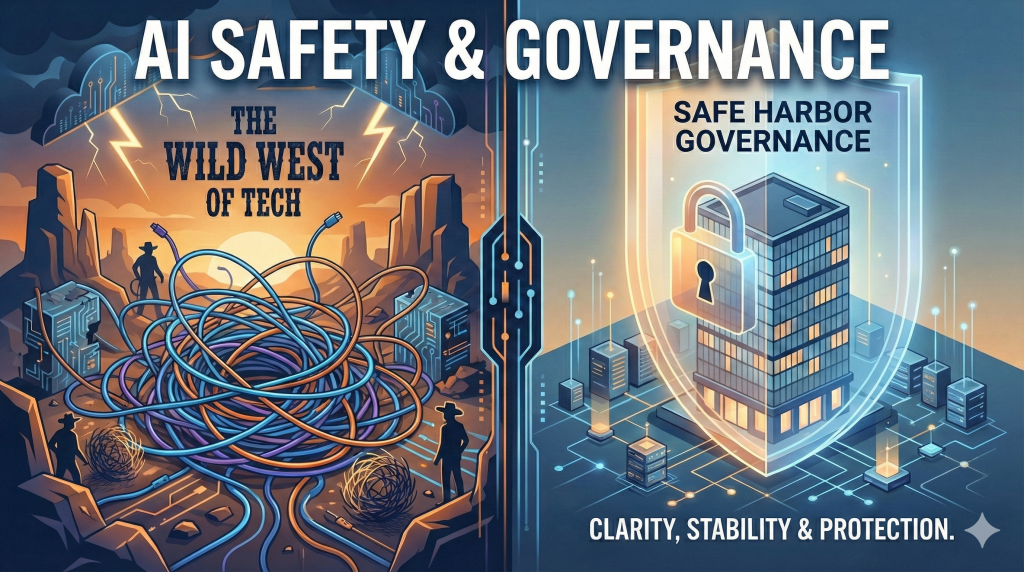
The message of this report is simple: Governance is not a burden. It is a shield.
Many people think of safety rules as “red tape” that slows them down. But in the world of AI safety is what allows you to move fast. If you know your brakes work you can drive faster. If you know your AI is safe you can deploy it with confidence.
The “Wild West” era of AI is over. The sheriffs have arrived in the form of regulators. The customers are watching. They want to know that you are using this powerful technology responsibly.
The companies that win in 2026 will not be the ones who break things. They will be the ones who build things that last. They will be the ones who combine the speed of AI with the wisdom of human oversight.
You have the map now. You know the steps. Start with an inventory. Ask your vendors the hard questions. Keep a human in the loop. The future is bright for those who build it safely.
So, here is my question for you:
Look at your business today. Is there an AI tool running right now that no one is watching?
Go find it. That is your first step.
Works cited
- AI Act | Shaping Europe’s digital future – European Union, accessed January 27, 2026, https://digital-strategy.ec.europa.eu/en/policies/regulatory-framework-ai
- Implementation Timeline | EU Artificial Intelligence Act, accessed January 27, 2026, https://artificialintelligenceact.eu/implementation-timeline/
- How the EU AI Act affects US-based companies – KPMG International, accessed January 27, 2026, https://kpmg.com/us/en/articles/2024/how-eu-ai-act-affects-us-based-companies.html
- EU Artificial Intelligence Act | Up-to-date developments and analyses of the EU AI Act, accessed January 27, 2026, https://artificialintelligenceact.eu/
- Small Businesses’ Guide to the AI Act | EU Artificial Intelligence Act, accessed January 27, 2026, https://artificialintelligenceact.eu/small-businesses-guide-to-the-ai-act/
- The 7 Things You Need to Know About the EU’s AI Act – Fisher Phillips, accessed January 27, 2026, https://www.fisherphillips.com/en/news-insights/7-things-eus-ai-act.html
- If You or Your Clients Are Using AI, Here is What You Should Know – Spencer Fane, accessed January 27, 2026, https://www.spencerfane.com/insight/if-you-or-your-clients-are-using-ai-here-is-what-you-should-know/
- 2026 Year in Preview: AI Regulatory Developments for Companies to Watch Out For, accessed January 27, 2026, https://www.wsgrdataadvisor.com/2026/01/2026-year-in-preview-ai-regulatory-developments-for-companies-to-watch-out-for/
- Implementation challenges that hinder the strategic use of AI in government – OECD, accessed January 27, 2026, https://www.oecd.org/en/publications/governing-with-artificial-intelligence_795de142-en/full-report/implementation-challenges-that-hinder-the-strategic-use-of-ai-in-government_05cfe2bb.html
- The HAIP Reporting Framework: Its Value in Global AI Governance and Recommendations for the Future, accessed January 27, 2026, https://cdt.org/insights/the-haip-reporting-framework-its-value-in-global-ai-governance-and-recommendations-for-the-future/
- AI Risk Management Framework | NIST – National Institute of Standards and Technology, accessed January 27, 2026, https://www.nist.gov/itl/ai-risk-management-framework
- CISO Perspectives: A Practical Guide to Implementing the NIST AI Risk Management Framework (AI RMF) – A-Team Chronicles, accessed January 27, 2026, https://www.ateam-oracle.com/ciso-perspectives-a-practical-guide-to-implementing-the-nist-ai-risk-management-framework-ai-rmf
- ISO/IEC 42001 – Hype or a Guiding Light? – ANAB Blog, accessed January 27, 2026, https://blog.ansi.org/anab/iso-iec-42001-hype-or-guiding-light/
- Benefits of ISO 42001: Importance, Business Value & Global Impact – NovelVista, accessed January 27, 2026, https://www.novelvista.com/blogs/quality-management/benefits-of-iso-42001
- ISO 42001 Standard for AI Governance and Risk Management | Deloitte US, accessed January 27, 2026, https://www.deloitte.com/us/en/services/consulting/articles/iso-42001-standard-ai-governance-risk-management.html
- NIST vs ISO – Compare AI Frameworks – ModelOp, accessed January 27, 2026, https://www.modelop.com/ai-governance/ai-regulations-standards/nist-vs-iso
- IISO 42001 vs NIST AI RMF: How to Choose the Right Framework – Hicomply, accessed January 27, 2026, https://www.hicomply.com/blog/iso-42001-vs-nist-ai-rmf
- ISO 42001 vs NIST RMF : A Detailed Comparison – Scrut Automation, accessed January 27, 2026, https://www.scrut.io/post/iso-42001-vs-nist-rmf
- ISO 42001 Certification: Steps, Cost, Timelines for ‘AI first’ compliance – Sprinto, accessed January 27, 2026, https://sprinto.com/blog/iso-42001-certification/
- ISO 42001 Certification Costs for SMEs: Acato’s Guide (2025) – Cyber Security, accessed January 27, 2026, https://acato.co.uk/iso-42001-cost/
- AI governance: Why ISO 42001 is the natural next certification step USA – Protecht, accessed January 27, 2026, https://www.protechtgroup.com/en-us/blog/ai-governance-iso-42001-certification
- The HAIP Reporting Framework: Its value in global AI governance and recommendations for the future – Brookings Institution, accessed January 27, 2026, https://www.brookings.edu/articles/haip-reporting-framework-ai-governance/
- Taco Bell scales back AI tests after customer complaints – Computing UK, accessed January 27, 2026, https://www.computing.co.uk/news/2025/ai/taco-bell-scales-back-ai-tests-after-customer-complaints
- After 2 Million AI Orders, Taco Bell Admits Humans Still Belong in the Drive-Thru – CNET, accessed January 27, 2026, https://www.cnet.com/tech/services-and-software/after-2-million-ai-orders-taco-bell-admits-humans-still-belong-in-the-drive-thru/
- The AI Testing Fails That Made Headlines in 2025 – Testlio, accessed January 27, 2026, https://testlio.com/blog/ai-testing-fails-2025/
- It Seems Every Brand Wants To Use Voice AI. Yet Taco Bell Is Pulling Back., accessed January 27, 2026, https://foodondemand.com/09242025/it-seems-every-brand-wants-to-use-voice-ai-yet-taco-bell-is-pulling-back/
- McDonald’s ends AI drive-thru experiment – YouTube, accessed January 27, 2026, https://www.youtube.com/watch?v=el_f82ZXGME
- McDonald’s ends AI drive-thru orders — for now – CBS News, accessed January 27, 2026, https://www.cbsnews.com/news/mcdonalds-ends-ai-drive-thru-ordering/
- Air Canada ordered to pay customer who was misled by airline’s chatbot – The Guardian, accessed January 27, 2026, https://www.theguardian.com/world/2024/feb/16/air-canada-chatbot-lawsuit
- Moffatt v. Air Canada: A Misrepresentation by an AI Chatbot – McCarthy Tétrault LLP, accessed January 27, 2026, https://www.mccarthy.ca/en/insights/blogs/techlex/moffatt-v-air-canada-misrepresentation-ai-chatbot
- AI Gone Wild: Airline Has to Honor a Refund Policy Its Chatbot Fabricated, accessed January 27, 2026, https://www.manatt.com/insights/newsletters/advertising-law/ai-gone-wild-airline-has-to-honor-a-refund-policy
- The Biggest AI Fails of 2025: Lessons from Billions in Losses – NineTwoThree Studio, accessed January 27, 2026, https://www.ninetwothree.co/blog/ai-fails
- TOP 2025 AI related incidents – Medium, accessed January 27, 2026, https://medium.com/law-and-ethics-in-tech/top-2025-ai-related-incidents-1e74bc66ebc7
- 26 Biggest AI Controversies of 2025-2026 | The Latest Edition – Crescendo.ai, accessed January 27, 2026, https://www.crescendo.ai/blog/ai-controversies
- Enterprise AI Governance: Complete Implementation Guide (2025) – Liminal, accessed January 27, 2026, https://www.liminal.ai/blog/enterprise-ai-governance-guide
- AI implementation: The 4 responsible questions every business should ask – Mural, accessed January 27, 2026, https://www.mural.co/blog/ai-implementation-the-4-responsible-questions-every-business-should-ask
- AI Governance 101: The First 10 Steps Your Business Should Take | Fisher Phillips, accessed January 27, 2026, https://www.fisherphillips.com/en/news-insights/ai-governance-101-10-steps-your-business-should-take.html
- AI Governance Checklist for 2025: control and safety via an AI gateway – Portkey, accessed January 27, 2026, https://portkey.ai/blog/ai-governance-checklist-for-2025/
- AI Is Transforming Small Business: A Colorado Success Story – U.S. Chamber of Commerce, accessed January 27, 2026, https://www.uschamber.com/technology/artificial-intelligence/ai-is-transforming-small-business-a-colorado-success-story
- How AI impacts business: 5 success stories | Altamira, accessed January 27, 2026, https://www.altamira.ai/blog/how-ai-impacts-business-5-success-stories/
- The Essential Questions to Ask Your AI Vendor Before Deploying Artificial Intelligence at Your Organization | Fisher Phillips, accessed January 27, 2026, https://www.fisherphillips.com/en/news-insights/essential-questions-to-ask-ai-vendor-before-deploying-artificial-intelligence.html
- AI Bias – Definition and meaning – Flint, accessed January 27, 2026, https://flintk12.com/ai-glossary/ai-bias
- What Is AI Alignment? | IBM, accessed January 27, 2026, https://www.ibm.com/think/topics/ai-alignment
- What is AI Alignment? Ensuring AI Works for Humanity – DataCamp, accessed January 27, 2026, https://www.datacamp.com/blog/ai-alignment
- What Is Human-in-the-Loop AI and Why It Matters for Identity, accessed January 27, 2026, https://www.pingidentity.com/en/resources/blog/post/human-in-the-loop-ai.html
- ‘Human in the loop’ in AI risk management — not a cure-all approach | IAPP, accessed January 27, 2026, https://iapp.org/news/a/-human-in-the-loop-in-ai-risk-management-not-a-cure-all-approach
- What Will Define AI in 2026? These 10 Trends, accessed January 27, 2026, https://arunapattam.medium.com/what-will-define-ai-in-2026-these-10-trends-ee5c05a817d0
- 2026 global AI trends: Six key developments shaping the next phase of AI – Dentons, accessed January 27, 2026, https://www.dentons.com/en/insights/articles/2026/january/20/2026-global-ai-trends