

Using Chat GPT for Keyword Research is a very good idea in the recent time. this article provide detailon why and also how use can effectivley use Chat GPT for Keyword Research
Key Takeaways
The landscape of search is changing faster than ever. To help you navigate this report and apply these strategies immediately, the table below summarizes the most critical points.
| Core Concept | Old Way (Traditional SEO) | New Way (AI & AEO) | Why It Matters |
| Research Focus | Hunting for high-volume keywords. | Building “Answer Engines” and topic clusters. | AI users ask specific questions (15-25 words), not just short phrases.1 |
| Data Analysis | Manual spreadsheets and pivot tables. | Python-powered “Code Interpreter” analysis. | You can analyze 5,000 keywords in seconds to find hidden patterns.2 |
| Safety | Not a major concern with standard tools. | High risk of “Shadow AI” data leaks. | Pasting client data into public AI can leak trade secrets.3 |
| User Intent | Matching keywords to pages. | Satisfying “Grounding Searches.” | AI breaks complex questions into smaller sub-searches you must satisfy.1 |
| Competitors | Looking at who ranks #1. | Analyzing why they rank using Gap Analysis. | You can find topics your competitors missed entirely.4 |
Introduction: Why Is Keyword Research So Hard in 2025?
Problem: You are trying to grow your business or website, but the old ways of getting traffic are broken. You spend hours staring at keyword tools, looking for “magic words” that will bring you customers. You write articles, but no one reads them. The search results are crowded, and now, AI robots are answering questions directly, meaning people might not even click on your website anymore. It feels like you are shouting into a void.
Agitation: It gets worse. Your competitors are likely using advanced Artificial Intelligence to do their work ten times faster than you. They are finding hidden opportunities you cannot see. Meanwhile, using these powerful AI tools incorrectly can actually hurt you. There is a hidden danger called “Shadow AI” where your private ideas could be leaked to the public if you are not careful.3 You are stuck between a rock and a hard place. You need to use AI to compete, but you don’t want to lose your privacy or waste time on strategies that don’t work. The technical jargon is confusing, and most guides are too complicated.
Solution: This guide is the answer. We are going to walk you through exactly how to use ChatGPT for keyword research in 2025. We will make it simpler than the technical articles you might see on various sites.5 We will strip away the confusing words and give you a safe, step-by-step plan. We will show you how to find the questions your customers are actually asking, how to organize thousands of keywords in seconds, and how to keep your data safe. This is not just about writing deeper content. It is about building a strategy that works for Google and the new world of AI answers.
Section 1: How Do You Start with ChatGPT Safely?
What is the First Step to Expert Results?
Most people make a mistake the moment they open ChatGPT. They treat it like a search engine. They type in “give me keywords for shoes” and get a boring list. To get expert results, you must tell ChatGPT exactly who it is supposed to be. This is called creating a “Persona.”
Think of ChatGPT like a very talented actor. If you do not give it a script, it will just improvise poorly. If you tell it to be a “World-Class SEO Expert,” it will suddenly use better strategies and give you smarter answers.
Actionable Persona Prompt:
You can copy and paste this simple instruction to start your session. It sets the rules for the AI.
“Act as an expert SEO Strategist. You have 10 years of experience helping businesses grow. You understand how people search for things in 2025. You are helpful, accurate, and you always look for data to back up your ideas. We are going to do keyword research today. Do you understand?”.6
By doing this, you “prime” the AI. It now knows it needs to think about “search intent” (what people want) and “user psychology” (how people think), not just simple words.
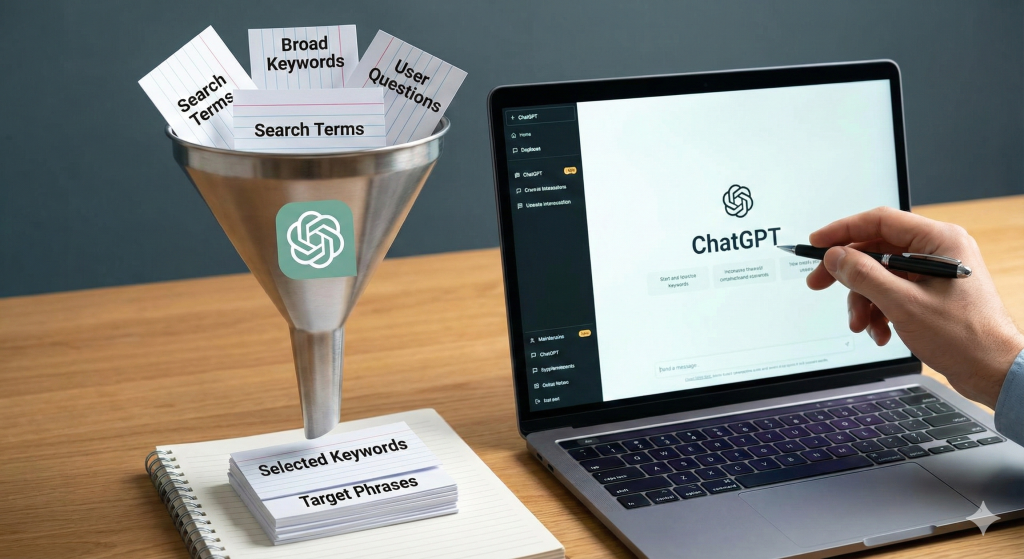
Is It Safe to Paste My Company Data?
This is the most important warning in this entire guide. You must understand “Shadow AI.” This is a term used to describe when employees use AI tools without permission or safety rules.5
When you type something into the free version of ChatGPT, that information is sent to a server. OpenAI, the company that owns ChatGPT, may use that conversation to train their future models.
The Risk Scenario:
Imagine you are launching a secret new product called “Project X.” You paste the confidential description into ChatGPT and ask for keywords. Later, a competitor asks ChatGPT, “What are some rumors about new products in this industry?” The AI might remember your secret description and tell them.3
How to Stay Safe:
- Never paste secrets: Do not put real customer names, passwords, or secret product names into the chat.
- Use specific settings: If you have the paid version (Team or Enterprise), you can turn off “Training.” This means your data stays private.
- Anonymize: If you must analyze data, change the names first. Call your product “Product A” instead of its real name.3
Section 2: How Do You Find Your First Keyword Ideas?
What If You Have Zero Ideas?
Sometimes you are starting from scratch. You have a topic, like “Vegan Dog Food,” but you don’t know what people type into Google to find it. Traditional tools show you numbers, but ChatGPT gives you ideas.
We will use a technique called the “Topic Explosion.” This helps you find the different “buckets” or categories that your customers care about.
The “For Dummies” Strategy:
A great way to find broad topics is to ask ChatGPT to imagine it is writing a book for beginners.
Actionable Prompt:
“I want to start a website about. Imagine you are writing a ‘For Dummies’ book about this topic. What would the chapter titles be? Give me a list of 10 chapters that cover the basics, the problems, and the advanced tips.”.8
Why This Works:
The “For Dummies” series is famous for breaking complex topics down into simple steps. When ChatGPT mimics this, it gives you a perfect list of “Seed Keywords.”
- Chapter 1 might be “Understanding Dog Nutrition.” (Keyword: “dog nutrition guide”).
- Chapter 2 might be “Common Allergies.” (Keyword: “dog food allergies”).
- Chapter 3 might be “Best Plant-Based Proteins.” (Keyword: “vegan dog protein”).
Now you have 10 main topics instead of just one.
How Can You Find Keywords for Different Types of People?
Not everyone searches the same way. A busy mom searches differently than a veterinarian. To capture all the traffic, you need to find keywords for every “Persona” or type of customer.
The Persona Matrix Prompt:
“Create a table for me. In the first column, list 5 different types of people who might buy. In the second column, write the specific problem they have. In the third column, write 3 keywords they would type into Google to solve that problem.”.9
Example Output:
| Persona | Problem | Keywords |
| Busy Mom | No time to cook. | “healthy easy dog food,” “quick vegan dog meals,” “best dry vegan dog food.” |
| Eco-Conscious Student | Wants to save the planet. | “sustainable dog food brands,” “low carbon pawprint food,” “ethical pet food.” |
| Veterinarian | Worried about health. | “nutritional value of vegan dog diet,” “taurine supplements for dogs,” “is vegan food safe for dogs.” |
See how different those words are? You would never have found “low carbon pawprint” if you just looked for “dog food.” This helps you write articles that speak directly to the person buying your product.10
Section 3: How Do You Master the “Long Tail” and Questions?
Why Are Long Questions Better Than Short Words?
In the past, we focused on short keywords like “running shoes.” But in 2025, people are using voice search and talking to AI chatbots. They ask long, specific questions. These are called “Long-Tail Keywords.”
A short keyword is hard to rank for because everyone uses it. A long keyword (like a full sentence) has fewer people searching for it, but those people are much more likely to buy.
The AEO Shift:
This is called “Answer Engine Optimization” (AEO). You want to be the best answer to a specific question.11
How Do You Find These Secret Questions?
ChatGPT is excellent at predicting these questions because it has read the entire internet. It knows how people talk.
The “People Also Ask” Prompt:
“Generate a list of 20 specific questions that people ask about. Focus on questions that start with ‘How,’ ‘Why,’ ‘What,’ and ‘Where.’ Include questions that show someone is ready to buy, and questions that show someone is confused.”.12
Deep Dive Strategy: The “Grounding Search”
When someone asks a complex question to an AI, the AI does something smart. It breaks that big question down into smaller, hidden searches to check its facts. These are called “Grounding Searches”.1 If you can answer these hidden searches, the AI will trust you more.
Actionable Grounding Prompt:
“I am going to ask you a complex question. I want you to act like a search engine robot. Tell me what smaller, simple searches you would need to do to answer my big question.
Big Question: ‘What is the best CRM software for a small real estate agency with 5 agents that works with Slack?'”.1
ChatGPT’s Likely Answer:
To answer that, the robot would need to search for:
- “CRM software for real estate.”
- “Slack integration CRM.”
- “Small business CRM pricing.”
- “Best CRM for 5 users.”
The Result:
Those four items are your new keywords! You should write content that answers each of those specific points. By doing this, you become the perfect source for the AI to use.1
Section 4: How Do You Analyze Competitors Without Expensive Tools?
Can ChatGPT See What My Competitors Are Doing?
Yes and no. ChatGPT cannot log into your competitor’s private analytics. However, it can read their public websites (using the browsing feature) and “reverse engineer” their strategy. This allows you to find “Gaps”—things they missed.
How to Find the “Content Gap”?
A Content Gap is a topic that your competitors are writing about, but you are not. Or even better, a topic that none of them are writing about, which gives you a chance to be number one.4
The Gap Analysis Prompt:
“I want you to analyze the top 3 competitors for my topic.
Competitor 1:
Competitor 2:
Competitor 3:
Compare their content. What main topics are they covering? What important questions are they FAILING to answer? Give me a list of 5 opportunities where I could write a better, more complete article.”.4
Why This Is Powerful:
ChatGPT will read the subheadings (the little titles) on their pages. It might notice that Competitor 1 talks about “Price” and Competitor 2 talks about “Features,” but neither of them talks about “Customer Support.”
- Your Strategy: Write an article that covers Price, Features, AND Customer Support. You will have the most complete guide on the internet.6
How to Find “LSI” Keywords (The Helper Words)?
Search engines look for “LSI” keywords. These are words that are neighbors to your main keyword. If you write about “Coffee,” Google expects to see words like “Bean,” “Roast,” “Brew,” and “Caffeine.” If those words are missing, Google thinks your article is poor quality.14
The Semantic Helper Prompt:
“I am writing an article about. List 20 ‘LSI’ (Latent Semantic Indexing) keywords and related terms that I should use in my article to help search engines understand my context. Include technical terms and synonyms.”.15
Tip:
Do not just stuff these words in. Use them naturally. If the list says “Roast,” write a sentence like “The darkness of the roast affects the flavor.” This makes your content look expert and trustworthy (E-E-A-T).16
Section 5: How Do You Organize Thousands of Keywords? (Advanced)
What is “Clustering”?
Imagine you have a basket of laundry. You have socks, shirts, and pants all mixed up. “Clustering” is just sorting that laundry into piles.
In SEO, you might find 1,000 keywords.
- “Buy red shoes”
- “Red sneakers for sale”
- “Purchase crimson trainers”
These are all the same intent. You do not want to write three different articles. You want to write one article that targets all three. Clustering helps you group them.2
Using “Code Interpreter” (The Magic Data Scientist)
If you have the paid version of ChatGPT, you have a feature called “Advanced Data Analysis” or “Code Interpreter.” This is like having a data scientist in your pocket. You can upload a file, and it will do the math for you.
Step-by-Step Clustering:
- Get your data: Download a list of keywords from Google Search Console or any free tool into a CSV (Excel) file.
- Upload the file: Click the little paperclip icon in ChatGPT and attach your file.
- Run the Prompt:
The Clustering Prompt:
“I have uploaded a list of keywords. I want you to group them into ‘Clusters’ based on their meaning. Put keywords that mean the same thing into the same group.
Then, create a table that shows:
- The Name of the Cluster.
- The keywords inside that cluster.
- The search intent (Informational or Transactional).
Please give me the file back as a download.”.2
The Result:
ChatGPT will write a small computer program (in Python) to sort your words. It will define the groups for you. Now, instead of being overwhelmed by 1,000 rows, you have 50 clear topic ideas to write about.17
Finding “Cannibalization”
“Cannibalization” is when you accidentally compete with yourself. If you have two pages trying to rank for “Best Pizza,” Google gets confused and ranks neither of them.
You can ask Code Interpreter to check this too.
“Look at my keyword list. Are there any clusters that look too similar? Identify any potential ‘cannibalization’ issues where two groups might overlap.”.18
Section 6: How Do You Turn Keywords into Content?
Why Are Content Briefs Important?
You have your keywords. Now what? You need a plan for writing. If you just start typing, you might miss important points. A “Content Brief” is a recipe for your blog post. It tells you what ingredients (keywords) to use and what steps (headings) to follow.
The Master Brief Prompt:
“Create a detailed Content Brief for a blog post about.
Include the following:
- A catchy Title.
- The Target Audience (Persona).
- The User Intent (What do they want?).
- A list of Secondary Keywords to include.
- A detailed Outline with H2 and H3 headings.
- Key questions to answer in the FAQ section.”.19
Using the Output:
This brief gives you a skeleton. You can write the article yourself, or give this brief to a writer. It ensures that the final article hits all the SEO requirements without you having to remember them all.20
How to Write Good Titles and Meta Descriptions?
The “Title Tag” and “Meta Description” are the first things people see on Google. If they are boring, no one clicks. ChatGPT is great at writing catchy headlines.
The Click-Magnet Prompt:
“Write 5 catchy Title Tags for my article about. They must be under 60 characters. They should make the reader curious but also include the main keyword.
Also, write 3 Meta Descriptions. They must be under 160 characters and include a ‘Call to Action’ like ‘Read now’ or ‘Learn more’.”.21
Tip:
Always check the character count. Google cuts off titles that are too long. ChatGPT usually gets close, but it is good to double-check.6
Section 7: Technical SEO Tricks for Non-Coders
What is Schema Markup?
Schema is a special code that helps search engines understand your content. It is how you get those star ratings or recipe cards to show up in Google search results. Usually, you need a programmer to write this. But ChatGPT can do it for you.
The FAQ Schema Prompt:
“I have written a FAQ section for my page. Here are the questions and answers:
[Paste Q&A]
Please write the ‘JSON-LD Schema Markup’ code for these FAQs. I want to copy and paste this code into my website header so Google can display rich snippets.”.22
Why Do This?
Pages with Schema often take up more space on the search results page. This attracts more clicks, even if you are not in the #1 spot.23
What is Regex? (A Super Power)
“Regex” stands for Regular Expressions. It is a way to filter data. If you use Google Search Console to see your traffic, you know the filters are basic. Regex lets you do advanced filtering.
The Regex Prompt:
“I want to filter my Google Search Console data. Write a ‘Regex’ code that matches any query that contains a question word (who, what, where, when, why, how) related to. I want to see exactly what questions people are asking.”.8
You can paste the weird-looking code it gives you directly into Google Search Console, and suddenly you will see data you never saw before.
Section 8: The Dangers of “Hallucinations” and Mistakes
Can You Trust ChatGPT’s Data?
You have to be careful. ChatGPT has a weakness called “Hallucination.” This means it can confidently tell you a lie.
- Search Volume: ChatGPT cannot know the exact search volume for a keyword unless it is browsing a live tool. If you ask “What is the search volume for ‘red shoes’?”, it might make up a number like “10,000” because that sounds right.
- Fake Keywords: It might invent keywords that sound real but no one actually uses.
The Rule of Verification:
Use ChatGPT for ideas and strategy. Use trusted tools (like Google Keyword Planner, Semrush, or Ahrefs) for numbers.
- Bad Prompt: “Tell me the exact search volume for these keywords.”
- Good Prompt: “Rank these keywords from ‘Most Likely to be Popular’ to ‘Least Likely’ based on your knowledge of the industry.” (This asks for an estimate, which the AI is good at).23
The “Echo Chamber” Effect
If you ask generic questions, you get generic answers. Everyone using ChatGPT is getting the same advice. To win, you need to be unique.
- Add “Experience” (E-E-A-T): Google loves “Experience.” ChatGPT has no life experience. It has never walked a dog or fixed a car. You must add your own personal stories and real-life examples to the content ChatGPT outlines. This is what separates human content from AI slop.24
Conclusion: Your New Workflow for 2025
The world of keyword research has moved beyond simple lists of words. It is now about understanding intent, answering complex questions, and building authority. By using ChatGPT, you can do the work of a whole marketing team yourself, but only if you use it wisely.
Summary of Your New Process:
- Define Persona: Tell ChatGPT who to be.
- Generate Seeds: Use “For Dummies” and “Persona Matrix” prompts to find broad ideas.
- Expand with Questions: Find the “Long-Tail” questions that real humans ask.
- Analyze Gaps: Look at your competitors and find what they missed.
- Cluster Data: Use Code Interpreter to sort the mess into a clear plan.
- Create Content: Use Briefs and Schema to write articles that Google and AI engines love.
- Verify: Check the facts and add your human touch.
If you follow these steps, you will not just be “doing SEO.” You will be building a digital presence that is future-proof, secure, and ready for the age of Artificial Intelligence.
Appendix: Master Prompt Library (Copy-Paste)
Here is a collection of the best prompts from this guide. You can copy these directly into ChatGPT to get started immediately.
1. The Expert Setup
“Act as a Senior SEO Strategist. You specialize in semantic search and user intent analysis. Your goal is to help me build a keyword strategy that targets high-intent users for [Industry/Niche]. Avoid generic advice; focus on actionable, data-backed tactics.”
2. The Competitor Spy
“Analyze the content structure of these three competitor URLs:,,. Compare them to my website. Identify specific topics, questions, and entities that they cover but I do not. Prioritize these gaps based on their likely relevance to a ‘Ready to Buy’ user persona.”
3. The Grounding Search Finder
“Act as an AI inference engine. I am asking the question: ‘[Complex User Query]’. Break this down into the specific sub-queries (grounding searches) you would run to verify the answer. List these sub-queries as target keywords for my content.”
4. The LSI Generator
“For the keyword ”, identify 20 LSI keywords and semantic neighbors. Include technical terminology, acronyms, and industry jargon. Categorize them by topic.”
5. The Content Improver
“Review this article draft. Identify any sentences that are hard to read. Suggest where to insert bullet points, bold text for emphasis, and tables to break up walls of text. Ensure the tone is helpful and authoritative.”
Detailed Analysis: Why This Matters for Your Business
The Shift from “Keywords” to “Entities”
In the old days (around 2015), Google looked for strings of text. If you searched for “Jaguar,” it looked for pages with the word “Jaguar” on them. Today, Google uses a “Knowledge Graph.” It understands “Entities.” It knows that “Jaguar” can be an Animal or a Car.15
When you use ChatGPT, you are tapping into this same kind of logic. ChatGPT understands the concept of your business, not just the spelling. When you ask it for “LSI Keywords” or “Semantic Neighbors,” you are effectively telling Google, “I know what I am talking about.” You are building a web of meaning.
- If you write about “Jaguar” (the car), and you include words like “Speed,” “Engine,” “Luxury,” and “Tata Motors,” Google is 100% sure you are talking about the car.
- If you miss these entities, Google gets confused.
ChatGPT is the best tool in the world for finding these entities because it has been trained on the relationships between them.
The “Intent-to-Revenue” Mindset
Traditional keyword tools give you “Search Volume.” They tell you that 10,000 people search for “Free SEO Tips.” That sounds great, right?
But maybe 0% of those people want to buy your service. They just want free stuff.
ChatGPT helps you find “High Intent” keywords. These might only have 50 searches a month, but they are searched by people with a credit card in their hand.1
- Low Intent: “What is SEO?”
- High Intent: “Best SEO agency for dentists in Chicago.”
Using the Persona Matrix Prompt (from Section 2) forces you to think about these High Intent users. It moves you away from vanity metrics and toward money-making metrics.1
The Technical Edge: Python for Everyone
The most “expert” part of this guide is the use of Code Interpreter. Usually, clustering keywords requires learning a coding language like Python or paying $100/month for a tool like Keyword Insights.
ChatGPT gives you this power for $20/month.
By simply uploading a spreadsheet and asking it to “Cluster these,” you are performing data science. You are finding patterns that no human brain could spot in a list of 5,000 rows. This allows you to build “Topic Clusters” on your website. Instead of having one messy blog, you have organized “Hubs” of content. This is exactly what Google wants to see in 2025.2
Final Thoughts on “Shadow AI“
We mentioned this in the introduction, but it bears repeating. As you get better at using ChatGPT, you will be tempted to do more with it. You might want to analyze your customer emails to find keywords. You might want to analyze your sales data.
- Stop.
- Think.
- Sanitize.
Always remove personal names, emails, and addresses. Treat ChatGPT like a public library. Do not leave your diary on the table. If you follow this simple rule, you can unlock all the power of AI without any of the risks.3
By mastering these prompts and workflows, you are not just keeping up with the changes in SEO; you are getting ahead of them. You are ready for a future where search is conversational, visual, and AI-driven.
Citations used:.1
Works cited
- AEO Keyword & Question Research: Finding and Targeting Al …, accessed December 2, 2025, https://www.maximuslabs.ai/answer-engine-optimizations/aeo-keyword-and-question-research
- What Is Keyword Clustering and How to Do It – SEOTesting, accessed December 2, 2025, https://seotesting.com/blog/keyword-clustering/
- Cheto AI – The world of technology and AI, accessed December 2, 2025, http://chetoai.com/
- Cool ChatGPT prompt for content gaps – SEO – Reddit, accessed December 2, 2025, https://www.reddit.com/r/SEO/comments/1kauyf2/cool_chatgpt_prompt_for_content_gaps/
- Cheto AI – The world of technology and AI, accessed December 2, 2025, https://www.chetoai.com
- SEO Prompts for ChatGPT: Elevate Rankings with AI Prompts – Search Engine Land, accessed December 2, 2025, https://searchengineland.com/guide/seo-prompts-for-chatgpt
- I was tired of generic “SEO tips” that don’t work in 2025, so I built the most detailed blog optimization prompt that covers traditional SEO + AI search (ChatGPT, Perplexity, etc.). Here it is – completely free. : r/ChatGPTPromptGenius – Reddit, accessed December 2, 2025, https://www.reddit.com/r/ChatGPTPromptGenius/comments/1nzjcgq/i_was_tired_of_generic_seo_tips_that_dont_work_in/
- How to use ChatGPT for keyword research (with actual prompts) – Search Engine Land, accessed December 2, 2025, https://searchengineland.com/keyword-research-chatgpt-prompts-393741
- How To Use ChatGPT For Keyword Research – Search Engine Journal, accessed December 2, 2025, https://www.searchenginejournal.com/chatgpt-for-keyword-research/483848/
- Keyword Research That Works: AI SEO Tactics for 2025 – Passionfruit SEO, accessed December 2, 2025, https://www.getpassionfruit.com/blog/ultimate-guide-to-keyword-research-how-to-do-keyword-research-that-actually-works-for-ai-seo
- Answer engine optimization aeo keyword research & selection strategies 2025 – SEMAI.ai, accessed December 2, 2025, https://semai.ai/search-engine-optimization/aeo-guides/answer-engine-optimization-aeo-keyword-research-and-selection-strategies-2025
- The best and easiest ChatGPT prompts for keyword research – Morningscore, accessed December 2, 2025, https://morningscore.io/chatgpt-keyword-research-prompts/
- SEO Content Gap Analysis Prompt – Reliablesoft, accessed December 2, 2025, https://www.reliablesoft.net/chatgpt-prompts/seo/seo-content-gap-analysis-prompt/
- How to Use ChatGPT for SEO Keyword Research: A Guide for Creatives | Davey & Krista, accessed December 2, 2025, https://daveyandkrista.com/chatgpt-keyword-research/
- How to Select Keywords with ChatGPT – SEOLAB, accessed December 2, 2025, https://seolab.com.ua/how-to-select-keywords-with-chatgpt/
- How To Use ChatGPT for Your Keyword Research and Content Topic Ideation, accessed December 2, 2025, https://thriveagency.com/news/how-to-use-chatgpt-for-your-keyword-research-and-content-topic-ideation/
- awesome-chatgpt-prompts-clustering/README.md at main – GitHub, accessed December 2, 2025, https://github.com/daniel-furman/awesome-chatgpt-prompts-clustering/blob/main/README.md
- The 8 Best Keyword Clustering Tools in 2025 (Free & Paid), accessed December 2, 2025, https://answersocrates.com/blog/best-keyword-clustering-tools/
- 12 ChatGPT Prompts For SEO : r/DigitalMarketing – Reddit, accessed December 2, 2025, https://www.reddit.com/r/DigitalMarketing/comments/1mjp5q4/12_chatgpt_prompts_for_seo/
- Steal Your Competitor’s Traffic & Keywords! FREE ChatGPT Prompt – YouTube, accessed December 2, 2025, https://www.youtube.com/watch?v=ERjKZE62pa8
- 10 Powerful ChatGPT Prompts for SEO (Ultimate Guide for 2025), accessed December 2, 2025, https://www.godofprompt.ai/blog/10-powerful-chatgpt-prompts-for-seo
- 20 ChatGPT Prompts for SEO to Optimize Your Website for Success Today – Digital First AI, accessed December 2, 2025, https://www.digitalfirst.ai/blog/chatgpt-prompts-for-seo
- ChatGPT for SEO: Ultimate Guide, Tips & Prompts – Backlinko, accessed December 2, 2025, https://backlinko.com/chatgpt-for-seo
- 8 SEO Metaphors to Enhance your SEO Understanding – Socialed Inc, accessed December 2, 2025, https://socialed.ca/blog/seo-metaphors/
- 9 ChatGPT Prompts to Instantly Upgrade Your SEO Strategy : r/NextGenAITool – Reddit, accessed December 2, 2025, https://www.reddit.com/r/NextGenAITool/comments/1oxrtff/9_chatgpt_prompts_to_instantly_upgrade_your_seo/