
Building AI agents used to be a very lonely and difficult process because every tool spoke a different language. You would spend weeks writing custom code just to help a chatbot read a simple file or check a calendar. The Model Context Protocol changes all of that by acting as a universal translator. This new standard allows any AI model to connect to any data source or tool without needing a unique connector for every single pairing. 1
Key Takeaways
- The Model Context Protocol solves the mess of custom integrations by providing a single, open standard for how AI models talk to data sources and tools. 2
- Major tech leaders like Anthropic, Google, and Microsoft have adopted this system to allow agents to perform real world tasks in apps like Slack, GitHub, and BigQuery. 4
- New efficiency features like code execution and tool search help agents handle thousands of tools while using fewer tokens and costing less money. 7
- Security is a top priority for this system, using strict boundaries and features like Model Armor to prevent data leaks and keep agents safe from bad prompts. 4
- The protocol is now part of the Agentic AI Foundation under the Linux Foundation to ensure it stays open and free for everyone to use forever. 1
What is the Model Context Protocol?
The Model Context Protocol is an open standard that lets AI models connect to external data and tools through a universal interface. It replaces the old way of building unique connectors for every app with a single system that works across different models and services. 1
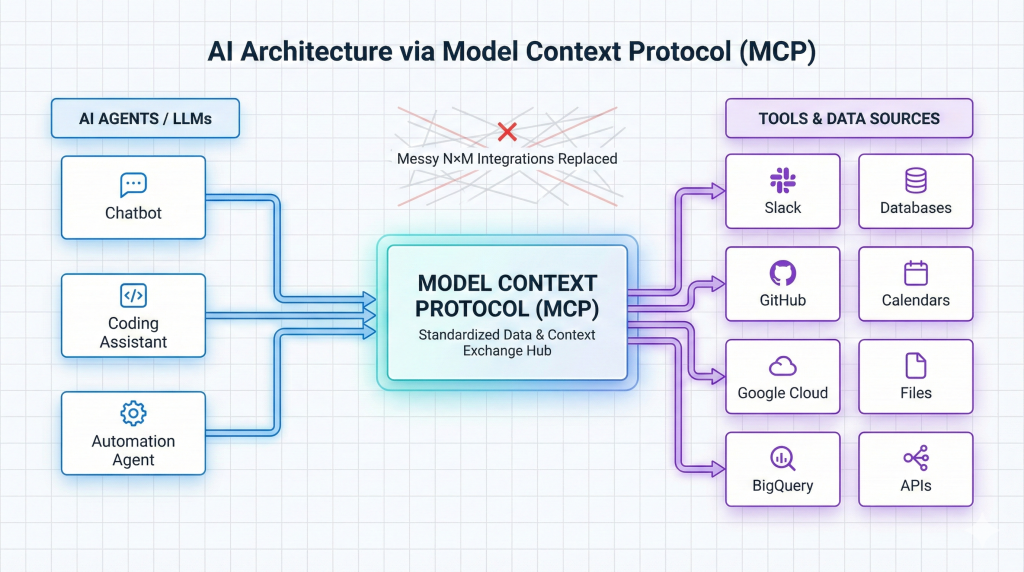
For a long time, artificial intelligence lived in a bubble. It knew what it was trained on, but it could not easily see your personal files or use your office software. To give a model access to a database, a developer had to write a specific piece of code. If they wanted to use a different model the next day, they often had to start that work all over again. This created a huge amount of redundant work that slowed down the entire industry. 2
The Model Context Protocol acts as a bridge between these two worlds. Think of it like a USB-C port for AI applications. Before USB-C, you needed a different cable for your phone, your laptop, and your camera. Now, one cable can handle everything. This protocol does the same thing for software. It gives developers a standard way to plug their data and tools into any AI model. 4
This shift is a big deal because it moves AI from being just a chatbot to being a doer. Instead of just talking about a problem, an agent can now use this protocol to look up the right data, run a calculation, and then send an email with the result. By making these connections easy and standard, the protocol allows for much more powerful and autonomous agentic workflows. 3
Why do we need a universal standard for AI agents?
A universal standard is necessary because the old method of connecting AI to tools resulted in a complex mess called the N times M problem. This meant every new model and every new tool required a unique connection, which made scaling professional AI systems nearly impossible. 1
In the early days of AI development, every company built its own way for models to talk to the outside world. This created a fragmented landscape where tools did not work together. If you had five different AI models and ten different data sources, you might have to build fifty different integrations. This is the core of the N times M problem. It wastes time, money, and energy on basic plumbing instead of innovation. 1
These custom integrations were also very fragile. If an API changed or a model was updated, the connection would often break. This lack of consistency meant that different integrations would handle the same task in totally different ways. This caused confusion for users and made it hard for businesses to trust that their AI agents would behave predictably. 15
| Integration Type | Complexity Level | Maintenance Requirement | Scalability |
| Custom Bespoke Code | High (N x M problem) | Very High (breaks often) | Poor |
| Model Context Protocol | Low (Single Standard) | Low (Unified updates) | Excellent |
| Manual API Linking | Medium | High | Fair |
1
By moving to a single protocol, the industry can finally stop reinventing the wheel. A developer can build an MCP server once for their database, and then every AI application that supports the protocol can use it immediately. This allows for a massive ecosystem of ready to use tools that can be plugged in like pieces of a puzzle. 12
How does the architecture of the protocol work?
The architecture uses a simple client server model where the AI application acts as a host and the data source acts as a server. This design is inspired by the Language Server Protocol and uses structured messages to ensure that the model and the tools understand each other. 1
The system is made of three main parts. First, there is the host, which is the main application where the user is working. This could be a coding tool like Cursor or a desktop assistant like Claude. The host is the brain that manages everything. Second, there is the client, which is a small part inside the host that knows how to speak the protocol. It handles all the talking between the brain and the outside world. 16
Third, there is the server. The server is like a specialized worker that holds a specific set of tools or data. One server might know how to talk to GitHub, while another might know how to search the web. The host can connect to many different servers at the same time. This modular design means that you can mix and match tools based on what you need for a specific task. 1
Communication between these parts happens using a standard called JSON-RPC 2.0. This ensures that every message is clear and follows a specific structure. The system also uses a transport layer to move these messages. For tools on the same computer, it uses standard input and output. For tools on the internet, it uses a web standard called Server Sent Events. 1
What are the three pillars of the protocol?
The protocol is built on three pillars known as tools, resources, and prompts. Together, these three components define exactly what an agent is allowed to do, what information it can read, and how it should talk to the user during a task. 10
Think of tools as the hands of the agent. They are functions that the AI can call to make things happen in the real world. A tool might be a function that adds a new row to a spreadsheet or one that sends a Slack message to a team. Each tool has a name and a description that helps the model understand when it should use it. Tools are active and can change things. 10
Resources are like the agent’s library. They are pieces of data that the agent can read but usually not change. This could include a PDF document, a piece of source code, or a setting from a configuration file. Resources provide the agent with the facts it needs to answer questions accurately. By using resources, the agent can avoid guessing and stay grounded in real data. 10
Prompts are the instructions that guide the agent. They are templates that help the model figure out the best way to interact with a user. For example, a prompt might tell an agent how to interview a job candidate or how to summarize a long legal contract. Prompts ensure that the agent follows a consistent style and asks the right questions to get the job done. 10
How does the protocol solve the context window problem?
The protocol solves the context window problem by using smart features like tool search and on demand discovery. This prevents the model’s memory from becoming cluttered with thousands of tool definitions, which saves money and keeps the AI focused on the task at hand. 7
When an agent has access to a lot of tools, it can quickly run out of memory. This is because every tool needs a detailed description so the model knows how to use it. If an agent has a thousand tools, and each description takes up space, the model might use up its entire context window just reading the tool list. This leaves no room for the actual conversation or the user’s data. 7
To fix this, the protocol uses a system called tool search. Instead of loading every single tool at the start, the agent first uses a special search tool to find the ones it actually needs. If a user asks about the weather, the agent only looks for weather tools. Once it finds the right ones, it loads their full descriptions into its memory. This keeps the workspace clean and efficient. 5
This approach is much more scalable for large companies. It allows an agent to be connected to every database and app in the entire organization without getting overwhelmed. By only loading the context that is relevant to the current moment, the agent stays fast and accurate while keeping the cost of tokens as low as possible. 7
What is code execution in the context of this protocol?
Code execution allows an agent to write and run small scripts to process data locally instead of sending everything back to the model. This makes the agent much more efficient and can reduce the amount of data it needs to handle by nearly ninety nine percent. 7
In a normal AI workflow, the model has to see every piece of data to make a decision. If you want an agent to find one specific email out of five thousand, it usually has to read all of them. This is very slow and uses a lot of tokens. With code execution, the agent can write a short Python script that searches the emails for it. The script runs in a safe sandbox and only sends the one correct email back to the model. 7
This shift is often called code mode or programmatic tool calling. It turns the AI into an orchestrator that uses code to handle the heavy lifting. Think of it like a manager who writes a quick instruction for a specialized worker instead of trying to do every small task themselves. This keeps the manager’s mind clear and allows them to focus on the big picture. 7
| Method | Data Handling | Token Usage | Efficiency |
| Traditional Tool Use | Reads every data point. | Very High | Low |
| Code Execution | Processes data with scripts. | Very Low | Very High |
| Manual Fetching | Limited by memory size. | High | Medium |
Using code execution also improves privacy. Since the scripts run in a local environment, the model itself never sees the sensitive raw data that is being filtered. It only sees the final result that the script produces. This provides a natural layer of protection for personal information and company secrets. 7
How is Google Cloud using the protocol for its services?
Google Cloud has released official support for the protocol to connect AI agents with services like Maps, BigQuery, and Compute Engine. This allows agents to work with real world location data and manage enterprise infrastructure through a unified and secure interface. 4
Google has created remote protocol servers that live in the cloud. This means developers do not have to set up their own servers to use Google tools. They can just point their agents to the official Google endpoints. This provides a consistent experience across all Google services, making it much easier to build complex agents that need to use many different Google apps at once. 4
One of the most exciting parts is Google Maps integration. Through a feature called Grounding Lite, agents can look up fresh information about places, the weather, and travel routes. This stops the model from hallucinating or guessing where things are. If you ask an agent to find a kid friendly restaurant near your hotel, it uses the protocol to get real data from Google Maps to give you a perfect answer. 4
For developers, this means agents can now be grounded in the real world. They can check the distance between two spots, see what the weather will be like this weekend in Los Angeles, and provide accurate routing details. This level of reliability is essential for building AI assistants that people can actually trust for travel and local planning. 4
Can an agent really manage cloud infrastructure?
Yes, agents can now manage cloud infrastructure by using the protocol to talk to Google Compute Engine and Google Kubernetes Engine. These servers expose tools that allow agents to create servers, resize disks, and fix failures automatically without human intervention. 4
Managing a cloud environment is usually a very technical task that requires a lot of manual work. With the new protocol servers, these tasks are turned into tools that an AI can understand. An agent can now see a list of available server types and choose the right one for a specific project. It can also monitor the health of a system and take action if something goes wrong. 4
For example, if a database is running out of space, an agent can recognize the problem and use a tool to resize the disk. It can also help with day to day operations like setting up firewalls or managing security policies. This allows for a new kind of autonomous management where the agent acts as a junior cloud engineer that handles all the boring and repetitive tasks. 4
| GCE Tool Category | Examples of Capabilities | Primary User |
| Instance Management | Start, stop, suspend, or resize servers. | Infrastructure Agents |
| Networking | Manage firewalls, networks, and VPNs. | Security Agents |
| Storage | Create snapshots and resize disks. | Database Agents |
| Health Monitoring | Check health and manage global operations. | Reliability Agents |
The Kubernetes integration is just as powerful. It gives agents a structured way to interact with container APIs. Instead of trying to read complicated text logs, the agent gets clean data that it can use to diagnose issues and optimize costs. This helps companies keep their systems running smoothly and cheaply with much less human effort. 4
How does BigQuery work with the protocol?
The BigQuery protocol server lets agents analyze enterprise data directly where it lives without moving it around. This allows agents to understand data structures, write SQL queries, and interpret the results while keeping everything secure and governed. 4
BigQuery is where many large companies store their most important information. Usually, it is hard for an AI to access this data because the datasets are too big to fit into a chat window. The protocol changes this by letting the agent act as a data analyst. The agent can look at the schema of a table and figure out how to write the correct SQL query to answer a user’s question. 4
This is much safer than moving data to the model. Since the query runs inside BigQuery, all the existing security rules are still in place. The model only sees the final answer, not the entire database. This allows for natural language data analysis where a business leader can just ask their agent for a sales forecast or a summary of customer trends. 4
Using the protocol with BigQuery also reduces latency. The agent does not have to wait for large files to download before it can start working. It can just send the command and get the result back in seconds. This makes it possible to build real time dashboards and reporting tools that are entirely powered by AI agents. 4
What are the security benefits of using this protocol?
Security is a core part of the protocol, providing strict boundaries that prevent agents from accessing data they should not see. By using controlled tools instead of direct database access, the system minimizes the risk of data leaks and makes models much harder to trick. 4
In the past, giving an AI access to a system often meant giving it a lot of power. If the model was fooled by a clever user, it might accidentally delete data or show private information. The Model Context Protocol uses a principle called least privilege. This means the agent only gets the specific tools it needs to do its job, and nothing more. 10
For example, a customer service agent might have a tool to look up a shipment status. That tool only returns the status and the tracking number. It does not have the power to see the customer’s credit card info or change their address. Because these boundaries are built into the protocol server, the agent physically cannot perform those actions even if a user tries to convince it to. 10
Google Cloud also adds an extra layer of protection called Model Armor. This feature scans all the messages coming in and out of the agent to look for signs of trouble. It can detect attempts to manipulate the model and block sensitive data from being shared. This makes it much safer for big companies to use agents for important tasks. 4
How does the protocol improve security in healthcare?
In the healthcare field, the protocol helps protect patient privacy by separating actions from information through the use of discrete tools and resources. This ensures that agents can help with scheduling and triaging without ever having direct access to sensitive medical records. 10
Healthcare is one of the most regulated industries because patient data is so sensitive. The Model Context Protocol provides a framework that fits these strict rules. By using resources for static data like provider directories and tools for active tasks like booking an appointment, the system keeps everything organized and safe. 10
Think of it like a bank teller. The teller can see your account balance to help you, but they cannot just walk into the vault and take whatever they want. The protocol acts as the glass window between the agent and the patient’s data vault. It only lets the right information through to complete the specific task at hand. 10
| Healthcare Task | MCP Component | Privacy Protection |
| Finding a Doctor | Resources | Only shows public directory info. |
| Booking Appointments | Tools | Restricted to specific time slots only. |
| Patient Triage | Prompts | Guides the agent to ask safe questions. |
| Checking Vitals | Remote Tools | Data is verified before the model sees it. |
The protocol also helps reduce hallucinations in medical settings. By normalizing how data like dates and dosages are shared, it reduces the chance that the model will misinterpret a record. This makes the agent a much more reliable assistant for doctors and nurses who need quick and accurate information. 3
How does the protocol help with financial negotiations?
Financial teams use the protocol to give agents access to historical emails and current vendor terms to help with contract renewals. This allows the agent to provide data driven advice and even draft negotiation emails that are based on the best possible information. 14
Negotiating a software renewal can take a lot of time. You have to find old contracts, look up how much you paid last year, and see what the vendor is offering now. An agent using the Model Context Protocol can do all this work in a few seconds. It can pull data from your email and your accounting software at the same time to see the whole picture. 22
Once it has all the context, the agent can recommend a strategy for the renewal. It can tell you if the new price is fair or if there are things you should ask for based on your past usage. This gives finance teams a huge advantage because they are always armed with the latest data during a negotiation. 22
The agent can also take care of the actual communication. It can draft a professional email to the vendor that highlights the points you want to negotiate. Because the agent stays connected to the conversation, it can keep updating its advice as the vendor replies. This turns the agent into a tireless partner that ensures you always get the best deal. 22
How can recruitment teams use this protocol?
Recruitment agents use the protocol to search internal databases and project management tools to find the best candidates for a job. By looking at how candidates performed in past interviews across different systems, the agent can surface the highest quality talent more quickly. 22
Finding the right person for a job often involves looking at many different places. You might have a list of resumes in one app and interview notes in another. An AI agent using the protocol can talk to all these apps through a single interface. It can search for senior engineers who have worked on specific projects and see who got the best feedback from your team in the past. 22
This allows for much more personalized sourcing. Instead of just looking for keywords on a resume, the agent can understand the context of what your company actually needs. It can compare a new job description with successful hires from the past to see what traits truly matter for the role. 22
| Recruitment Workflow | MCP Integration | Expected Outcome |
| Candidate Sourcing | Link to ATS and CRM data. | High fit candidate lists. |
| Interview Analysis | Connect to notes and transcripts. | Better understanding of team needs. |
| Automated Outreach | Email and Slack tools. | Faster response times from talent. |
| Data Integration | Internal talent database access. | Unified view of all candidates. |
By automating the boring parts of sourcing, recruiters can spend more time actually talking to people. The agent handles the deep search and the data entry, while the human makes the final decision on who to hire. This partnership makes the entire hiring process much more efficient and less stressful. 12
How do coding assistants like Cursor and GitHub Copilot use the protocol?
Coding assistants use the protocol to get a deep understanding of an entire codebase by searching files and reading code across many different repositories. This allows the AI to fix bugs, explain complex logic, and even commit changes directly to the project with the developer’s permission. 15
In the past, AI coding tools could only see the file you were currently editing. If you had a bug that was caused by a different file, the AI might not be able to find it. With the Model Context Protocol, the agent can search the entire project to find every place a specific function is used. This gives it the full context it needs to provide a perfect fix. 11
This is especially helpful for large projects with thousands of files. An agent can use a tool to fetch the content of any file it thinks is relevant to your current task. It can also use a protocol server for GitHub to check the history of a file and see who changed it last. This makes the AI feel like a team member who has read every single line of code in the company. 23
| Feature | Before MCP | After MCP |
| Code Context | Limited to the current file. | Access to the entire codebase. |
| Bug Fixing | Guesses based on partial info. | Verified fixes using full context. |
| Repository Access | Manual copy and paste needed. | Automatic file search and retrieval. |
| Commit Power | Cannot change the repository. | Can stage and commit changes |
The protocol also allows these tools to be much more modular. Instead of the IDE having to know how every database works, it can just connect to an MCP server for Postgres or Redis. This means that as new tools and databases are created, your coding assistant can learn how to use them instantly just by plugging into the new protocol server. 12
What is the Agentic AI Foundation and why does it matter?
The Agentic AI Foundation is a non profit group under the Linux Foundation that manages the Model Context Protocol as a neutral, open standard. This ensures that no single company can control how AI agents talk to the world, which keeps the technology fair and accessible for everyone. 1
When a technology is owned by just one company, there is always a risk that they might start charging high fees or stop other companies from using it. By donating the protocol to the Linux Foundation, Anthropic has made sure that this will not happen. The foundation acts as a neutral home where everyone from Google to Microsoft can work together to improve the standard. 5
This matters because a universal standard only works if everyone uses it. Because the foundation is neutral, it encourages more companies to adopt the protocol. It also provides a way for the community to help make the rules. If a developer has a great idea for a new feature, they can propose it to the foundation, and it might become part of the official standard for everyone to use. 5
Being part of the Linux Foundation also gives the protocol a lot of credibility. The Linux Foundation has a long history of managing some of the most important software in the world, like the Linux kernel and Kubernetes. This track record gives businesses the confidence to build their future products on top of the Model Context Protocol, knowing that it will be supported and maintained for many years. 5
How do you build your first MCP server?
Building an MCP server is a straightforward process using SDKs for popular languages like Python and TypeScript. You can use the FastMCP library to quickly create tools and resources that an AI model can use to interact with your local data or web services. 13
The first step is to choose a language you are comfortable with. Python is a very popular choice because it is easy to read and has a lot of libraries for data. You can install the FastMCP library and write a few lines of code to define your first tool. For example, you could build a tool that tells the AI your current local time or one that reads a specific text file on your computer. 13
Once you have written your server, you need to test it. There is a tool called the MCP Inspector that lets you see exactly how the agent is talking to your server. You can see the messages going back and forth and make sure everything is working correctly. After that, you can add your server to an app like Claude Desktop to see your agent actually use your new tool in a real conversation. 2
| Development Step | Action Needed | Recommended Tool |
| Choose Language | Select Python, TypeScript, or Java. | VS Code |
| Install SDK | Add the protocol library to your project. | FastMCP or Python SDK |
| Define Tools | Write functions and add descriptions. | Python |
| Test Server | Verify messages and handle errors. | MCP Inspector |
| Connect to Host | Add the server settings to an AI app. | Claude Desktop |
As you get more comfortable, you can build much more complex servers. You could connect to an API for weather data, a database for customer records, or even a local smart home system. The beauty of the protocol is that once you build the server, any AI model that supports the standard can use those same tools without any extra work from you. 12
What are the main challenges people face with AI agents?
The main challenges include dealing with messy data, managing the high cost of model usage, and making sure the agent does not make mistakes when it is not being watched. These problems show that building a great agent requires more than just good code; it also requires good processes. 20
One of the biggest issues is that the software we use every day is often very old and disorganized. If you try to point an AI agent at a messy folder full of confusing spreadsheets, it is going to struggle. Developers often find that they spend eighty percent of their time just cleaning up data so the AI can understand it. This is why it is often better to start with one small and simple problem instead of trying to automate everything at once. 26
Cost is another big hurdle. AI models can be expensive to run, especially if they are performing many steps in a row. If an agent gets stuck or is too talkative, your monthly bill can skyrocket very quickly. Successful teams use features like code execution to keep these costs down. They also set strict limits on how many actions an agent can take before it has to ask a human for help. 26
Finally, there is the problem of trust. AI models can be confidently wrong, and you do not want an agent sending a weird email to your best customer at two in the morning. Building an autonomous agent actually requires a lot of human babysitting at the start. You need to keep detailed logs of every decision the agent makes and build clear rules for when it should just give up and get a human to take over. 26
How does the protocol handle multi step workflows?
The protocol enables multi step workflows by allowing agents to chain together different tools and maintain context across a long series of actions. This allows an agent to gather data from one source, process it, and then use that result to perform an action in a completely different app. 12
Think of a multi step workflow like a relay race. The first tool gets the data and passes it to the next tool. For example, an agent might first use a search tool to find a customer’s order number. Then, it uses a database tool to find the tracking link for that order. Finally, it uses an email tool to send that link to the customer. The Model Context Protocol ensures that the data moves smoothly between each of these steps. 12
This is possible because the protocol uses a standard format for all its messages. The agent does not have to worry about translating data from one app to another. It just gets the result in a clean structure that it can immediately use for the next step. This allows for very complex automation that can handle an entire business process from start to finish. 12
| Workflow Step | Action Taken | Tool Used |
| Data Retrieval | Fetch customer ID from a CRM. | CRM Server |
| Status Check | Look up order status in a warehouse app. | Inventory Server |
| Information Summary | Combine details into a short report. | Internal Model |
| Final Action | Post the update to a Slack channel. | Slack Server |
To keep these workflows under control, developers often use a system of nodes and edges. Each node is a step in the process, and the edges are the paths the agent can take based on what happens. This gives the agent a clear map to follow and ensures that it stays within the boundaries set by the developers. 20
Why is industry adoption of the protocol growing so fast?
Industry adoption is growing because major companies realized that they cannot solve the integration problem alone and need a shared standard to move forward. The protocol provides a way for competitors to work together on infrastructure while still competing on the quality of their AI models. 1
In the past, tech companies often tried to lock users into their own specific systems. But with AI, the world is moving too fast for that to work. Every day there is a new model or a new tool, and no single company can build all the connections themselves. Major players like OpenAI and Google joined the protocol because they knew it would help their own users get more value out of their models. 1
This creates a virtuous cycle. As more companies support the protocol, more developers build protocol servers. As more servers are built, the AI models become more useful, which draws in even more users. This rapid growth is why the protocol has become the de facto standard for connecting agents to tools in less than a year. 5
The shift is also being driven by tool makers like Zed, Sourcegraph, and Replit. These companies want their AI features to work with as many data sources as possible. By adopting the protocol, they can give their users instant access to a massive library of pre built tools. This helps them innovate faster and focus on making their core product better instead of writing endless integration code. 2
What is the difference between RAG and this protocol?
Retrieval Augmented Generation is mostly used for answering questions based on documents, while the Model Context Protocol is designed for agents that need to perform real world actions. While both help models avoid hallucinations, the protocol provides a much more powerful framework for two way interaction. 3
RAG is like giving a model a textbook to read before it takes an exam. It helps the model find the right facts in a large collection of papers or articles. It is great for building chatbots that can answer questions about a company’s internal policies or a technical manual. But RAG usually cannot do things like book a flight or update a database record. 3
The Model Context Protocol is more like giving the model a universal remote control. It can still read documents using resources, but it can also take action using tools. This allows the AI to move beyond just talking and start doing actual work. While RAG is a search problem, this protocol is an action and integration problem. 3
| Feature | RAG (Retrieval) | MCP (Integration) |
| Primary Goal | Fact checking and summarizing. | Performing actions and tasks. |
| Interaction Type | Mostly read only. | Two way (read and write). |
| Best For | Chatbots and FAQ systems. | Autonomous agents and tools. |
| Core Mechanism | Searching documents for text snippets. | Calling functions and using APIs. |
Many advanced systems use both at the same time. An agent might use RAG to find the right information in a contract and then use an MCP tool to update the pricing in a billing system. By combining these two technologies, developers can build agents that are both smart and capable of handling real world business processes. 3
How do agents maintain session memory across tools?
Agents use session IDs and metadata to keep track of a user’s context as they move between different tools and servers. This ensures that the agent remembers who you are and what you were doing, even if it has to talk to five different apps to finish your request. 14
Maintaining memory is one of the hardest parts of building a good agent. If an agent forgets your name or your goal halfway through a task, it is very frustrating. The protocol handles this by including session management in its core design. Every conversation has a unique ID that follows the agent as it calls different tools. 14
This allows for much smoother transitions. Imagine you are booking a trip. The agent first looks up flights on a travel server. Then, it checks your calendar on a Google server to see if you are free. Because the session ID is consistent, the agent knows that the flight it found in the first step is the one it needs to compare with your calendar in the second step. 14
Memory also helps with personalization. Over time, an agent can learn that you prefer certain types of data or that you always want your summaries to be short. By storing these preferences as part of the session context, the agent becomes more helpful the more you use it. This creates a more natural and human like experience for the user. 14
What is the future of the agentic ecosystem?
The future of the ecosystem is a world of agentic software where specialized tools are designed from the ground up to be used by artificial intelligence. This will lead to a more connected digital world where your personal agent can seamlessly manage your work and life across any platform. 4
We are moving away from a world where you have to do everything yourself. Instead of spending your morning moving data between spreadsheets and emails, you will have an agent that does it for you. This is only possible if every app we use supports a standard like the Model Context Protocol. As more companies join this movement, the friction of using software will slowly disappear. 12
Developers will also change how they build apps. Instead of just making a website for people to click on, they will make protocol servers for agents to talk to. This is often called the agentic first approach. It means that the next generation of software will be built with the understanding that an AI model will be the primary user, helping humans stay creative while the machine handles the mechanical tasks. 2
This will eventually lead to agents that can learn and adapt on their own. By having access to a global library of standardized tools, an agent can figure out how to solve new problems that its developers never even thought of. This is the true potential of the agentic future, a world where artificial intelligence is not just a tool we use, but a partner that helps us get things done faster and better than ever before. 5
Conclusion
The Model Context Protocol has fundamentally changed the way we think about artificial intelligence. By providing a simple, secure, and universal way for models to connect with the world, it has broken down the barriers that used to keep AI stuck in a box. We are now entering an era where agents can act as true assistants, managing complex tasks across all our favorite apps with ease.
Whether you are a developer building the next great tool or a business leader looking to save time, this protocol is the key to unlocking the full potential of agentic software. The journey from a simple chatbot to a versatile doer is finally complete, and the future of connected AI looks brighter than ever. 3
What is the first boring task in your daily routine that you would love to hand over to an autonomous AI agent?
Works cited
- Model Context Protocol – Wikipedia, accessed December 18, 2025, https://en.wikipedia.org/wiki/Model_Context_Protocol
- Introducing the Model Context Protocol \ Anthropic, accessed December 18, 2025, https://www.anthropic.com/news/model-context-protocol
- What is Model Context Protocol (MCP)? A guide – Google Cloud, accessed December 18, 2025, https://cloud.google.com/discover/what-is-model-context-protocol
- Announcing official MCP support for Google services | Google Cloud …, accessed December 18, 2025, https://cloud.google.com/blog/products/ai-machine-learning/announcing-official-mcp-support-for-google-services
- Donating the Model Context Protocol and establishing the Agentic AI Foundation – Anthropic, accessed December 18, 2025, https://www.anthropic.com/news/donating-the-model-context-protocol-and-establishing-of-the-agentic-ai-foundation
- Driving agentic innovation w/ MCP as the backbone of tool-aware AI, accessed December 18, 2025, https://www.youtube.com/watch?v=Wt1-u8wD_Xs
- Code execution with MCP: building more efficient AI agents – Anthropic, accessed December 18, 2025, https://www.anthropic.com/engineering/code-execution-with-mcp
- Introducing advanced tool use on the Claude Developer Platform – Anthropic, accessed December 18, 2025, https://www.anthropic.com/engineering/advanced-tool-use
- OpenAI vs Google vs Anthropic: This Week in AI – Simple.AI, accessed December 18, 2025, https://simple.ai/p/openai-vs-google-vs-anthropic-this-week-in-ai
- Model Context Protocol: The Key to Agentic Healthcare – Artera, accessed December 18, 2025, https://artera.io/blog/model-context-protocol-explanation/
- Model Context Protocol (MCP): A Beginner’s Guide | by Alaa Dania Adimi | InfinitGraph, accessed December 18, 2025, https://medium.com/infinitgraph/model-context-protocol-mcp-a-beginners-guide-d7977b52570a
- Model Context Protocol (MCP): A comprehensive introduction for …, accessed December 18, 2025, https://stytch.com/blog/model-context-protocol-introduction/
- Creating Your First MCP Server: A Hello World Guide | by Gianpiero Andrenacci | AI Bistrot | Dec, 2025, accessed December 18, 2025, https://medium.com/data-bistrot/creating-your-first-mcp-server-a-hello-world-guide-96ac93db363e
- Top 10 Model Context Protocol Use Cases: Complete Guide for 2025 – DaveAI, accessed December 18, 2025, https://www.iamdave.ai/blog/top-10-model-context-protocol-use-cases-complete-guide-for-2025/
- Model Context Protocol (MCP) real world use cases, adoptions and comparison to functional calling. | by Frank Wang | Medium, accessed December 18, 2025, https://medium.com/@laowang_journey/model-context-protocol-mcp-real-world-use-cases-adoptions-and-comparison-to-functional-calling-9320b775845c
- What Is the Model Context Protocol (MCP) and How It Works – Descope, accessed December 18, 2025, https://www.descope.com/learn/post/mcp
- Model Context Protocol (MCP): A Comprehensive Guide – Replit Blog, accessed December 18, 2025, https://blog.replit.com/everything-you-need-to-know-about-mcp
- Introduction to the Model Context Protocol (MCP) Java SDK | Baeldung, accessed December 18, 2025, https://www.baeldung.com/java-sdk-model-context-protocol
- Scaling Agents with Code Execution and the Model Context Protocol | by Madhur Prashant | Dec, 2025, accessed December 18, 2025, https://medium.com/@madhur.prashant7/scaling-agents-with-code-execution-and-the-model-context-protocol-a4c263fa7f61
- AI agents get office tasks wrong around 70% of time, and many aren’t AI at all | Hacker News, accessed December 18, 2025, https://news.ycombinator.com/item?id=44412349
- Is This the End of MCP for AI Agents?, accessed December 18, 2025, https://www.youtube.com/watch?v=4h9EQwtKNQ8
- 5 real-world Model Context Protocol integration examples – Merge.dev, accessed December 18, 2025, https://www.merge.dev/blog/mcp-integration-examples
- Extending AI Agents: A live demo of the GitHub MCP Server, accessed December 18, 2025, https://www.youtube.com/watch?v=LwqUp4Dc1mQ
- Deep Dive into mcp-server-sourcegraph-react-prop-mcp: An AI Engineer’s Perspective, accessed December 18, 2025, https://skywork.ai/skypage/en/Deep-Dive-into-mcp-server-sourcegraph-react-prop-mcp:-An-AI-Engineer’s-Perspective/1972548893928386560
- Early Adopters of the Model Context Protocol (MCP) & Open-Source Implementations | Ardor — The Fastest Way to Build Agentic Software, accessed December 18, 2025, https://ardor.cloud/blog/early-adopters-mcp-open-source-implementations
- I build AI agents for a living. It’s a mess out there. : r/AI_Agents – Reddit, accessed December 18, 2025, https://www.reddit.com/r/AI_Agents/comments/1ojyu8p/i_build_ai_agents_for_a_living_its_a_mess_out/
- AI agents break rules under everyday pressure | Hacker News, accessed December 18, 2025, https://news.ycombinator.com/item?id=46067995
- Agentic Workflows and Model Context Protocol – Lessons Learned – inovex GmbH, accessed December 18, 2025, https://www.inovex.de/de/blog/agentic-workflows-and-model-context-protocol-lessons-learned/
- Model Context Protocol — Simplified | by Aishwarya A R – Medium, accessed December 18, 2025, https://medium.com/@aishy-savi/model-context-protocol-simplified-88b98ea1a7e5
- Building enterprise AI agents with Model Context Protocol, accessed December 18, 2025, https://www.youtube.com/watch?v=ujyVw3V6ca4